Oxidative Reactions at the Microplastic–Water Interface: New Experimental Data

A plastic bottle holds water, and its polymer walls retain their shape for a long time. But sunlight, friction, and other influences gradually break the plastic down, releasing ever smaller particles. If a piece of plastic is broken into many small particles, their total surface area increases even though the amount of material stays the same. What chemical reactions can occur where this surface meets water?
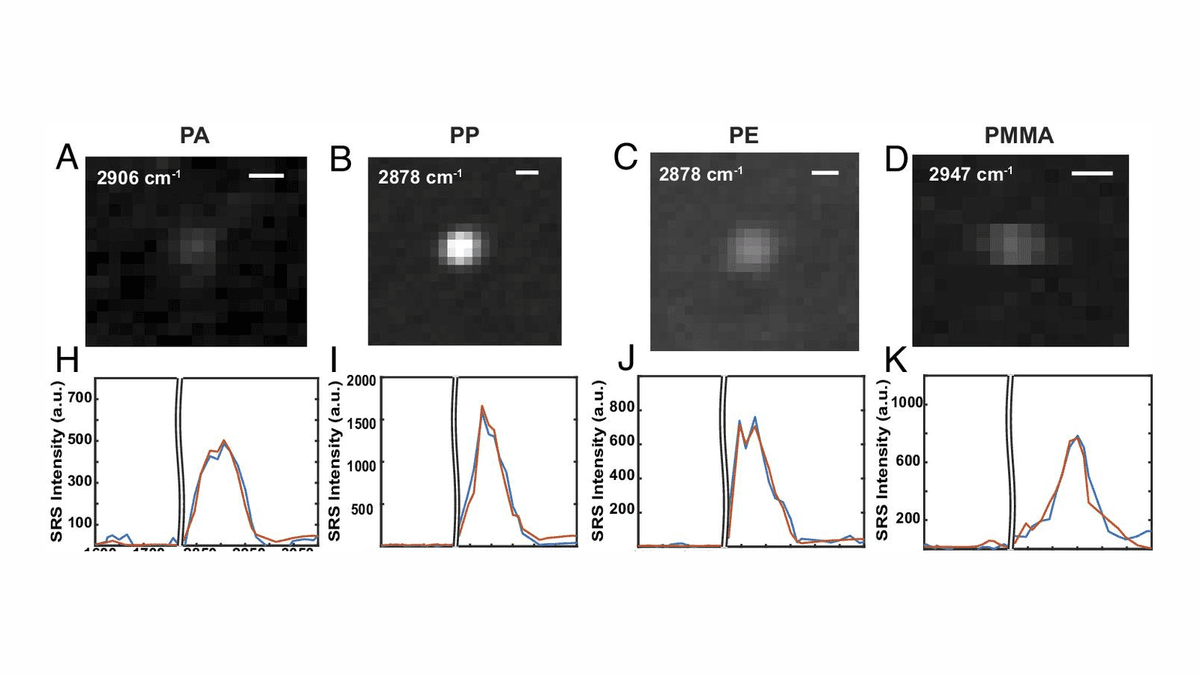
In 2024, chemist Naixin Qian and her colleagues at Columbia University developed a method to identify individual plastic particles, including nanoscale particles. They estimated an average of about 240,000 particles per liter in the bottled water they studied. Researcher Dušan Materić later challenged the appropriateness of the blank samples used in the study; the authors responded to the criticism in a scientific journal. This figure therefore cannot be taken as representative of all bottled water. Counting particles, however, did not answer another question: does the chemistry of water change right next to a plastic surface?
In a new study published in Nature in 2026, Qian and her colleagues moved from counting plastic particles to investigating what happens when they come into contact with water. They set out to determine whether reactive species can form at the plastic–water interface and which properties of the polymer govern the intensity of these processes.
Why breaking plastic into smaller pieces increases its surface area
Naixin Qian and her colleagues note that breaking plastic into smaller pieces increases its surface-area-to-volume ratio. This well-known geometric relationship can be illustrated with an idealized calculation.
Imagine a plastic cube with sides one centimeter long. Its surface area is 6 . If we were to divide it into identical cubes with sides one micrometer long, one thousandth of a millimeter, we would get a trillion particles. Their combined surface area would be 6 , a ten-thousandfold increase. The volume and mass of the plastic would remain unchanged.
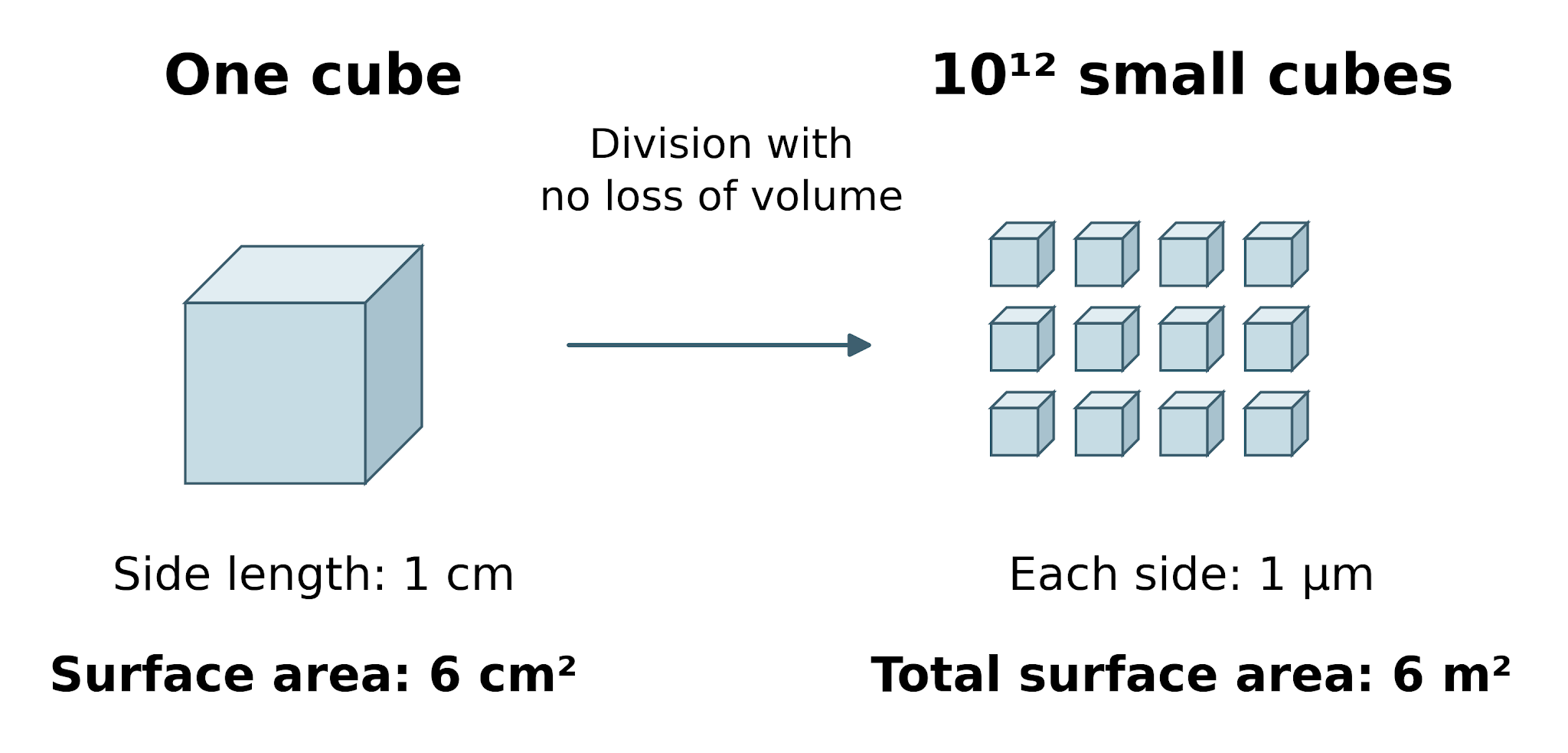
In natural waters, plastic fragments are far less regular: they vary in shape, clump together, and become coated with films of organic matter. Even so, this idealized geometric calculation shows why small particles deserve chemists' attention. For the same mass of plastic, their combined surface area can be much larger.
The disappearing color
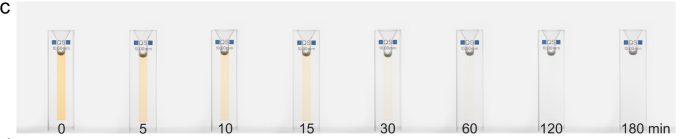
Qian and her colleagues began testing plastic's potential chemical activity in water with polystyrene, a common polymer used to make foam packaging and some types of disposable tableware. They added polystyrene powder to an aqueous solution of methyl orange. The more dye remains in solution, the more strongly the solution absorbs light at a particular wavelength; this absorbance can be used to estimate the dye concentration. The mixture, containing 10 milligrams of plastic per milliliter of solution, was stirred continuously for ten days. By the end of the tenth day, the pale yellow color had almost disappeared. Instrumental measurements also showed a decrease in the solution's light absorption. From this change, the authors estimated that about 90% of the initial amount of dye had degraded. No comparable result was observed in the organic solvents tested.
The loss of color did not, by itself, explain what had happened to the dye. Its molecules could have adsorbed onto the polystyrene surface, reacted with other substances, or changed their ability to absorb light. The paper does not identify which substances formed during the experiment. A color change alone therefore cannot establish exactly what fraction of the dye was actually broken down.
When interpreting this experiment, it is important to note that the polystyrene–dye mixture was stirred continuously for ten days. In 2022, Wang and colleagues showed that, when certain polymer powders are subjected to mechanical stimulation, repeated contact with water can be accompanied by charge transfer and the formation of reactive species capable of breaking down methyl orange. This process is linked to contact electrification. That study, however, used different polymers and different conditions of mechanical stimulation, so its findings cannot be applied directly to Qian's experiment. Qian and her colleagues cite that publication but do not provide a direct comparison of identical aqueous polystyrene suspensions with and without stirring. This experiment therefore does not establish how much stirring may have contributed to the loss of color.
How to catch a radical that disappears almost immediately
After the dye experiment, Qian and her colleagues set out to test whether reactive oxygen species form when polystyrene comes into contact with water. These include hydroxyl radicals (•OH), which can take part in breaking down the dye. Each such radical consists of one oxygen atom and one hydrogen atom. Hydroxyl radicals rapidly react with surrounding molecules and therefore have very short lifetimes. The researchers thus needed to look for chemical traces these short-lived species might leave, rather than for the species themselves.
In a separate experiment designed to look for chemical traces of radicals, the researchers used DMPO, an organic compound that acts as a radical trap. When a radical encounters a DMPO molecule, it can attach to it. This produces a longer-lived radical adduct that survives long enough to be detected by electron paramagnetic resonance (EPR). The researchers detected several components in the EPR spectrum of the mixture containing the DMPO trap. One of the weak signals was consistent with direct trapping of a hydroxyl radical (•OH) by DMPO. The authors attributed the strongest signal to an additional chemical transformation of the trap itself. The resulting substance could also react with radicals. The overall EPR signal intensity therefore could not be used to reliably determine how many hydroxyl radicals had formed during the experiment.
The researchers then tried to determine whether reactive species form mainly near the plastic surface. They placed polystyrene particles in an aqueous solution containing the APF probe. On its own, this probe is almost nonfluorescent, but upon reacting with certain strong oxidants it turns into brightly fluorescent fluorescein.
Under the microscope, fluorescence was observed mainly near the surfaces of the plastic particles. In a separate experiment, the researchers mixed polystyrene powder with an APF solution and confirmed the formation of fluorescein by liquid chromatography. Both findings are consistent with oxidative reactions at the plastic–water interface. On their own, however, these measurements cannot uniquely identify which reactive species converted the probe into fluorescein.
The next question was how strongly the formation of reactive species depends on the properties of the water–plastic interface. To test this, the researchers added Triton X-100, a surfactant that changes how water interacts with the polystyrene surface. At a concentration of 0.1%, APF fluorescence near the plastic particles dropped sharply. In a separate control experiment, the researchers confirmed that Triton X-100 did not interfere with the probe's own reaction with hydroxyl radicals (•OH). They therefore attributed the weaker fluorescence to altered conditions at the water–plastic interface.
Another feature of the observed reactions was that they did not require the plastic to be exposed to light beforehand. In some experiments, samples containing the APF probe or a protein were incubated in the dark before fluorescence was measured. When tracking changes in the signal over time, the researchers acquired images at set intervals, using a laser to excite fluorescence. This allowed them to monitor reactions that could also proceed without prior light exposure of the plastic.
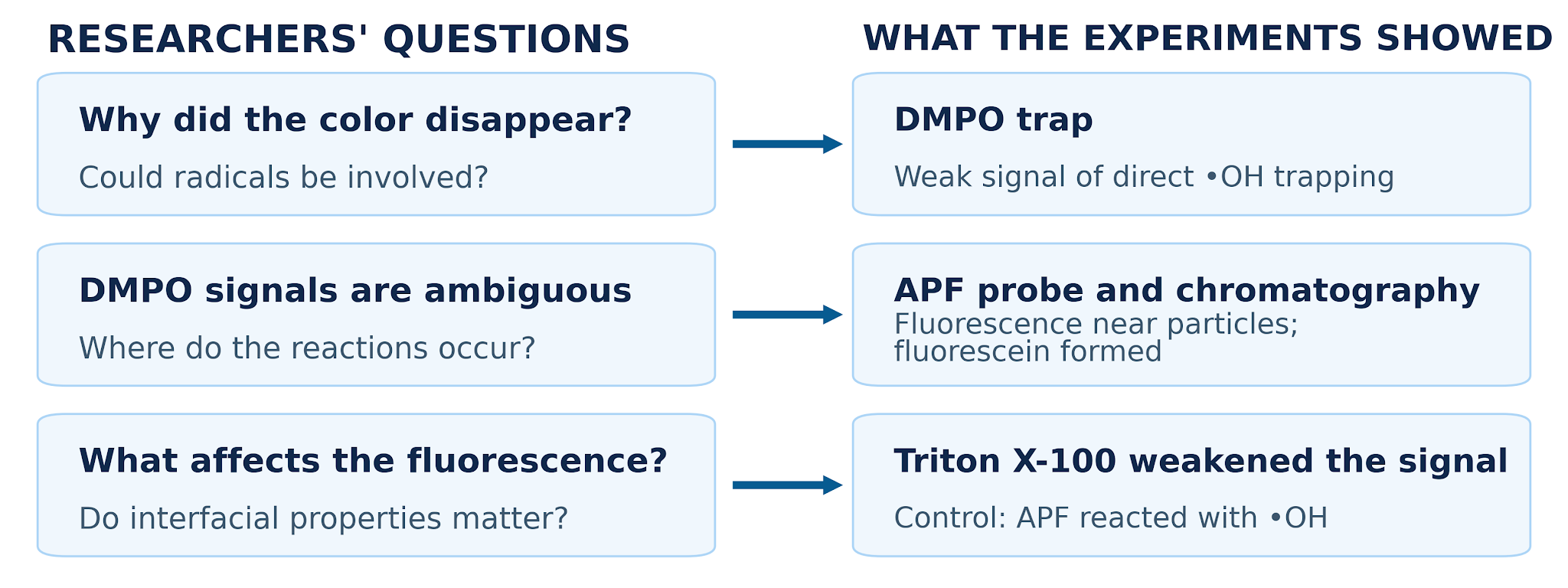
The DMPO experiments produced signals consistent with radical involvement, while the APF probe and chromatography indicated oxidative activity near the polystyrene surface. Measuring the production rate of the putative hydroxyl radicals proved much more difficult, however. From the rate at which APF fluorescence increased at the plastic surface, the authors obtained an approximate lower-bound estimate of the hydroxyl radical production rate on the order of 0.1–1 nanomoles per liter per minute. Qian and her colleagues describe this estimate as semiquantitative in the study's supplementary information. It gives only a rough indication of the hydroxyl radical production rate under the experimental conditions: some fluorescein leaves the field of view, some signal is lost, and the probe captures only a fraction of the radicals. The authors made measurements in phosphate-buffered saline, cell culture medium, and serum; the results depended on the medium. What this activity would be in river water or inside a living organism remains to be determined.
How chemical activity varies among plastics
After polystyrene, the researchers tested five other common polymers: polyethylene, polypropylene, polyvinyl chloride, polyethylene terephthalate, and poly(methyl methacrylate). The APF probe produced a signal with all six materials, but the signal was strongest for polyethylene and polypropylene. These polymers are highly hydrophobic: water does not readily wet their surfaces, so a droplet spreads out less.
To determine whether hydrophobicity was associated with APF signal intensity, the researchers compared the signal with the water contact angle. The larger this angle, the less readily water spreads over the material's surface. Across the six polymers, the contact angle and probe signal were strongly correlated, with = 0.93. Only six materials were compared, however, and the contact angle values came from a separate reference database. In seeking a possible explanation for this relationship, the researchers examined how water molecules behave near polymer surfaces.
Water molecules continually form and break hydrogen bonds with one another. Near the surface of water-repellent plastic, some water molecules form fewer such bonds than they do in the bulk liquid. This can alter the local environment of hydroxide ions (OH⁻) in the water. The researchers proposed that, under certain conditions near the plastic surface, these ions might lose an electron more easily and become hydroxyl radicals (•OH). They explored this possibility using computer calculations. “Water is a key active player here, rather than just a spectator. It’s integral to making these microplastics reactive,” explained chemist Wei Min, one of the study's leaders, in Columbia University's announcement about the work.
How a radical might form near a plastic surface
To test the idea that conditions near a plastic surface might make hydroxyl radical formation easier, the researchers turned to computer calculations. They calculated how much energy is required for a hydroxide ion (OH⁻) to lose an electron and become a hydroxyl radical (•OH). They used a quantity known as the vertical ionization energy, which describes the removal of an electron while the positions of the atoms remain unchanged.
For hydroxide ions in water near the surfaces of polyethylene, polyvinyl chloride, and poly(methyl methacrylate), most calculated values were around 210 kilocalories per mole. This is close to the experimental value of 207 kilocalories per mole for the hydroxide ion in bulk water. In most of the cases considered, then, removing an electron was about as difficult as it was in bulk water.
In some calculated configurations near polyethylene and polyvinyl chloride surfaces, however, the ionization energy fell below 130 kilocalories per mole. These states were less common for polyvinyl chloride than for the more hydrophobic polyethylene. In a separate model, the researchers considered the effect of a stronger electric field near the polyethylene surface. Under these conditions, some ionization energy values fell below 100 kilocalories per mole.
Even this energy remains high. The researchers therefore suggest that hydroxyl radical formation may be accompanied by other chemical reactions. For example, oxygen dissolved in the water could accept the electron lost by a hydroxide ion. The calculations are compatible with this pathway of radical formation, but individual steps in the proposed mechanism still need to be tested experimentally.
The researchers also used measurements to test a possible link between chemical activity and the electrical properties of the surface. They measured the zeta potential, which indirectly characterizes the electrical state of the region near a particle's surface. It is calculated from the way the particle moves in an electric field.
Polystyrene had a strongly negative zeta potential in water. In ethanol, where no appreciable dye degradation had been observed, the magnitude of the negative value was much smaller. After Triton X-100 was added, the zeta potential approached zero and APF probe fluorescence dropped sharply. At an additive concentration of 0.1%, the absolute value of the zeta potential was less than 5 millivolts.
Across four Triton X-100 concentrations, the correlation between zeta potential and APF fluorescence was = −0.99. As the potential became less negative, the fluorescence weakened. These observations are consistent with a proposed link between the electrical properties of the surface and the formation of reactive species.
How plastic interacts with proteins and cells
If radicals form near the plastic surface, could they affect biological molecules that accumulate there? The researchers examined the accumulation of molecules with different electrical charges, including proteins and short DNA fragments, and then turned to lysozyme, a protein that helps the body defend itself against bacteria. They assessed possible protein aggregate formation using thioflavin T fluorescence: this dye fluoresces more brightly when it binds to certain ordered protein aggregates.
Thioflavin T fluorescence increased in the presence of polystyrene. When caffeine, which can scavenge radicals, was added to the mixture, the signal weakened noticeably. The researchers obtained a similar result after treating the polystyrene surface with Triton X-100.
The caffeine concentration was high: 100 millimoles per liter, or about 19.4 grams per liter. At this concentration, caffeine served as a laboratory reagent for testing the possible involvement of radicals in protein aggregate formation. The weaker fluorescence is consistent with possible radical involvement, but a thioflavin T signal alone is not enough to rule out other reasons for the change in fluorescence or to establish the structure of the aggregates.
The researchers then observed what happened to mouse red blood cells in a laboratory suspension. After direct contact with polystyrene particles, some cells lost their usual disk-like shape and broke into characteristically helmet-shaped fragments called schistocytes. At the same time, hemoglobin, which is normally contained within red blood cells, was detected in the surrounding medium. Its release from the cells indicated damage to their membranes. Across the six polymers studied, the amount of hemoglobin released correlated with the signal indicating chemical activity ( = 0.75).
In the experiment, 2 milligrams of polystyrene particles were added to 150 microliters of a red blood cell suspension that had first been diluted with buffer. The mixture was incubated for one hour at 37 °C without stirring. Based on the volume of this suspension, that corresponds to about 13.3 milligrams of plastic per milliliter. To put the plastic concentration used in the experiment in perspective, we can consider another study: in 2022, Leslie and colleagues examined blood from 22 volunteers. Plastic could be quantified in 17 of them, and the mean concentration of the sum of the measured polymers across all 22 participants was 1.6 micrograms per milliliter, about 8,300 times lower than the plastic concentration in Qian's experiment.
These numbers, however, cannot be used to compare the cells' exposure conditions directly, much less to assess human risk. Qian and her colleagues used isolated red blood cells in a diluted laboratory suspension, whereas Leslie and her colleagues measured plastic content in human whole blood. In addition, Qian's experiment used polystyrene, whereas the blood study measured the combined content of several polymers. The human blood study measured particles 700 nanometers and larger, whereas the description of Qian's red blood cell experiment does not provide a detailed particle size distribution. For particles of the same polymer with the same total mass, smaller sizes generally mean a larger combined surface area. The concentration difference therefore helps convey the scale of the laboratory experiment, but it does not establish how comparable the cells' exposure conditions were or what risk such particles might pose to humans.
What remains unknown about plastic in natural waters
The limitations of the laboratory findings concern not only plastic's possible effects on cells but also its behavior in natural waters. In their main experiments, Qian and her colleagues used laboratory polystyrene powders. When plastic particles spend a long time in river water, their surfaces change under the influence of light and oxygen; minerals can settle on them, and biofilms can form. Qian and her colleagues compared polystyrene samples from different manufacturers: powders with more oxidized surfaces produced weaker chemical signals. This observation shows a link between chemical activity and the surface properties of the laboratory samples tested, but it does not establish whether the same relationship holds for particles that have spent a long time in natural waters.
Equally important, chemical activity may also depend on the composition of the water itself. Unlike laboratory solutions, natural waters contain a variety of dissolved salts and organic matter that can influence interactions between water and plastic and the fate of reactive species. The intensity of such processes in a river or lake therefore needs to be studied separately.
The study by Qian and her colleagues showed that the surfaces of common polymers can be chemically active when in contact with water. In laboratory experiments, signs of oxidative reactions were detected near plastic particles, including in the absence of prior light exposure. Such signs were observed for all six polymers tested, although the signal intensity varied and was associated with their surface properties.
In the protein experiments, the researchers also found signs of aggregate formation, and they observed cell damage when polystyrene came into contact with mouse red blood cells. At present, however, these changes cannot be attributed specifically to hydroxyl radicals, nor can it be claimed that the same processes occur in a living organism at environmentally relevant microplastic concentrations. The study by Qian and her colleagues thus shows why studying microplastics requires attention not only to the number of particles in water but also to their surface properties and the chemical processes that may occur at the plastic–water interface.
Sources
- Qian N. et al. (2026). Intrinsic physicochemical activity at microplastic–water interfaces. Nature 658, 650–657. Supplementary Information is available for the article.
- Qian N. et al. (2024). Rapid single-particle chemical imaging of nanoplastics by SRS microscopy. PNAS 121, e2300582121.
- Materić D. (2024). Nanoplastics measurements must have appropriate blanks. PNAS 121, e2411099121.
- Qian N. et al. (2024). Reply to Materić: Appropriate blanks should avoid major contamination sources in the lab. PNAS 121, e2415874121.
- Leslie H. A. et al. (2022). Discovery and quantification of plastic particle pollution in human blood. Environment International 163, 107199.
- Columbia Climate School. State of the Planet, October 14, 2026. News report based on Columbia University materials, with quotations from chemist Wei Min: Microplastics Are Chemically Active, and Could Cause Biological Harm
- Wang Z. et al. (2022). Contact-electro-catalysis for the degradation of organic pollutants using pristine dielectric powders. Nature Communications 13, 130.
- Liu P. et al. (2021). Simulation of natural aging property of microplastics in Yangtze River water samples via a rooftop exposure protocol. Science of the Total Environment 785, 147265.