Skip to content
See the World Through ScienceA project of ALLATRA
Source: Peer-reviewedGeophysical Research Letters1 source

Study Ties Europe's Hotter Summers to Emissions Released Since the Paris Agreement

Environment

Republish this story

Our work is licensed under Creative Commons BY-NC 4.0. You may republish this piece for free — with credit to ALLATRA Media and a link to the original, unedited beyond length trims, and not for commercial use.

Read the full license

People stand and sit in the jets of a public fountain on a city square in Krakow, Poland, with tenement houses and market umbrellas behind them.
People cool off in a public fountain in Krakow, Poland, during a heat wave in 2015 (illustrative)."2015 Hitzewelle in Krakau 0164" by Silar, via wikimedia, CC-BY-SA-4.0 · CC-BY-SA-4.0

An open-access study published Sept. 22 in Geophysical Research Letters reports that greenhouse gases released since the 2015 UN Paris Agreement have already made Europe's summer heat extremes more intense.

The researchers describe the work as an answer to a limit in existing methods: those methods can say little about changes in extreme weather caused by small subsets of human emissions and less about any single event.

The study comes from Jared T. Trok of Stanford University's Doerr School of Sustainability, the senior author Noah S. Diffenbaugh of the same school and colleagues at Boston University and Colorado State University. They trained a machine-learning model to generate maps of daily surface temperature at different levels of cumulative emissions, the running total released to date. Each run is conditioned on the weather pattern the real event had, which is how the team holds the atmosphere fixed and varies only the emissions.
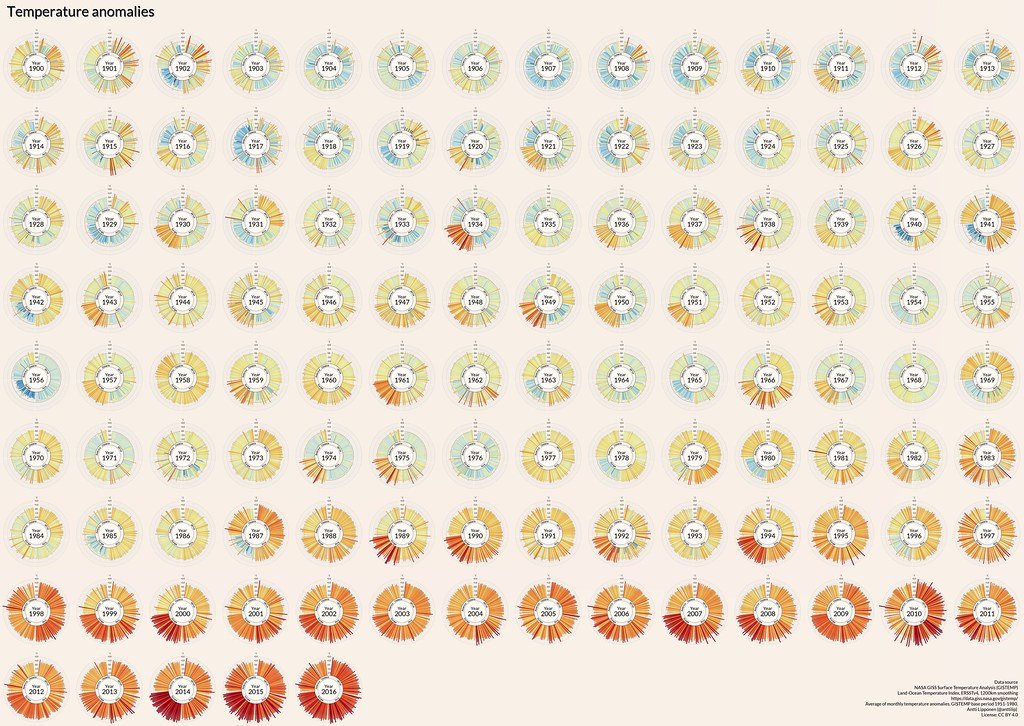
A grid of small circular charts, one for each year from 1900 to 2016, in which each spoke is a month colored blue for below-average temperature and red for above-average; the later rows are almost entirely red.
Monthly global temperature anomalies, one dial per year from 1900 to 2016. Blue months are colder than the reference period and red months warmer. – "Temperature anomalies 1900–2016 horizontal" by anttilipponen, via flickr, CC-BY-2.0

On that basis, the authors report what they call strong evidence, better than 95% probability, that emissions released since the Paris Agreement have increased the intensity of Europe's summer temperature extremes since 2021. For Europe's June 2025 heat wave, the model gives a greater than 99% probability that the temperature averaged across the region would have been lower, by a median of 0.34 °C, had the same large-scale weather occurred at 2015 levels of cumulative emissions. Both numbers come from comparing model runs, not from measurements.

The study lists the National Science Foundation as its funder.

Sources

Spot an error?

Spot an error?

Report an error

Spotted a mistake on this page? Tell us what's wrong and our editors will take a look.

What kind of problem?

Only if you'd like us to be able to follow up. We won't use it for anything else.

We correct mistakes openly. Select any text to flag it. Fixes are logged under our Corrections Policy.

Report an error

Reporting on

Study Ties Europe's Hotter Summers to Emissions Released Since the Paris Agreement

What kind of problem?

Only if you'd like us to be able to follow up. We won't use it for anything else.

We read every report. Corrections are logged publicly.