Irrigation Barely Moves the Global Heat Balance. Over Northern India It Moves a Lot

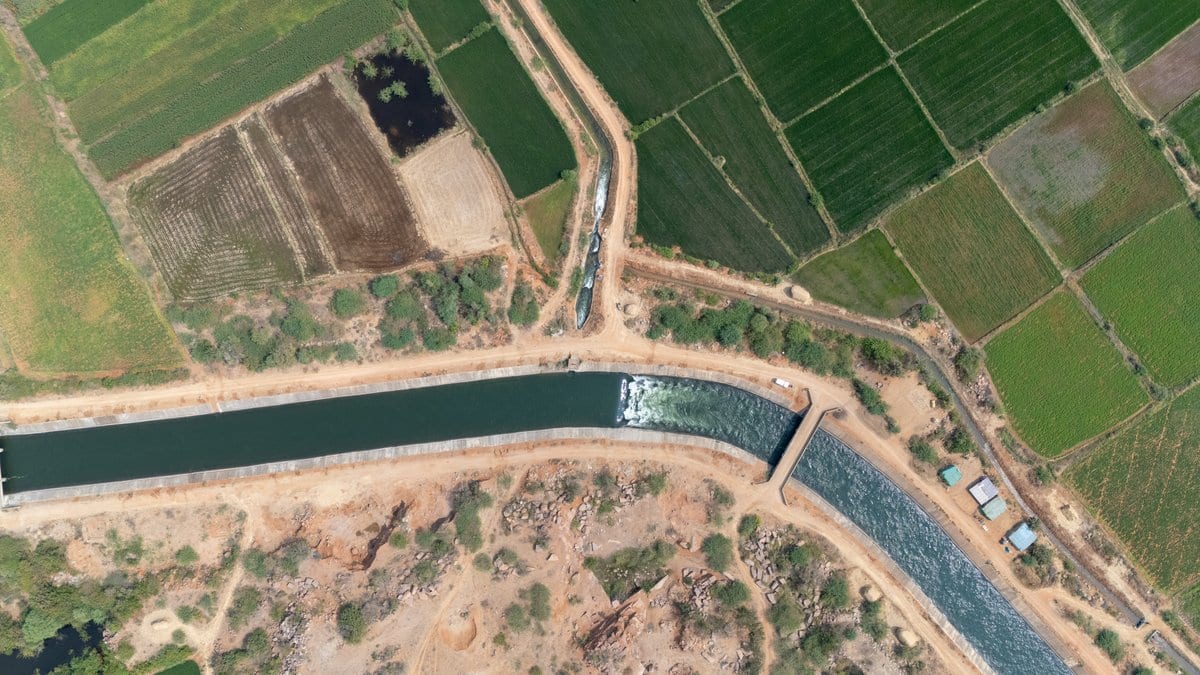
Pump water onto a field in Punjab before the monsoon and some of it goes up rather than down. Evaporation is half the point: it is what cools the crop and the ground under it. But the water that leaves the field does not leave the system. Water vapor is a greenhouse gas, so it absorbs heat on its way out to space and sends part of it back.
Irrigation is the largest use people make of fresh water on Earth, and the land equipped for it has grown more than fivefold over the past century. That is a great deal of added moisture, and it leaves a question climate science has answered only in pieces: what has it done to the planet's energy balance?
A study published Nov. 5, 2026, in Earth System Dynamics puts the first multi-model number on it. Amen Al-Yaari and Wim Thiery, both at Vrije Universiteit Brussel, worked with colleagues at institutes from Oslo to Taipei. They took seven Earth system models, each of which had been run twice: once with irrigation expanding as it really did, once with it frozen at its 1901 extent. Subtracting one run from the other leaves irrigation's mark on the energy budget at the top of the atmosphere. The seven belong to the Irrigation Model Intercomparison Project, or IRRMIP, which exists so that questions like this one stop being answered one model at a time.
What the models were asked for is effective radiative forcing, meaning the change in how much heat the planet keeps once the atmosphere has made its quick adjustments. Averaged over the globe and over 1902 to 2014, with sea surface temperatures held fixed, irrigation's forcing comes out positive and small: about 0.023 watts per square meter.
Small is worth pinning down. The paper sets its own figure against the large forcings in the most recent assessment from the Intergovernmental Panel on Climate Change, where greenhouse gases come to 3.84 watts per square meter. Irrigation's global number is more than a hundred times smaller than that.
The global average is where the signal goes missing
Two cancellations are buried in that small number. One is physical. The moisture irrigation adds traps outgoing heat, which pushes the number up; the clouds that form in moister air reflect more sunlight away, which pushes it down. In the models the two nearly cancel out. The second cancellation is geographic: regions forcing in one direction are offset by regions forcing in the other, which is why the global mean shows no clear trend across a century in which irrigated area never stopped growing.
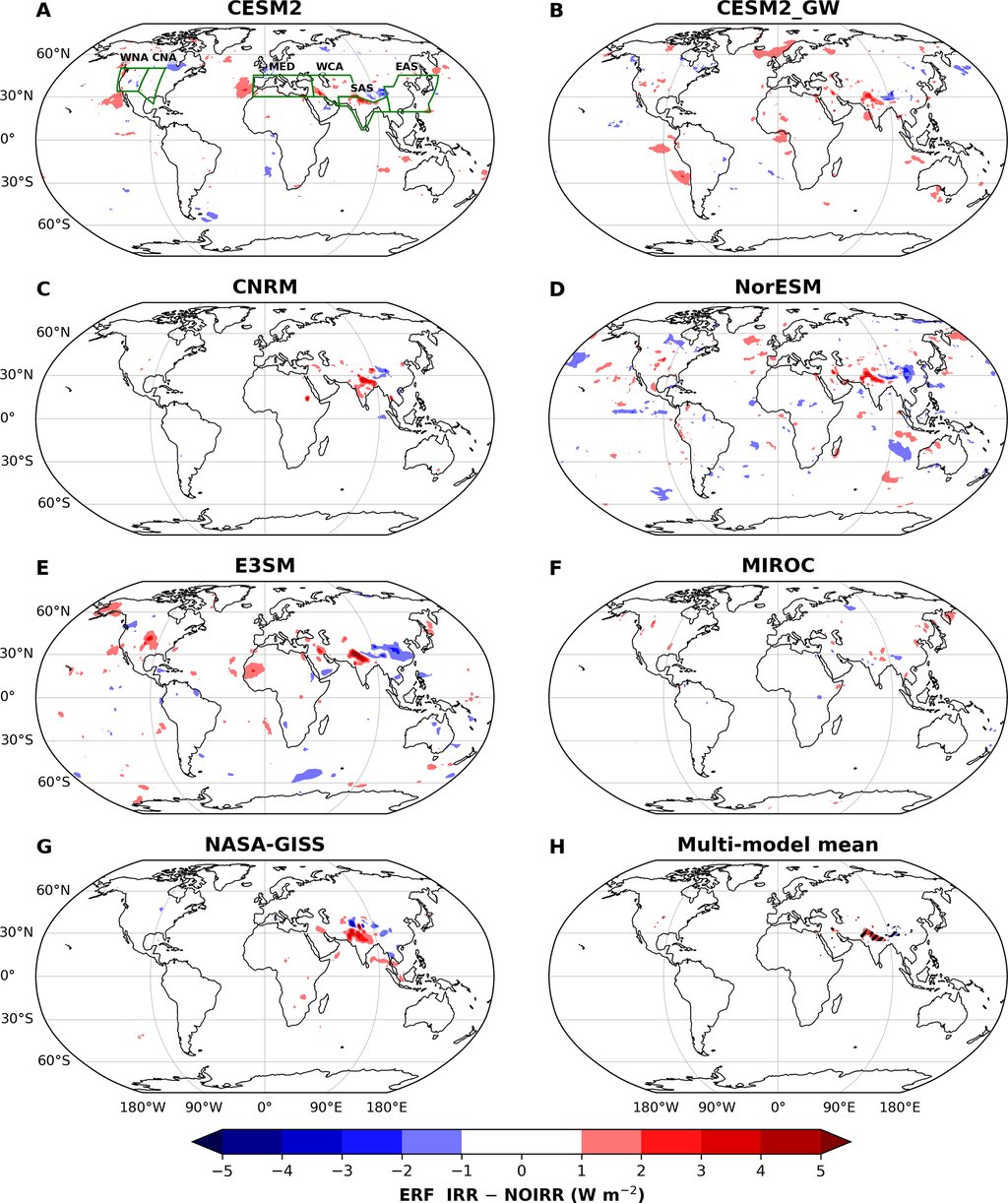
Pull the global average apart and the regional numbers grow by an order of magnitude. South Asia and West Central Asia average about 0.23 watts per square meter across the historical period. The maps are stronger still: a coherent patch reaching up to 5 watts per square meter lies across northern India and Pakistan, and it appears in every model in the ensemble, a set that seldom agrees about anything involving clouds.
That agreement is the paper's strongest card, and it is agreement inside a single project. All of the models ran the same protocol, and three of them share a land model. The simulations themselves are still being loaded onto the Earth System Grid Federation archive, so nobody outside IRRMIP can rerun the numbers yet.
One thing that patch is not is a local heat wave. Irrigation cools the land surface where it is applied; that is the evaporation doing its work. The energy held back at the top of the atmosphere and the cooler ground underneath are both real, and over South Asia the models that reported the necessary variables all agree the two travel together: the stronger the surface cooling, the stronger the positive forcing above it.
Nor is the sign the same everywhere. East Asia comes out negative, at about minus 0.03 watts per square meter in the multi-model mean, with its strongest negative patches over eastern and central China. The paper's reading is that cloud effects there are strong enough to hold the moisture effect down, and possibly to reverse it. That is the clearest sign in the study that irrigation's radiative effect does not point one way.
Clouds are pushing back
Clouds turn up a second time. When the authors redo the calculation for clear skies only, leaving clouds out of the radiation sums, the forcing comes out larger in most regions. The gap between the two is what the clouds contribute, and it is negative. The paper offers that as a possibility rather than a conclusion, which is the honest form: cloud behavior is where these models differ from one another most, and the clear-sky comparison measures the net cloud contribution without identifying the process behind it.
The forward-looking half rests on one model
The second half of the paper looks ahead, and the evidence thins. Only one model in the project, CESM2, has run future irrigation scenarios, and those runs let the ocean respond to the irrigation. What they yield is therefore not a forcing but the net energy imbalance at the top of the atmosphere, which folds in the climate's own reaction. Between 2015 and 2070 that imbalance is more positive along a high-emissions pathway with heavy irrigation demand than along a low-emissions one where better irrigation efficiency cuts the amount of water applied. The regional pattern survives, with South Asia strongest. The authors call these projections preliminary rather than a robust multi-model result.
Work on the same ensemble, published in Nature Communications in 2025, has already found that irrigation blunts dry heat extremes while making moist heat worse. That is a companion study from the same project, not an outside check on this one.
The reason a forcing this small earns a paper is attribution. Over South Asia, industrial aerosols force in the negative direction while irrigation forces positive, and the two grew through the same decades over the same countries. That makes them hard to separate in the observational record, and a regional trend credited to one of them may belong partly to the other.
The authors state the result this way: "These results demonstrate that irrigation's radiative influence, while small in the global mean, is regionally substantial and scenario-dependent, with implications for the attribution of regional climate change and for the design of land-based mitigation trajectories." In plainer words, scenarios that lean on land to manage the climate should count what the irrigation water does to the radiation budget, and count it region by region.