Stop Emissions and the Arctic Goes One of Two Ways
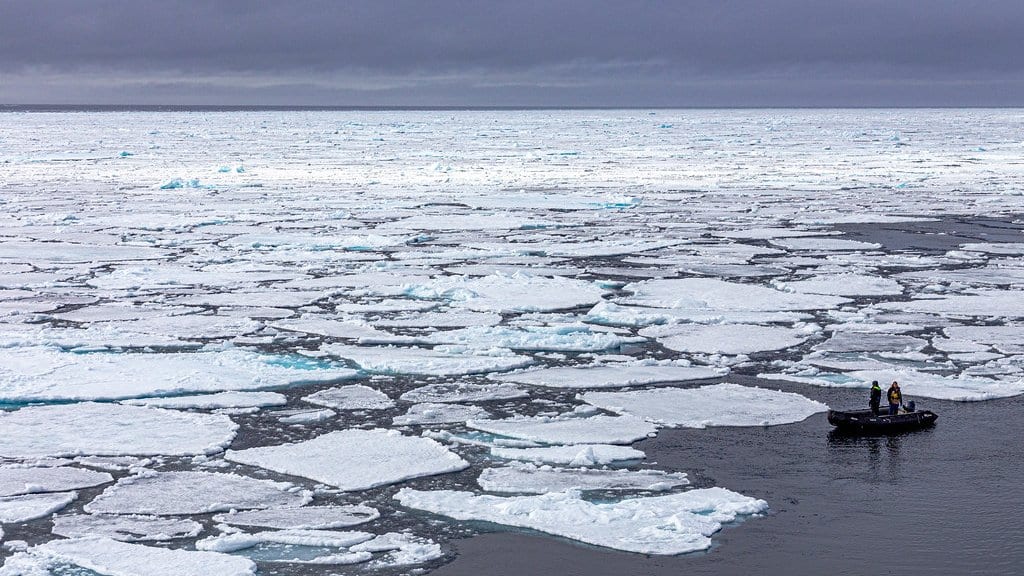
Climate model experiments published Oct. 10, 2026, switched carbon dioxide emissions off abruptly, and global average temperature stabilized. The modeled Arctic did not. It went one of two opposite ways: continued warming and sea ice loss in the runs with lower total emissions, and abrupt cooling with expanding sea ice in the runs with higher ones.
You-Ting Wu and Lorenzo M. Polvani of Columbia University, with colleagues at NASA's Goddard Institute for Space Studies, write in Communications Earth & Environment that the Arctic is warming more than three times faster than the global average and that its response to an end to those emissions has remained uncertain. The split appeared where mitigation was delayed long enough for global average temperature to pass the 2 °C Paris Agreement target.
The group analyzed 6-member ensembles of a single Earth system model, each with CO2 emissions set instantaneously to zero at a different cumulative total, ranging from 800 to 2,000 petagrams of carbon. The dividing line fell at about 1,700 petagrams, or 1.7 trillion metric tons of carbon.
The authors trace the cooling to a near-collapse of the Atlantic Meridional Overturning Circulation, the ocean current system that carries heat north. In the model, the heat it stops delivering to the Arctic is compounded by two further effects the group identifies: a change in how temperature falls with altitude, and sea ice that spreads and reflects more sunlight back to space.
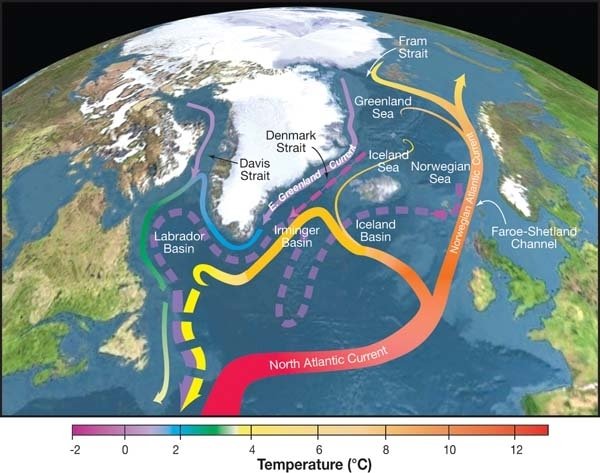
The researchers describe the behavior as stochastic tipping (a random switch between two states, driven by rising greenhouse gases) and as a transition to a different Arctic climate state. It is one Earth system model, under an idealized instant halt to emissions rather than any scenario of how emissions would actually fall.
The paper is open access, and the version posted is the accepted manuscript, ahead of the final version of record. The ensembles were run on computers at NASA's Center for Climate Simulation at Goddard Space Flight Center, with support from the National Science Foundation and NASA.
Sources
- Communications Earth & EnvironmentPeer-reviewed