A New Reading of Venezuela's Quake: One Rupture, Two Faults

A fault map is a human document. Someone traced a line where the ground had broken before, gave it a name, and stopped the line where the evidence ran out. The rock underneath has never read it.
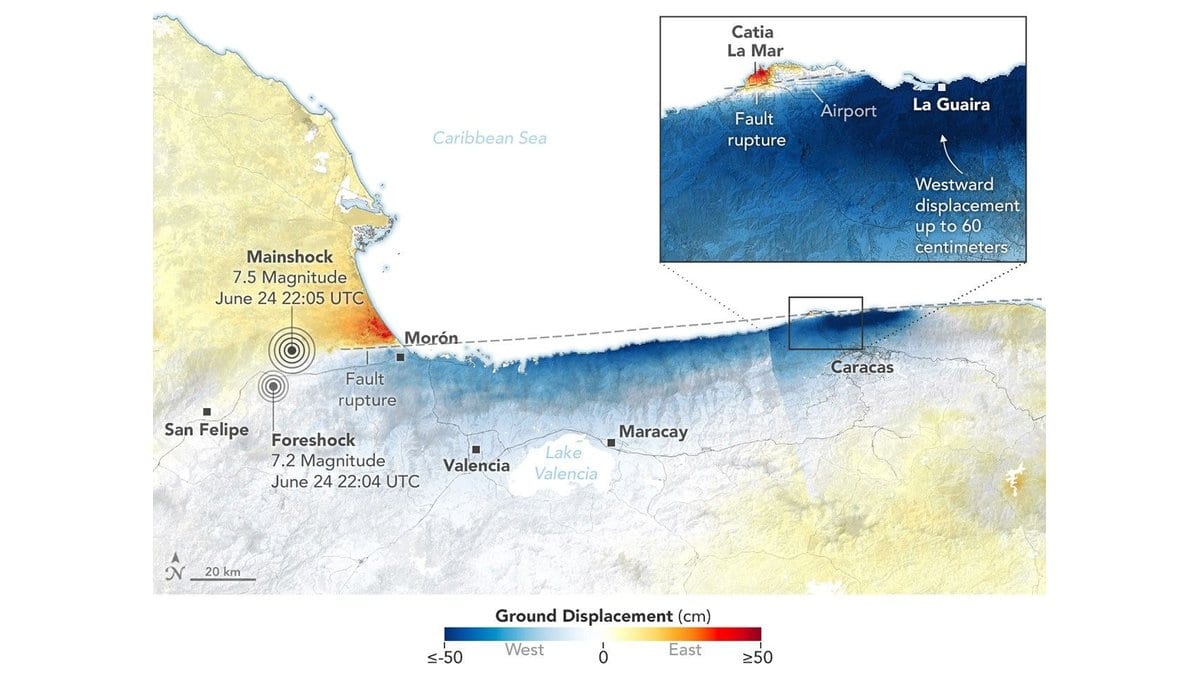
On June 24, 2026, northern Venezuela was shaken twice in 39 seconds. The U.S. Geological Survey cataloged the day as two earthquakes, magnitude 7.2 and magnitude 7.5; the sequence destroyed homes and buildings and killed more than 6,500 people. A team led by Sebastián Riquelme of the National Seismological Center at the University of Chile now argues that the day is better read as one complicated rupture, which began inland on the Boconó fault system and carried on out to sea along the San Sebastián fault. Their analysis was published Oct. 27, 2026, in The Seismic Record, the Seismological Society of America's open-access journal for rapid reports.
Northern Venezuela is a bad place for tidy fault maps. The Caribbean and South American plates meet there. The motion between them, Riquelme said in the society's own release, "combines sideways movement along faults with compression" across two main structures, the Boconó and the San Sebastián. With faults of several orientations crowded into one boundary, ruptures that involve more than one of them, and that change direction as they go, are reasonable things to expect.
Seismic moment measures how much rock slipped and how far. Read as a single event, the whole sequence is equivalent to magnitude 7.6. The evidence for the two-fault path is a preliminary source inversion, a fault model fitted to the recordings, and it comes back with two distinct fault planes rather than one. The authors claim no more than that: their model provides "evidence that the rupture propagated across two fault segments." Satellite radar measurements of how the ground surface moved support the same two-fault geometry.
The duration points the same way. About 70 seconds of rupture is roughly twice what global scaling laws predict for an earthquake of that size. Those laws hold because bigger earthquakes take longer, and a single fault plane of this magnitude should have been done sooner. In a line that the society's release quotes from the paper, the authors place the event "in the company of the most complex large strike-slip earthquakes in the global instrumental record."
The catalog still says two earthquakes
That single-event reading is this team's argument, not a settled catalog entry. A second paper in the same issue, by Catherine Hanagan of the U.S. Geological Survey and colleagues, describes the day as two earthquakes on the same pair of faults. Its high-resolution satellite images map a rupture that ran mostly offshore to the east. So the magnitude shifts with the reading, and so do the duration and the fault names attached to it. A reader who meets a different figure for this earthquake somewhere else is meeting a different interpretation of the same seismograms, not a correction.
Faster than the waves it was making
The sharper claim is about speed. A rupture front usually travels more slowly than the shear waves it sends out, the slower of the two kinds of wave an earthquake radiates. The authors report that along the San Sebastián fault it did not: the rupture went supershear. Strong-motion records near the fault point that way, and so does backprojection, which reads a rupture's progress from distant seismometers. The far-field records here came from networks in Alaska, Europe and the western United States. Together they indicate speeds of up to about 5.5 kilometers per second some 50 kilometers from the point where the earthquake began. That is an upper bound on one segment rather than the speed of the whole rupture, and no other group has yet reproduced it for this earthquake.
When a rupture outruns its own waves it builds a shock front, a Mach cone, much as a supersonic jet builds a sonic boom. Close to the fault the shaking turns fierce. One signature of all this is an absence: only a few aftershocks are seen in the zones where the rupture is inferred to have run supershear. The stretch that moved fastest went quiet.
In the society's release, Riquelme and colleagues put some of the earthquake's destructive power down to unusually long velocity pulses (single surges of ground movement) of about 14 seconds. "Pulses like these can produce large movements in flexible structures, including tall buildings and long-span bridges, even when peak ground acceleration is relatively moderate," Riquelme said. Nothing close to the rupture recorded that shaking directly. So a third paper in the issue, led by José Bustos of the University of Chile, reconstructed the pulse that struck the coastal town of Caraballeda from CCTV video, tracking a sliding traffic post and a swaying light pole. The motion they infer is comparable with the most intense ground motions ever recorded.
Hazard maps mostly take faults one at a time
Seismic hazard is usually estimated fault by fault, with each segment carrying its own largest plausible earthquake, so a rupture that jumps from one fault to the next breaks the arithmetic. In the society's account of the study, Riquelme and colleagues write that this earthquake adds to the evidence that seismic hazard in the region should be calculated for multiple-fault scenarios, since calculations that take in only individual segments might underestimate the maximum size of an earthquake. The paper's own strain accounting points the same way: the strain this event released matches what satellite positioning stations in the region had watched accumulate along these faults, strain that had built up to enough for an earthquake of just this size.
The precedent is thin, but it exists: the release points to historical evidence that the two faults may have ruptured together once before, in the 1812 sequence that killed thousands of people in Caracas and Mérida. Riquelme, pointing to recent supershear ruptures in Myanmar, Türkiye and Alaska, said that supershear rupture "should be considered a possible worst-case scenario" when the ground shaking from faults of this kind is estimated.
The names on the map are ours, not the crust's. "The crust does not respect the names we have given to individual faults," Riquelme said. "In the end, everything is connected."