Brain Control Circuits Did Not Reveal Who Handles Bad Feelings Best

Your manager picks your report apart in front of the whole team. You can take that as humiliation, or you can tell yourself she reads your work closely and wants the project to work. The same half hour then lands differently. Psychologists call the second move cognitive reappraisal, changing what a situation means in order to change what it does to you. It is a core technique of cognitive behavioral therapy, and the single strategy this study tested.
The scanner has had an account of how that works for two decades. Ask someone to reframe a distressing photograph and parts of the prefrontal cortex, the front of the brain, become more active. The field then took one further step: if those regions do the regulating, how strongly they respond should say who regulates well and who does not. A preregistered consortium of research teams set out to test that step, and in a paper published Oct. 28, 2026, in Nature, they report that it does not hold up.
Maurizio Sicorello, who leads the NIDER consortium at the Central Institute of Mental Health in Mannheim, and Carmen Morawetz, professor of affective neuroscience at the University of Innsbruck, pooled 40 task-based brain-imaging datasets covering up to 2,175 healthy adults. Each contributing team analyzed its own data according to one protocol, written down before anyone looked at the results.
Three measures that do not agree with each other
Reappraisal capacity is measured three ways, and all three sat in the pooled data. A questionnaire asks people how much they reframe things in daily life. The scanner task asks them to rate how bad a picture makes them feel after reframing it, against how bad it feels when they merely look. And the same task tracks how far activity falls in the amygdala, the region that handles emotionally charged material, while they reframe.
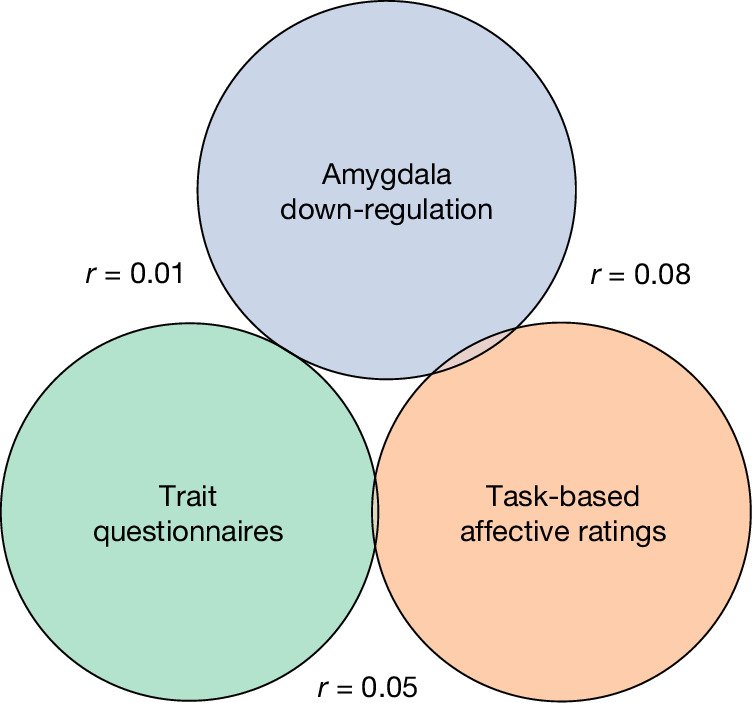
If all three index one underlying skill, they ought to move together. They barely do. Only one pair came out significantly related: people whose amygdala activity fell further also reported a larger drop in bad feeling, at a correlation of 0.08. Sicorello and colleagues put that in proportion themselves. To detect an effect that small reliably, a single study would need more than 1,000 participants. The questionnaire went with neither of the other two measures, and the analysis weighed the evidence for an absence rather than merely failing to find a presence. It came out for the absence.
One subgroup produced something stranger. Three of the larger studies had also asked people about their reappraisal ability, not just their habit of reappraising. Belief in one's own ability was significantly related to amygdala down-regulation, but in the wrong direction: the people who thought they reframed well brought the amygdala down less. The authors read that as strong evidence against an effect in the predicted direction.
The second question was the one the field cares about, and the answer is a clean absence. Comparing one person with another, none of the three measures tracked activity in the prefrontal circuits that earlier meta-analyses had marked as the regulatory ones. The questionnaire tracked nothing anywhere in the brain: no voxel, the small cube a scan divides the brain into, survived correction, and inside those circuits the evidence favored no effect for 98% of voxels at odds better than 100 to 1. The pooled sample was big enough to catch correlations as small as 0.10, so the absence was looked for properly.
The same control circuits were engaged while emotion was being generated, which challenges their presumed specificity to regulation rather than their involvement.
What showed up instead was not a control circuit
The only measure with any neural signal was the in-scanner rating, and it pointed away from control. People who dampened negative feeling more effectively showed slightly lower activity in sensorimotor and dorsal attention regions, which handle body sensation, movement and the direction of attention. Here the evidence runs the other way from the absences. With one contributing dataset in, the significant cluster is 86 voxels; with that dataset left out, it is 587. That dataset was collected during the first COVID-19 outbreak. The brainstem evidence rests on five voxels, the amygdala signal is uncorrected, and the effects are small throughout.
Why comparing brains is harder than comparing moments
The consortium also supplies an explanation for its own empty result, and it reaches past emotion research. People differ a great deal in how strongly the whole brain responds to a task, for reasons that have nothing to do with feelings: blood supply, scanner noise, head movement. Theory predicts that a good regulator shows a quiet amygdala and a busy prefrontal cortex. The pooled data show the opposite arrangement. Someone with a bigger amygdala response than other people tends to respond more strongly across the rest of the brain too, with a single voxel in the whole brain going the other way.
A second mismatch sits in the task itself. In two large samples, only 7% to 8% of the variation in moment-to-moment feeling ratings lay between people rather than within them, while roughly 60% of the variation in amygdala and network responses did. Standard reappraisal tasks were designed to produce a strong effect inside one person, which is a different thing from producing stable differences between people.
The limit is on comparing people, not on the prefrontal cortex
None of this overturns what happens inside one person. Morawetz says so plainly in the institute's announcement of the work (translated from German): "That does not mean the prefrontal cortex is unimportant for emotion regulation. Within a single person, brain activity does show how feelings change. But when we compare between people we run into limits, possibly also because different people apparently arrive at the same result along different neural routes." The paper adds that the systems mapped by within-person work could still be worth stimulating in treatment.
Two boundaries hold. Everyone scanned was a healthy adult, non-clinical by the consortium's own inclusion rule, and the authors name that first among their limitations: samples spanning the full range of psychiatric symptoms might show the differences that are absent here. And the finding is that no shared signature was found using standard task-based imaging, not that none exists. The team's own next steps are connectivity between regions and measures of large-scale brain organization.
The sharp practical consequence is in the clinic, where low prefrontal activity is routinely read as a sign that the person being scanned regulates emotion poorly. Morawetz calls that reading too narrow, and asks for more realistic tasks and for analyses that account for these global differences. Sicorello puts the positive version of it this way: "Changing your own feelings by looking at a situation in a new way is more than flexing a mental 'muscle' that some people have simply trained better."
Sources
- NaturePeer-reviewed
- idw-online.de