Microviscosity of Marine Snow and the Transport of Organic Carbon Into the Deep Ocean

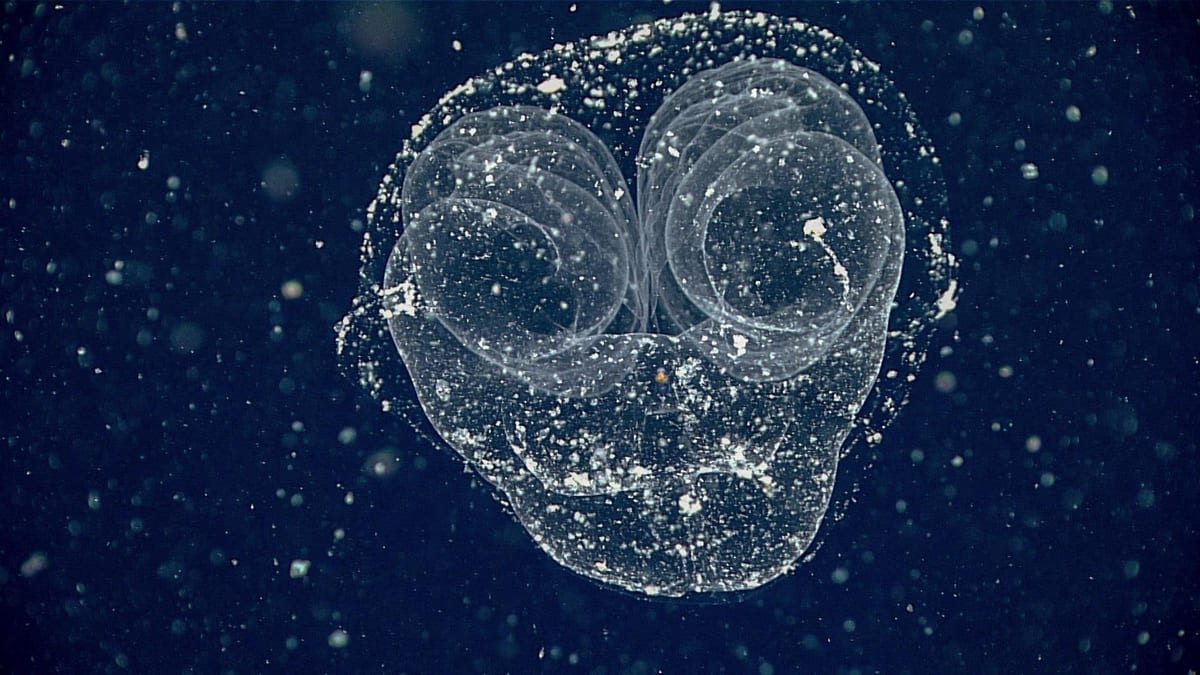
Tiny particles continually form in the ocean and slowly sink through the water column. Their movement resembles snowfall, although the process has nothing to do with cold temperatures or ice formation.
In the sunlit upper ocean, dead plankton cells, mucus secretions, and mineral particles stick together into loose aggregates that oceanographers call marine snow. The resulting flakes gradually leave the sunlit zone. Illuminated by a deep-sea vehicle's lights, these slowly sinking particles resemble a silent snowstorm in the darkness. As marine snow sinks from surface waters into deeper layers, it carries organic carbon that was recently part of living organisms.
But not all of this carbon reaches the deep ocean. As the particles sink, bacteria living on and inside them break down organic matter. A particle's sinking speed and the rate at which bacteria process its organic matter determine how much carbon remains in the ocean's upper layers and how much is transported to depth. If much of the organic matter is broken down near the surface, the carbon it contains will become available again for exchange with the atmosphere relatively quickly. But if the particle carries the organic matter deeper before it is broken down, it may take centuries for that carbon to return to the surface.
On a broader scale, this mechanism is important to the global carbon cycle: the deeper organic matter is transported before it is broken down, the longer its carbon remains isolated from rapid exchange with the atmosphere. Understanding which particles most effectively preserve organic matter and carry it into the deep ocean can therefore improve our assessment of the ocean's role in storing carbon and influencing the climate system.
One of the main sources of organic matter in marine snow is phytoplankton living in the sunlit upper ocean. Using sunlight, these microscopic organisms fix dissolved inorganic carbon and convert it into organic matter. Once incorporated into marine snow, this material begins its journey downward. Some particles reach deep waters relatively quickly, while others partially break apart along the way. A particle's size, density, and internal structure influence both its sinking speed and its resistance to breakdown. Polysaccharide-rich mucus secreted by plankton helps bind cellular remains and other particles together. Even patches of mucus only a few micrometers across can affect how well a particle holds together and how easily bacteria can reach its organic matter.
A Carbon Pump Without an Engine
The sinking of marine snow is part of the gravitational pathway of the biological carbon pump. The biological carbon pump comprises processes that transport organic carbon from surface waters into the deep ocean. These processes influence how much of that carbon quickly becomes available again for exchange with the atmosphere and how much remains in the ocean for longer periods. A review by David Siegel and colleagues, published in the Annual Review of Marine Science in 2023, identifies three main pathways for this transport: gravitational sinking of particles, carbon transport by vertically migrating animals, and transport by ocean mixing. Marine snow belongs to the first, gravitational pathway and makes up an important part of this flux.
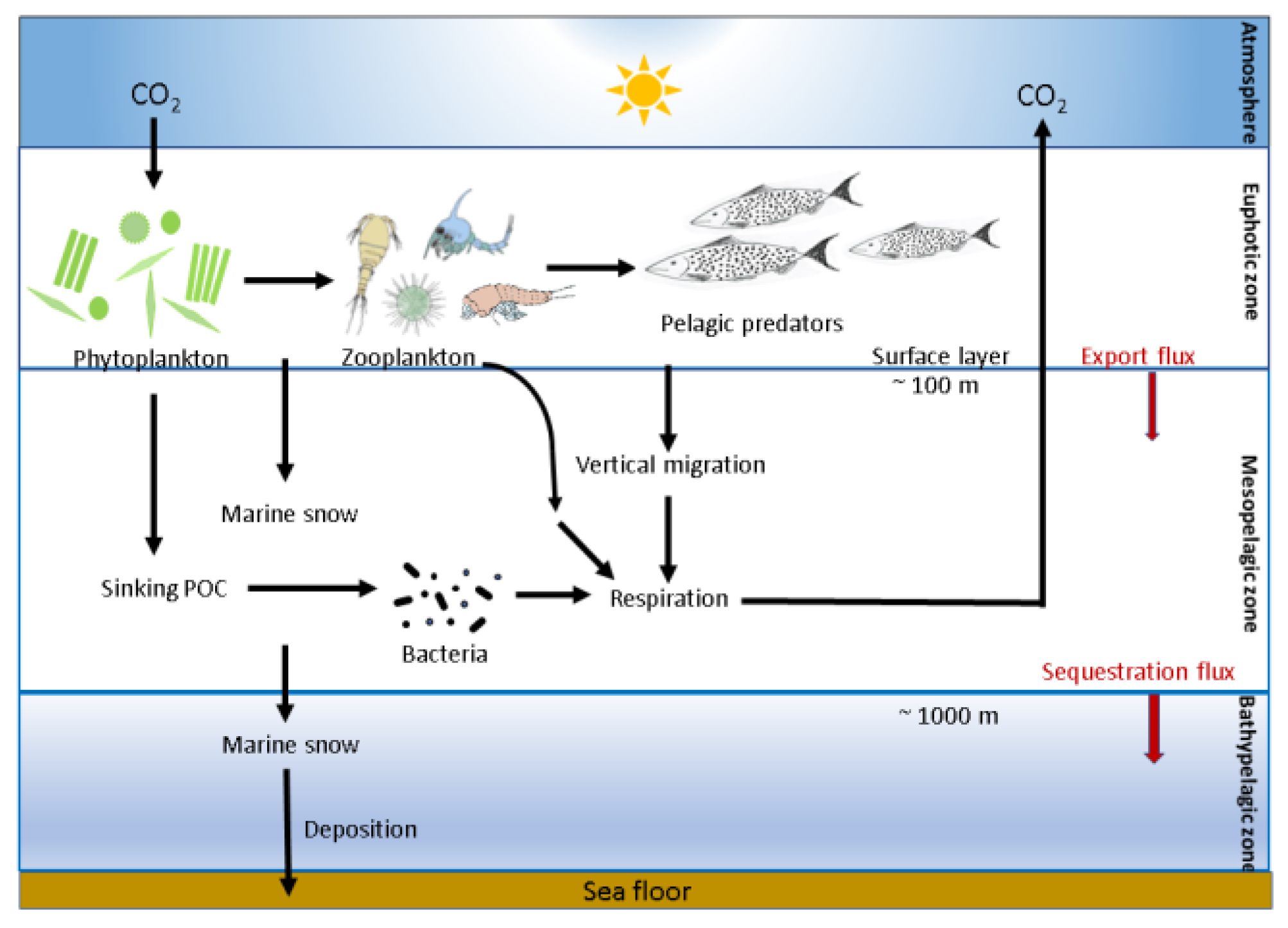
In a study published in Global Biogeochemical Cycles in 2023, D. Clements and coauthors estimated the annual global export of organic carbon across two depth horizons by sinking particles with equivalent diameters ranging from 35 m to 5 mm. The calculation yielded 5.8 0.1 billion metric tons of carbon per year across the base of the ocean's sunlit zone, and 6.1 0.1 billion metric tons across the annual maximum mixed-layer depth. These estimates describe the amount of carbon passing through each depth horizon. What happens to that carbon afterward, however, also depends on the depth at which the organic matter is broken down: the deeper this occurs, the longer the carbon may remain isolated from rapid exchange with the atmosphere.
Faster sinking may increase the proportion of organic carbon that reaches the deep ocean: for every meter traveled, organisms living on the particle have less time to respire. In 2010, Morten Iversen and Helle Ploug compared three types of marine aggregates (clusters of organic and mineral particles): those with carbonate ballast, those with silica ballast from diatoms, and those containing a mixture of both components. Aggregates containing calcium carbonate ballast sank approximately 2–2.5 times faster than those containing silica ballast from diatoms.
The mean carbon-specific respiration rate of the microbial communities, estimated from their total oxygen consumption within the aggregates, was approximately 0.13 day⁻¹. This corresponds to an initial rate of consumption of roughly 13% of the current organic carbon stock per day. If the relative rate remains constant, about 12% of the original stock is consumed in one day: 1 − exp(−0.13). This rate did not differ substantially among aggregate types, although it could vary between individual particles. At comparable microbial community respiration rates, faster sinking allowed particles to travel farther before the same amount of organic carbon was processed.
Sinking speed determines how long a particle takes to reach a given depth, while the carbon-specific respiration rate of the community within an aggregate determines how quickly its inhabitants consume organic carbon.
How Much Carbon Reaches a Depth of One Kilometer?
Imagine two groups of marine snow particles. Particles in the first group sink rapidly, but bacteria can readily break down their organic matter. Particles in the second group sink more slowly, but some of the material they contain is difficult for bacteria to access. Which group will carry a larger share of its original organic carbon to depth? To answer, we need to compare sinking speed with the rate at which carbon leaves the sinking-particle flux.
To illustrate this relationship, consider a simplified exponential model used in oceanography to describe the decline in organic carbon flux with depth (Marsay et al., 2015; Cael and Bisson, 2018). The goal is not to reproduce those studies' calculations, but to examine a general principle: how sinking speed relates to carbon loss during descent.
In the model, denotes particle sinking speed, while denotes the effective fractional rate of carbon loss from the sinking-particle flux. The faster the particles sink and the more slowly carbon leaves this flux, the farther it can be transported. The quantity is measured in meters per day, and in day⁻¹. If and are constant, their ratio defines the characteristic transport length :
is the characteristic transport length: over a depth interval equal to , the flux falls to approximately 37% of its initial value. This is a transport distance, not the physical size of a particle.
To express this relationship at any depth, the model uses for the current depth and for the initial, or reference, depth. The fluxes at these depths are denoted by and (). Then
The larger is, the more slowly the flux decreases with depth and the greater the fraction that reaches a given horizon.
The model assumes that the same fraction of the remaining organic carbon flux is lost over every equal increase in depth. Here, a loss means that carbon has left the sinking-particle flux being modeled. A flake breaking apart does not necessarily count as such a loss: smaller fragments may continue to sink. A model of the real ocean would therefore also need to account for the fate of those fragments, changes in their sinking speeds, and bacterial degradation.
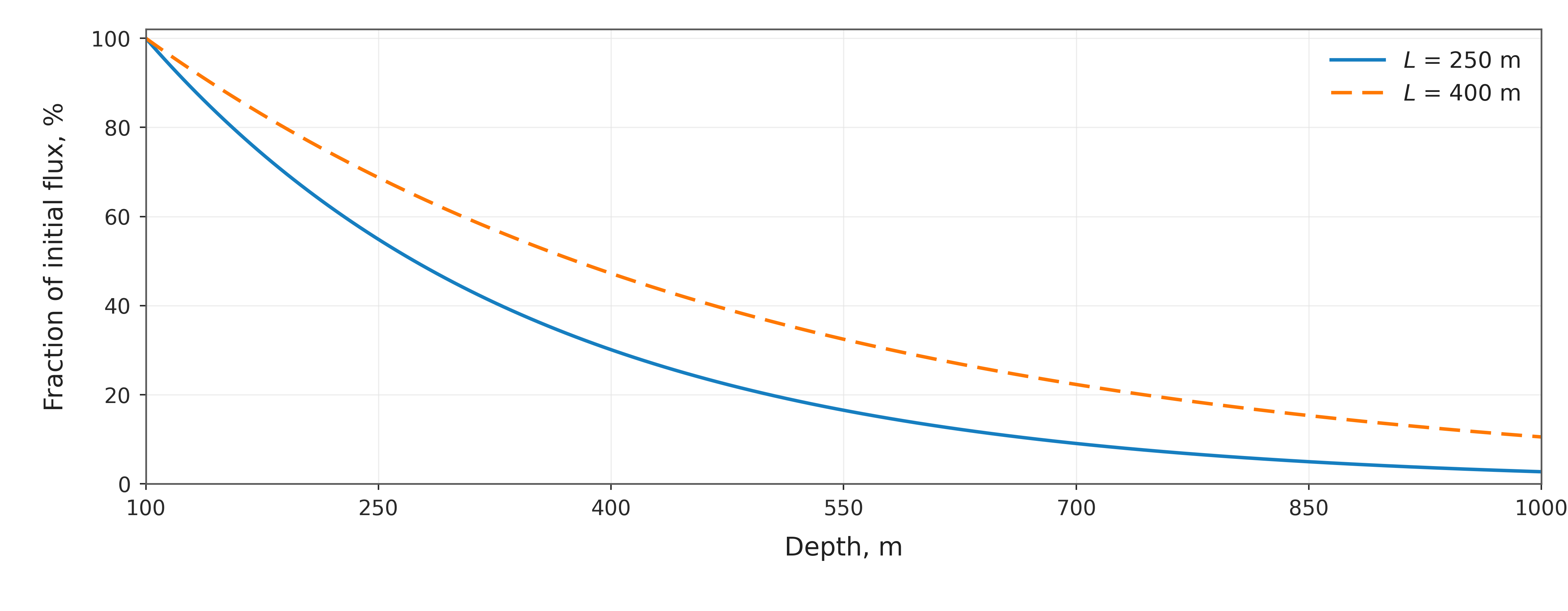
Let's look at how much carbon reaches a depth of one kilometer in this model. For this illustration, we set the flux at 100 meters to 100% and use two hypothetical values of , 250 and 400 meters, to show how transport length affects the fraction reaching depth. With = 250 meters, about 2.7% of the initial flux remains at a depth of one kilometer; with = 400 meters, about 10.5% remains. Thus, in this example, increasing by a factor of 1.6 results in an almost fourfold increase in the fraction of the flux reaching a depth of one kilometer. These are illustrative model results, not direct measurements from the ocean.
In the ocean, both the sinking rate of marine snow and the breakdown rate of its organic matter depend on particle properties. Mucus, which binds organic remains and other components of marine snow together and forms the internal environment of aggregates, may play an important role. Its properties can influence two processes at once: on the outside, mucus can increase drag and slow sinking, while more viscous regions inside the particle may restrict bacteria's access to organic matter. Researchers have examined these effects in separate experiments and models.
How Mucus Affects Particle Sinking and Breakdown
Rahul Chajwa, Manu Prakash, and their colleagues studied one of these effects in a paper published in Science in 2024. The researchers found that sinking marine snow particles can leave an almost invisible mucus “comet tail” in their wake. It increases hydrodynamic drag and slows sinking. The additional time may allow bacteria to break down more organic matter before the particle reaches the deep ocean.
Inside the particle, mucus forms a network of long molecules, primarily polysaccharides and other biopolymers. This network retains water and binds cellular remains together. As marine snow sinks, bacteria break down its organic matter. How easily bacteria can reach different regions of an aggregate therefore matters. They may have more difficulty penetrating more viscous regions, although their distribution also depends on other properties of the mucus and the microorganisms themselves.
Higher viscosity may also slow the movement of dissolved molecules and thereby influence microbial metabolism within an aggregate. The study did not measure this possible effect directly. To investigate the relationship between mucus microviscosity and bacterial distribution, the researchers needed to measure microviscosity and map bacterial positions simultaneously without destroying the sample.
To develop and test such a method, the researchers worked with hydrated mucus aggregates from laboratory cultures of diatoms and observed them in a microscopy chamber. The samples had to remain hydrated and intact: drying changes their structure, while mechanical sectioning disrupts how different regions are arranged within them.
Mapping an Invisible Internal Environment
In 2021, while working as a postdoctoral researcher at Scripps Institution of Oceanography, Bryce Inman set out to measure microviscosity inside mucus while mapping bacterial locations without damaging the sample. According to an institutional press release, Inman and his colleagues, including microbiologist Farooq Azam, spent approximately four years testing different observational methods. They developed a workable approach in 2025. In July 2026, the method was described in detail in Nature Communications.
The researchers used fluorescent molecules known as molecular rotors. After absorbing light, a molecular rotor can release energy as fluorescence or dissipate it through the rotation of a movable part of the molecule. The more viscous the medium surrounding the molecule, the harder it is for that part to rotate and the brighter the fluorescence becomes. This makes it possible to estimate microviscosity directly in a hydrated sample, without drying or sectioning it.
However, the intensity of a molecular rotor's fluorescence signal depends not only on the viscosity of its surroundings but also on dye concentration. The authors therefore used the water-soluble rotor RY3 and compared the red and blue components of its signal. The red component is more sensitive to microviscosity, while the blue helps account for dye concentration. They calibrated the method using solutions of known viscosity. The researchers also tested how acidity, dye concentration, and sample autofluorescence affected the signal so they could distinguish those influences from changes due to microviscosity.
The internal picture was not obtained by simply "looking through" an entire particle at once. A confocal microscope recorded successive thin optical sections at different depths within the sample, and a computer assembled them into a three-dimensional map. A second dye revealed the locations of bacteria. This allowed the researchers to compare bacterial distribution with microviscosity in different parts of an aggregate. Importantly, each molecular rotor measures microviscosity only in its immediate surroundings. Resistance to the movement of an entire bacterium also depends on the elasticity of the mucus and on how the bacterium's surface interacts with surrounding biopolymers.
The method proved useful beyond marine snow. In the same July study in Nature Communications, the researchers examined the mucus layer of a young Cassiopea xamachana jellyfish. They found granules measuring 1–2 micrometers whose microviscosity was, in some places, approximately 250 times that of seawater. Bacteria were found in the surrounding mucus but were considerably less common in the most viscous regions near the jellyfish's epidermal cells.
Two Aggregates, Different Conditions for Bacteria
For a detailed comparison, the researchers selected two mucus aggregates from different laboratory diatom cultures. Diatoms are microscopic algae with silica-containing cell walls.
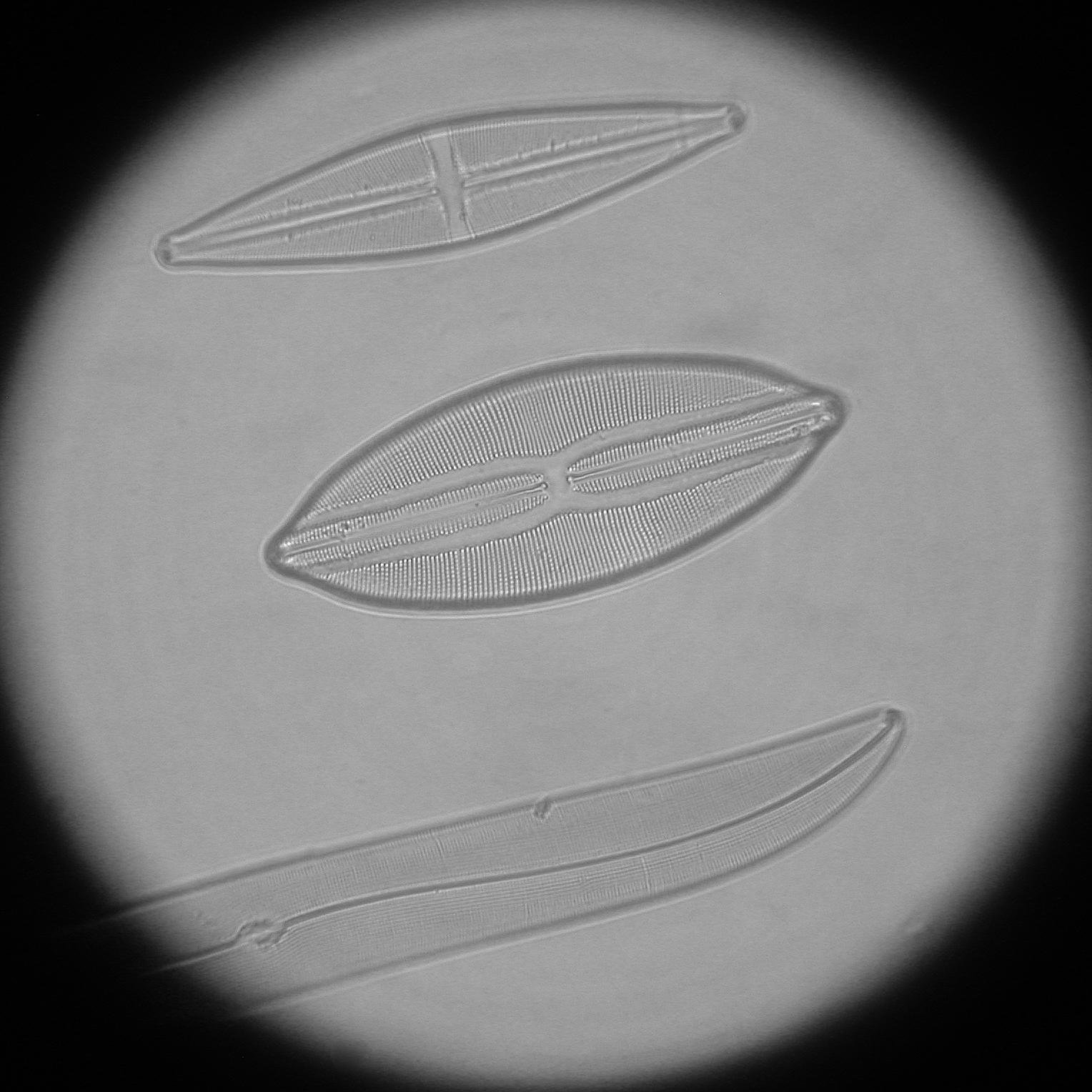
After the cells die, their remains and mucus secretions may become part of marine snow. In the sample from a Chaetoceros affinis culture, the mucus formed a small, dense clump containing no diatom cells. By contrast, the Pseudo-nitzschia sp. aggregate had a loose structure, with a network of algal cells held together by mucus.
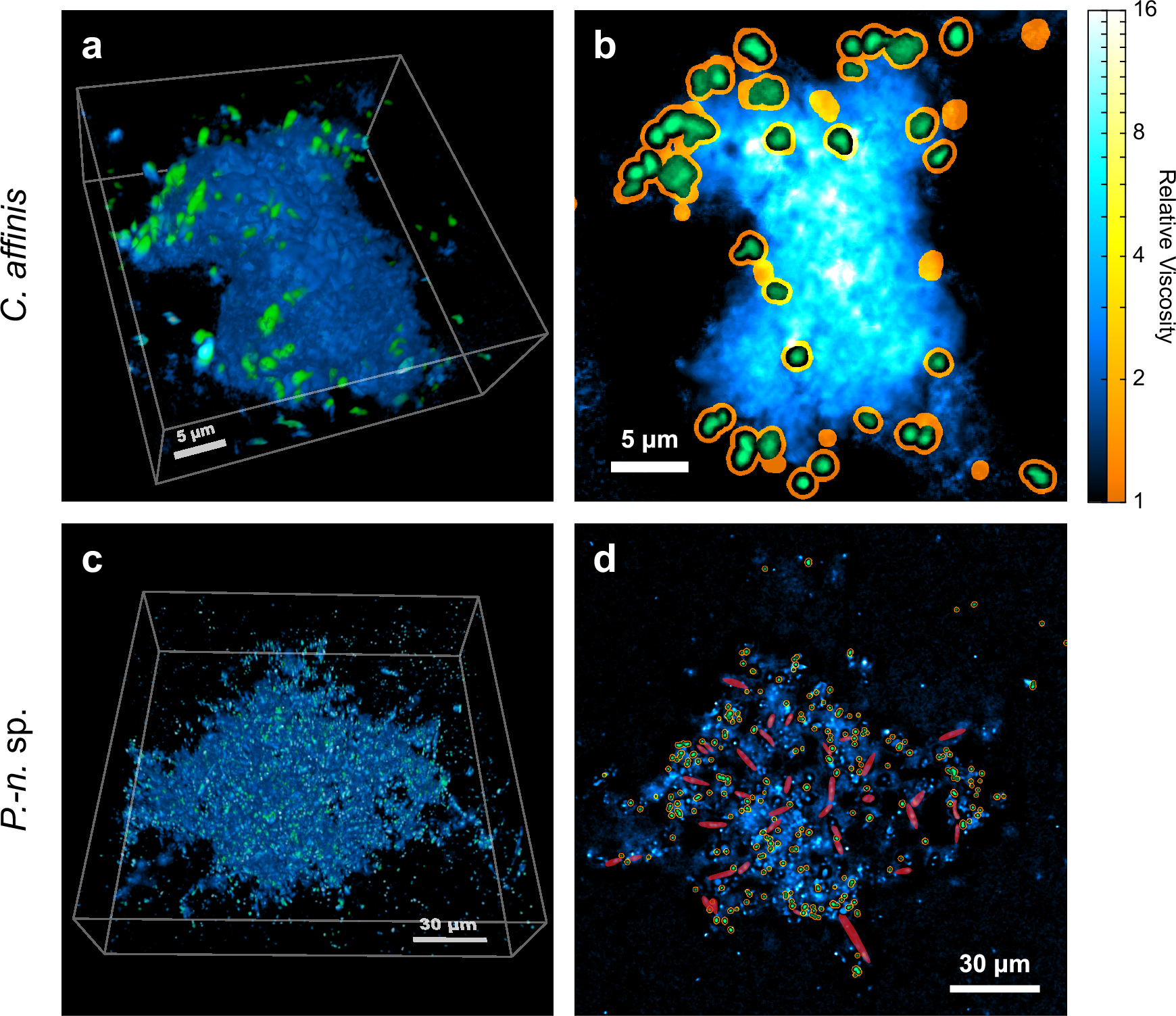
In the dense Chaetoceros aggregate, voids accounted for approximately 3% of the volume, compared with about 65% in the loose Pseudo-nitzschia aggregate. The most viscous regions of the Chaetoceros sample lay closer to its center, whereas the Pseudo-nitzschia aggregate contained numerous spaces between cells.
In some regions, microviscosity was approximately 16 times that of the surrounding seawater. In the dense Chaetoceros aggregate, bacteria were noticeably less common in more viscous regions. In regions where relative microviscosity exceeded 2.5, bacteria were less common than expected based on how much space those regions occupied, and they were almost absent from central regions with values above 4. The loose Pseudo-nitzschia aggregate lacked a continuous viscous barrier, allowing bacteria to penetrate deep into it as well. The researchers mapped the positions of hundreds to thousands of bacteria across the two selected samples and observed similar features in other aggregates from these cultures.
However, the spatial distribution of cells alone does not prove that viscosity itself controlled their penetration into the mucus. The authors also identify other possible factors: surface lectin proteins that bind to sugars in the mucus, bacterial motility, and the elasticity of the mucus itself.
To describe this microscopic space, Inman proposed the word "mucoscape": a kind of terrain with passageways, loose regions, and viscous barriers. In a press release from the Scripps Institution of Oceanography about the publication of the Science paper, he explained it this way: "Bacteria can latch on to less viscous portions of each particle, but cannot reach more viscous regions until they break it down. Think of it like a worm in an apple: the flesh is easy to penetrate, but the core is tough to chew through."
What Happens to Particles Outside the Laboratory
In a subsequent study published in Science on Oct. 8, 2026, Bryce Inman, Stuart Humphries, and Farooq Azam also investigated natural marine snow. Molecular rotors allowed the researchers to map microviscosity within aggregates and track how it changed over time. The publicly available dataset on Dryad contains measurements of 39 aggregates from a Chaetoceros affinis culture and 13 natural samples collected near the Scripps Institution of Oceanography pier. The researchers imaged seven laboratory aggregates at three time points over approximately seven hours.
In natural marine snow, bacteria were found more often in the less viscous regions of aggregates. They were substantially less common in the most viscous regions. These images show an association between microviscosity and bacterial distribution, but cannot establish that viscosity alone restricted bacterial penetration. Other properties of the mucus and bacteria also matter.
In laboratory experiments, the researchers tracked how bacteria changed the structure of mucus aggregates and found that more viscous samples broke down more slowly. In the same October paper in Science, the authors used a computer model to estimate how differences in particle stability might affect sinking depth and carbon transport. Using laboratory measurements of aggregate degradation rates, a computer model suggested that, under the conditions considered, more viscous particles could carry more than six times as much carbon to depth as less viscous particles. This estimate is not a direct measurement of the total carbon flux in the ocean.
The studies by Chajwa and Inman illustrate two different ways in which mucus affects the carbon's journey. An external "comet tail" slows a particle's descent, giving bacteria more time to break down organic matter. A more viscous internal structure, by contrast, may resist degradation for longer and thus help transport carbon into the deep ocean. The outcome depends not only on how quickly particles sink, but also on how much carbon they retain along the way.
The two effects may depend on the same mucus properties. Internal microviscosity, however, is only one characteristic: the shape and length of a mucus tail are also influenced by mucus elasticity and the movement of water around the particle. Researchers do not yet know how these effects interact in natural marine snow or which one predominates.
It is still unclear how often such dense, viscous regions occur in natural marine snow and how their structure changes as particles sink and fragment. Further observations at different depths, together with three-dimensional microviscosity maps, should reveal how aggregate structure influences breakdown and carbon transport into the deep ocean.
Sources
- Siegel D. A., DeVries T., Cetinić I., Bisson K. M. (2023). Quantifying the Ocean’s Biological Pump and Its Carbon Cycle Impacts on Global Scales. Annual Review of Marine Science 15, 329–356.
- Basu S., Mackey K. R. M. (2018). Phytoplankton as Key Mediators of the Biological Carbon Pump: Their Responses to a Changing Climate. Sustainability 10(3), 869.
- Passow U., Carlson C. A. (2012). The biological pump in a high CO2 world. Marine Ecology Progress Series 470, 249–271.
- Turner J. T. (2015). Zooplankton fecal pellets, marine snow, phytodetritus and the ocean’s biological pump. Progress in Oceanography 130, 205–248.
- Clements D. J. et al. (2023). New Estimate of Organic Carbon Export From Optical Measurements Reveals the Role of Particle Size Distribution and Export Horizon. Global Biogeochemical Cycles 37, e2022GB007633.
- Iversen M. H., Ploug H. (2010). Ballast minerals and the sinking carbon flux in the ocean: carbon-specific respiration rates and sinking velocity of marine snow aggregates. Biogeosciences 7, 2613–2624.
- Chajwa R. et al. (2024). Hidden comet tails of marine snow impede ocean-based carbon sequestration. Science 386, eadl5767.
- Inman B. G. et al. (2026). Molecular rotors reveal the 3D viscous habitat of mucus-colonizing bacteria. Nature Communications 17, 8952.
- Inman B. G., Humphries S., Azam F. (2026). Marine snow viscosity regulates microbial degradation and the ocean carbon sink. Science 394, 202–206.
- Inman B. G., Humphries S., Azam F. (2026). Data from: Viscosity voxel counts in mucus aggregates from diatom cultures and coastal samples [Dataset]. Dryad.
- Scripps Institution of Oceanography (9 October 2026). The gooier marine snow is, the better it is at transporting carbon, new study finds.
- NOAA Ocean Exploration. What is marine snow?
- Marsay C. M., Sanders R. J., Henson S. A., Pabortsava K., Achterberg E. P., Lampitt R. S. (2015). Attenuation of sinking particulate organic carbon flux through the mesopelagic ocean. Proceedings of the National Academy of Sciences 112(4), 1089–1094.
- Cael B. B., Bisson K. (2018). Particle Flux Parameterizations: Quantitative and Mechanistic Similarities and Differences. Frontiers in Marine Science 5, 395.