Listening to the Seafloor Before the Carbon Goes In

The plan for the Norwegian North Sea is to take carbon dioxide captured from industry, pipe it out under the seabed, and leave it there for good. Several storage licenses have already been awarded on the Horda Platform, the offshore block that will anchor projects including the Northern Lights venture. But committing millions of tonnes of gas to a rock formation raises an awkward prerequisite: to notice if injection ever disturbs the ground, you first have to know how the ground behaves when nobody is touching it.
That baseline is harder to establish than it sounds, because the standard listening posts are in the wrong place. Norway's seismic monitoring runs on land stations, and out over the North Sea their coverage thins: earthquakes get located imprecisely, and the smallest ones vanish into the noise entirely. A tremor that a dense onshore network would catch easily can go completely unrecorded beneath open water.
Three instruments on the seabed
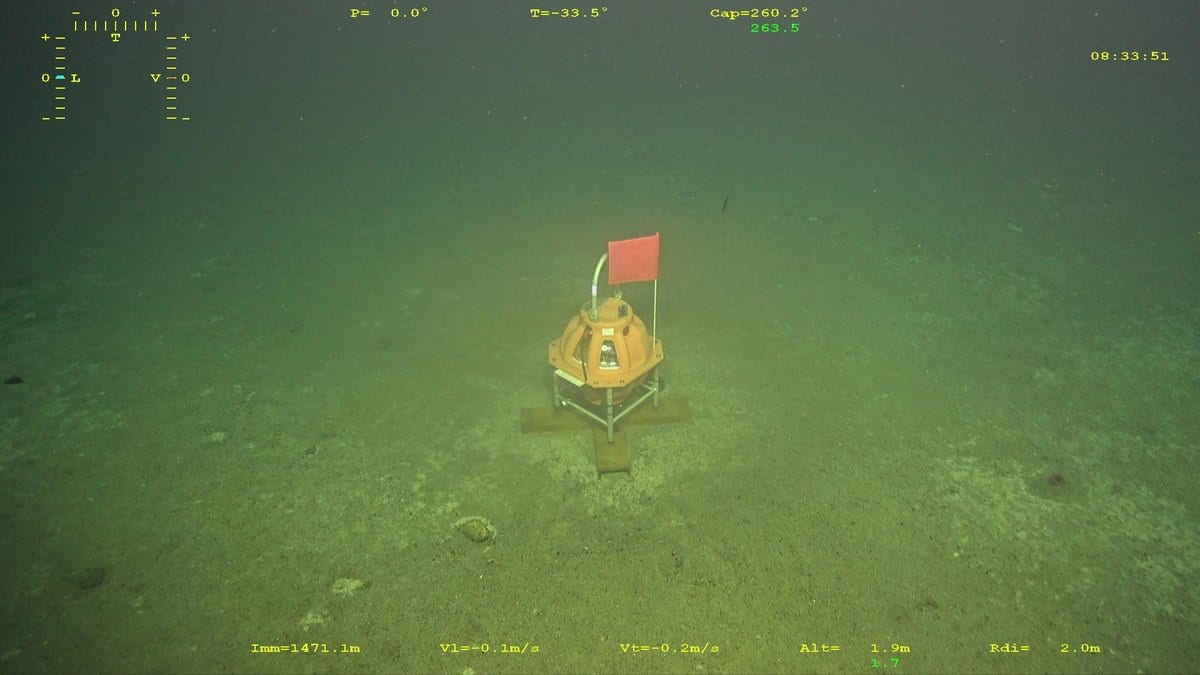
To close that gap, a team led by Hasbi Ash Shiddiqi of King Abdullah University of Science and Technology, working with Lars Ottemöller of the University of Bergen and colleagues, took the measurement to the source. Between October 2021 and September 2022 they deployed three broadband ocean-bottom seismometers directly on the seafloor of the Horda Platform and left them recording for a full year (Shiddiqi et al., 2026), published in the journal Seismica.
Putting instruments on the seabed brings its own complications, chief among them keeping time. An ocean-bottom seismometer has no GPS signal once it sinks, so its internal clock can drift, and a drifting clock corrupts every earthquake location built from its data. The team checked and corrected the timing using ambient-noise cross-correlations: a technique that leans on the steady background hum of the ocean itself. That same analysis turned up Scholte waves, a type of ground motion consistent with the soft sediments blanketing the platform.
To sift a year of continuous recordings for faint events, the researchers ran a deep-learning detection algorithm over both the seabed and land data, then reviewed candidate quakes by hand. Combined with the Norwegian National Seismic Network, the seafloor stations pulled the catalogue's magnitude of completeness (the smallest quake the network can reliably detect everywhere in the area) down to 0.8, meaningfully lower than land stations manage alone. A Bayesian relocation step then tightened where each event actually sat.
A quieter ground than the alarm-headline version
What the instruments heard was, in the reassuring sense, unremarkable. The seabed stations exposed offshore earthquakes that had never been detected before, clustered mostly to the north of the Horda Platform. The events were small and spatially scattered: not a hidden fault system announcing itself, but the low background murmur any piece of crust produces.
The value is precisely in that ordinariness. None of these quakes was triggered by carbon injection; no CO2 has been stored yet. They are the "before" picture: a record of the region's natural restlessness captured while the ground is still undisturbed. Once injection begins, monitors will be watching for anything that departs from this baseline, and a departure only means something if the baseline is trustworthy. Small events that were previously invisible could, without this work, have been mistaken later for an effect of storage. Now they are on the books as normal.
The study's own framing is modest: long-term deployment of seismometers near an injection site strengthens the passive-monitoring plan for offshore CO2 storage. One of the co-authors is affiliated with Equinor, the operator behind the licenses. That is worth noting for transparency, though the work went through independent peer review. As carbon storage moves from proposal to plumbing across the North Sea, the unglamorous task of characterising background seismicity is exactly the sort of groundwork a credible safety case is built on. You cannot tell whether something has changed unless you first took the trouble to measure how it sounded when it was quiet.
Sources
- SeismicaPeer-reviewed