How Indonesia Got ~9,000 People off Ruang Before It Blew: Anatomy of a Successful Volcanic Evacuation

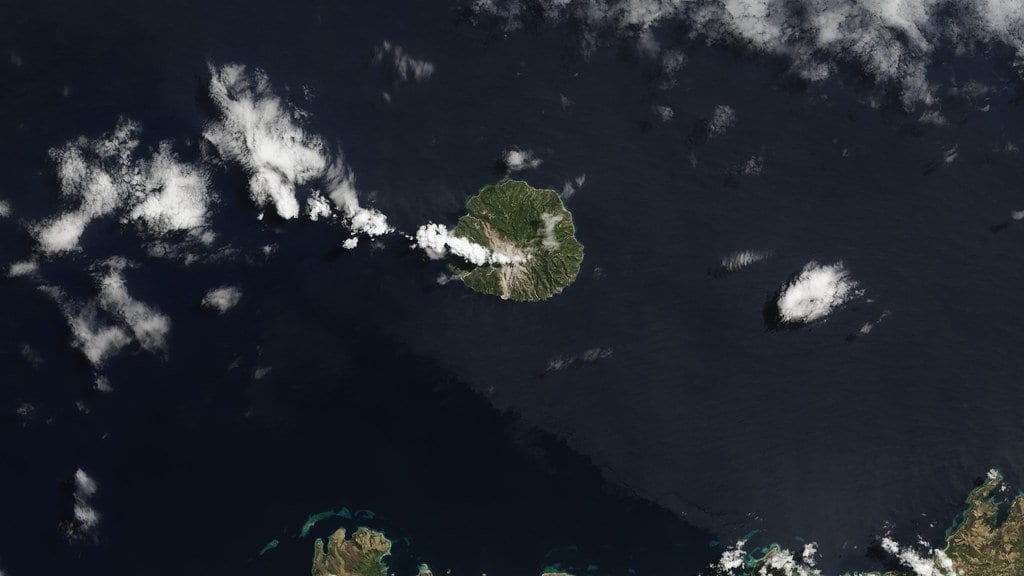
A volcano rarely gives you six days' notice. Ruang, a 725-metre cone rising straight out of the sea in North Sulawesi, gave Indonesia's monitors almost exactly that in April 2024. This time, the warning was heard.
By the second week of the month, the seismographs watching the island were logging deep volcanic earthquakes that climbed in number day after day. In the span of a few days, the count exceeded the total for all of March. To a volcanologist, that pattern reads like magma forcing its way upward through brittle rock. On 16 April, Indonesia's Center for Volcanology and Geological Hazard Mitigation, PVMBG, raised Ruang's alert to Level 2 on its four-step scale and told the public to stay two kilometres clear. A minor eruption began that same afternoon; within hours the alert went to Level 3, and overnight the mountain intensified into a series of towering explosions that drove ash plumes past 12 kilometres into the sky.
That sequence, and what the agency did with it, is the subject of a paper published on 10 July 2026 in the Bulletin of Volcanology by Yalda Purnamasari, Asep Saepuloh, Wendy Widiwijayanti and colleagues, under a blunt title: lessons learned from a successful hazard mitigation. The framing matters. Volcanology papers usually chase a mechanism or a measurement. This one asks a harder, more practical question: when an eruption is genuinely dangerous and the clock is short, what does a warning system have to get right?
Ruang is a good place to ask it. The volcano's two most recent large eruptions, in 2002 and 2024, both reached VEI 4 (explosive, ash-rich, capable of collapsing part of the edifice into the sea and generating a tsunami), and both came after precursory periods measured in days, not weeks. A short fuse is the nightmare case for hazard managers. There is little time to interpret ambiguous signals, less time to argue over them, and almost none to move people once an evacuation is called. The 2002 eruption killed people on the surrounding islands; the memory of it shaped how seriously the 2024 signals were taken.
What the 2024 response got right, in the reconstruction that the agency record makes possible, was speed married to a graded escalation. PVMBG did not wait for certainty. It stepped the alert up as the seismicity built (Level 2, then 3 within the same day), widening the exclusion zone each time rather than holding fire for one big decision. When the earthquakes surged again at the end of the month, with signals the agency read as magma moving back toward the surface, it pushed Ruang to Level 4, the highest rung, and extended the danger radius to seven kilometres. Residents of neighbouring Tagulandang island within six kilometres of the crater were ordered out.
The evacuation itself is where the numbers land. The whole of Ruang island, a population of only a few hundred, was cleared as a precaution, and as the crisis widened the orders eventually covered somewhere between 11,000 and 12,000 people across the affected islands. By mid-May, Indonesia's disaster agency BNPB counted 9,343 residents in evacuation centres. The most destructive explosions arrived after the exclusion zones were in place, not before. Ashfall still forced the closure of the international airport at Manado, more than 100 kilometres away, a reminder that even a well-run evacuation cannot shrink an eruption's reach.
Strip away the drama and the scientific interest is in the decision chain. Early warning for volcanoes is not one instrument or one alarm; it is a sequence of judgment calls made under uncertainty, each with a cost if it is wrong. Call an evacuation too early or too often and the public stops listening. Call it too late and people are inside the blast radius. The value of a case like Ruang is that it turns a set of good calls into something examinable: which seismic patterns triggered which alert step, how the exclusion zones were drawn, how the escalation to Level 4 was justified when it came. That is the material a peer-reviewed post-mortem can convert from institutional memory into transferable method.
The stakes reach well beyond one Indonesian island. The Pacific and Indonesian arcs are studded with volcanoes that share Ruang's uncomfortable profile: explosive, close to populated coastlines, capable of little warning. Many of them are monitored far more thinly than Ruang was, if at all.
Sources
- Bulletin of VolcanologyPeer-reviewed