Listening to Askja: How a Volcano's Background Hum Reveals Magma on the Move

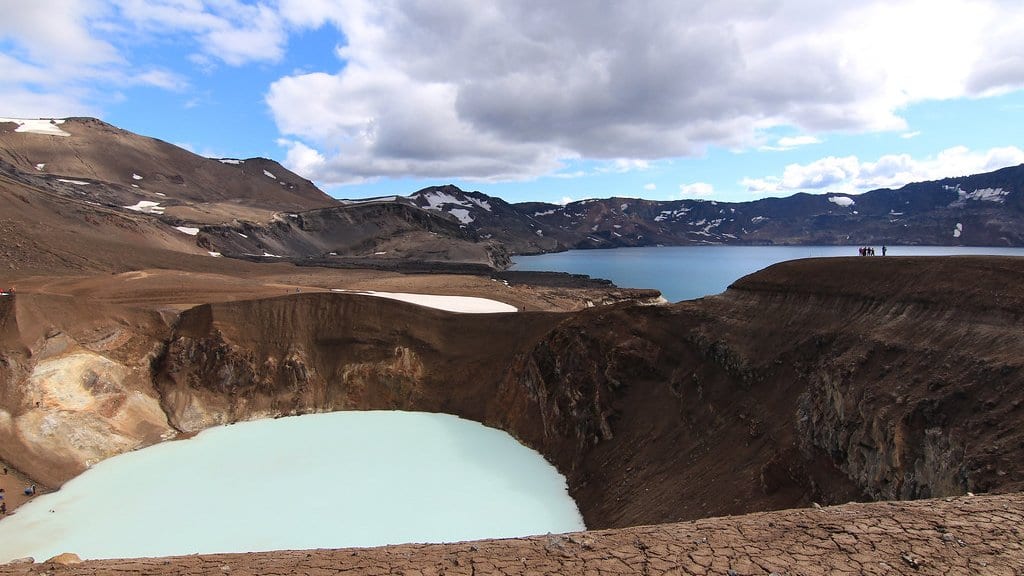
A volcano is never truly silent. Even when nothing erupts, the ground beneath a place like Askja hums with a faint, ceaseless vibration: ocean waves pounding a distant coast, wind dragging over rock, the low murmur of a planet in motion. To most instruments that hum is noise, the stuff you filter out to find the real signal. A team of seismologists working across Belgium, Iceland, Britain and Spain decided to listen to the noise itself. Sixteen years of it.
What they were listening for was subtle: a change in how fast those background waves travel through the rock beneath the caldera. When magma pushes in, when gas comes out of solution, when the crust cracks and pressurises, the material the waves pass through changes, and so does their speed, ever so slightly. Track that speed carefully enough and the volcano stops being a black box. It starts telling you what is happening a few kilometres below your feet.
From noise to signal
The technique has a name that sounds more forbidding than the idea behind it: relative seismic velocity variation, written dv/v. The researchers (led by Laure Brenot and Corentin Caudron of the Université libre de Bruxelles, working with the University of Iceland, the Icelandic Meteorological Office, the Royal Observatory of Belgium and others) used a method called coda wave interferometry, comparing the tail ends of cross-correlated ambient-noise recordings to measure changes of a fraction of a percent in wave speed. Their study in Seismica, published on 13 July 2026, stitched together continuous records from 2008 to 2024.
For much of that span, Askja was doing something odd: quietly deflating, sinking a little each year. Then, in August 2021, it flipped. Ground-positioning stations began to record uplift, the caldera floor rising as something pushed up from below. By August 2024 the swelling had reached 76 centimetres, and it has not stopped.
The seismic-velocity record caught the same turning point from a different angle. Around that August 2021 transition, the dv/v measurements dropped abruptly to predominantly negative values, reaching about −0.7 percent near the centre of the inflation. In plain terms: the waves slowed down, right where the ground was rising fastest. Sensitivity analysis put the bulk of that change at around 3 kilometres deep, the level of Askja's shallow magma storage.
What the slowdown means
A slowdown of well under one percent may sound trivial. Underground, it is a loud statement. Seismic waves lose speed when the rock they cross becomes more cracked, more fluid-filled, or more pressurised. Those are exactly the fingerprints you would expect from magma and its dissolved gases arriving at shallow depth. The authors read the velocity drop as magma-induced: fresh melt and volatiles accumulating, the system pressurising, and then reorganising itself.
What makes the result more than a single alarm is what came after the drop. The recovery was frequency-dependent (different seismic frequencies, which probe different depths, healed at different rates), and the volcano settled into a new state rather than simply returning to the old one. The researchers link that lingering change to hydrothermal circulation, hot fluids moving through the reshuffled rock and keeping its seismic properties altered. The velocity record, in other words, did not just catch the onset of unrest. It followed the aftermath.
That is the part surface measurements struggle with. Uplift tells you the ground is moving and roughly how much, but it is one number draped over a wide area. It cannot easily distinguish magma pushing in from gas coming out of solution, or tell you whether a system is still charging or beginning to relax. By combining the velocity record with GNSS uplift data, earthquake catalogues, single-station amplitude analysis and weather records, the team could separate the pressurisation from a partial depressurisation, sketching the subsurface plumbing in more than a single line.
Why it travels beyond Iceland
Askja is a natural laboratory: remote, well-instrumented, and freshly restless, which is precisely why it draws so many eyes. But the appeal of this work is not really about one caldera. It is that the raw material, background seismic noise, is already being recorded, continuously and cheaply, at monitored volcanoes around the world. No new fieldwork, no drilling, no fresh sensor network is required to ask whether the same hum can flag the shift from quiet to restless somewhere else.
The evidence here is peer-reviewed, and the study leans on multiple independent data streams rather than the velocity record alone, a caution worth keeping. Askja's uplift and its 2021 onset are also independently documented by the Icelandic Meteorological Office and in separate published work. What this study adds is the demonstration that the volcano's own noise, listened to over 16 patient years, can be turned into a running account of the magma beneath, and that the transition from silence to unrest leaves a trace in the hum long before anything reaches the surface.
Whether Askja erupts, and when, remains unknown. What is now on record is a method for hearing it think.
Sources
- SeismicaPeer-reviewed