The Eruption Lasted Days. Each Batch of Magma Climbed in Minutes

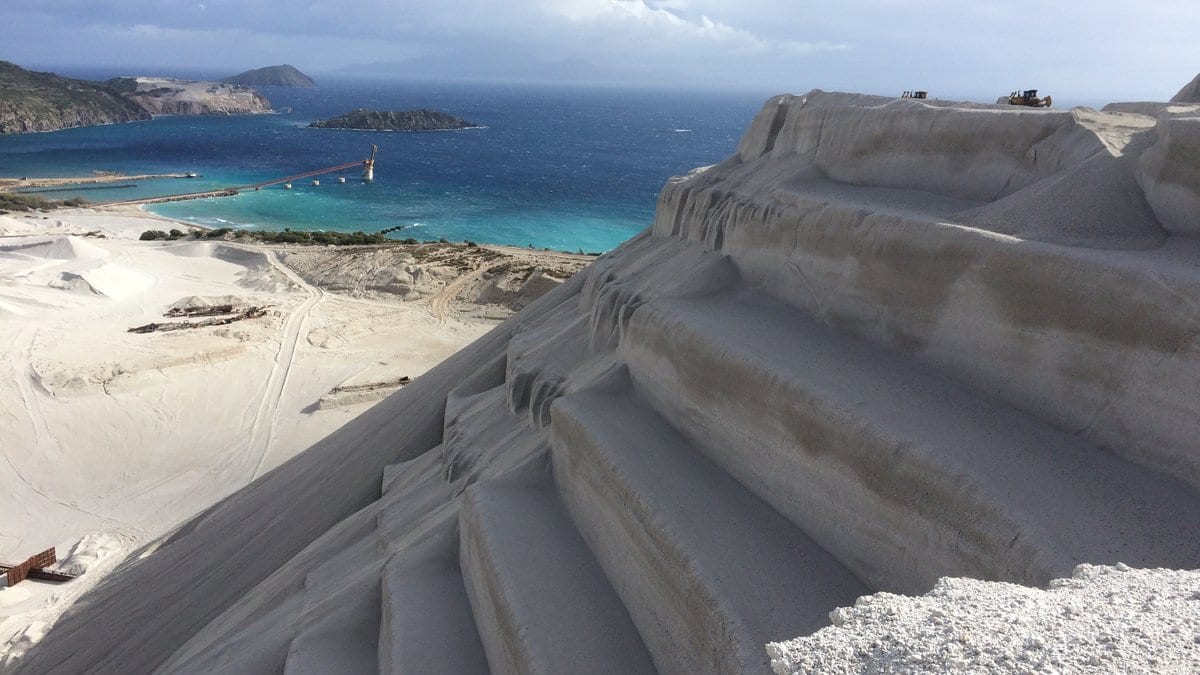
The eruption took days. The magma took minutes.
Roughly 161,000 years ago, a volcano on the seabed south of the Greek island of Kos threw out more than 60 cubic kilometers of ash and pumice, drained the magma reservoir beneath it and let its roof collapse into a caldera. The layers it left behind record an eruption that changed character as it went, from steam-driven blasts where magma met seawater to dry, ground-hugging flows of hot ash, and that stayed active for a few days. The days belong to the eruption as a whole. Each batch of magma that fed it, once it began to move, covered the last stretch to the depth where it tore itself into ash in 1 to 18 minutes.
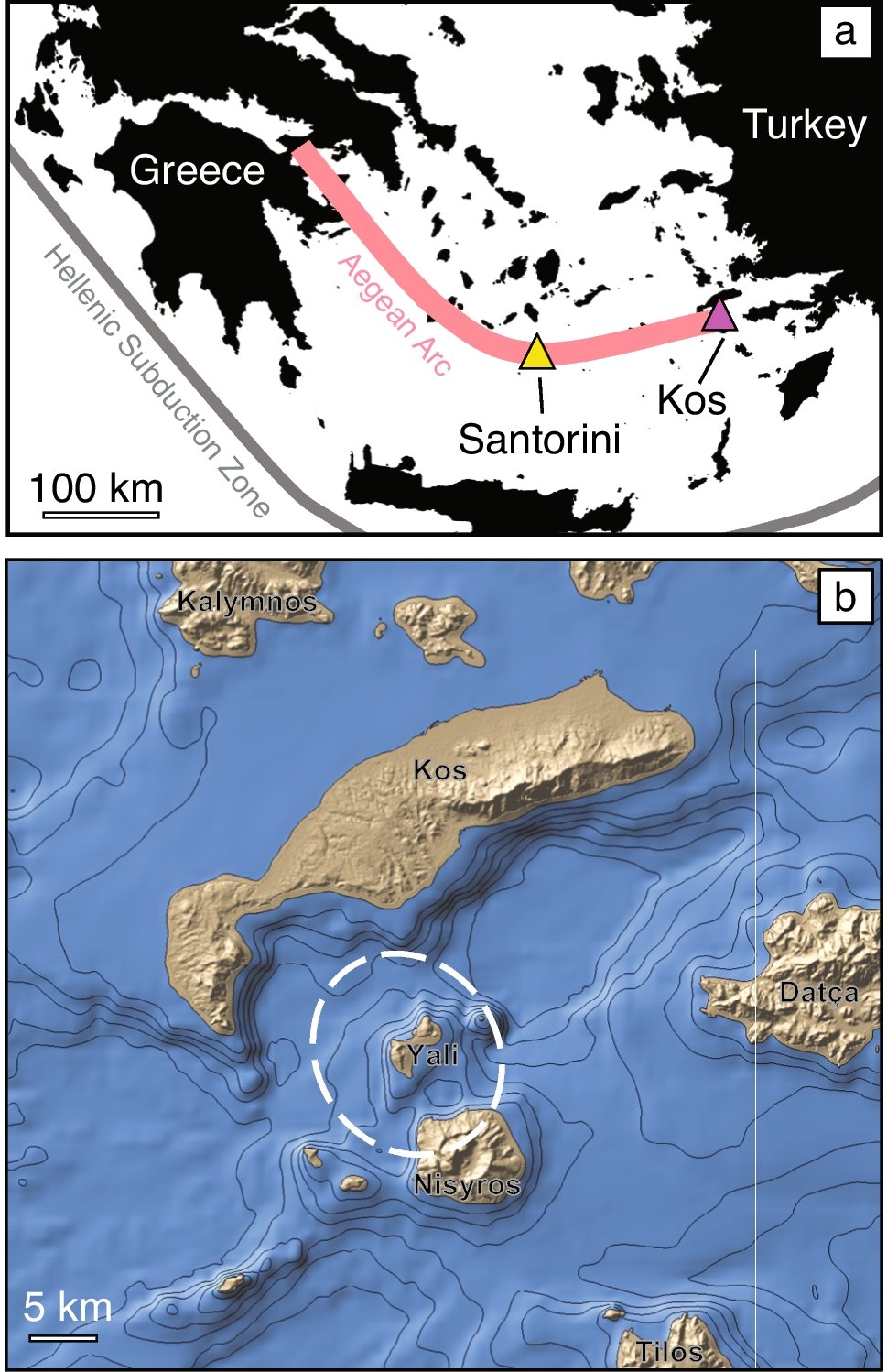
That timing comes from water, and the water comes from quartz. In a study published Nov. 24, 2026, in Bulletin of Volcanology, C. M. Allison of Baylor University, K. S. Befus of the University of Texas at Austin and colleagues at the University of Oregon and ETH Zürich measured the water left in glass trapped inside quartz crystals from the deposit and read the magma's rise from it.
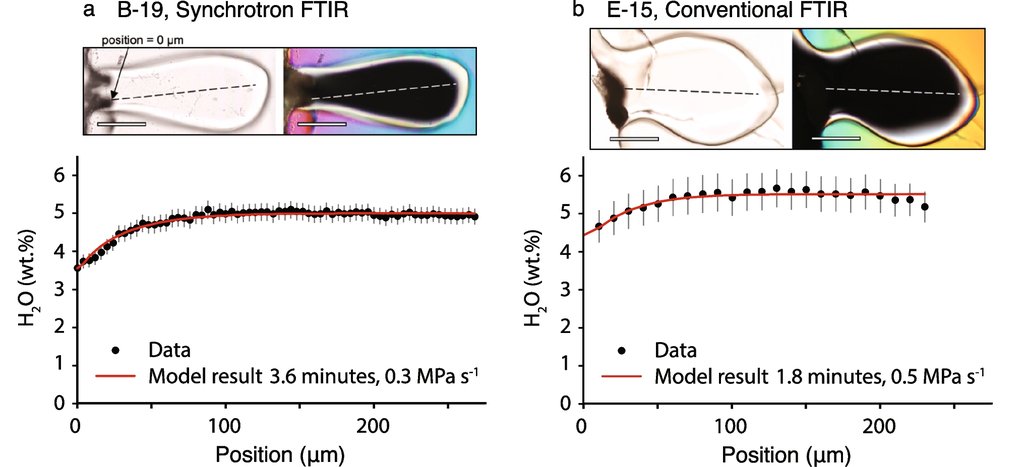
Crystals that grow in a magma reservoir keep a record of it. Some of the quartz in the Kos deposit holds embayments, melt pockets open at one end. While the crystal sits deep and under pressure, the melt in the pocket holds its dissolved water. As the magma rises and the pressure falls, water escapes from the open mouth, and more water diffuses along the pocket to follow it, leaving a concentration gradient that the eruption freezes into the glass. The steeper the gradient, the less time there was. Working on pumice collected during earlier field campaigns on Kos, the team measured 75 of these pockets by infrared spectroscopy, "the largest embayment speedometry dataset collected to date," and modeled the gradients to recover a climb of 2 to 95 meters a second.
The result comes with two bounds. It covers the magma's rise from storage up to the depth where it fragments, not the whole journey into open air. And the crystals come from four of the six units mapped in the deposit, B, C, D and E: pumice from the first and last units was never sampled, and just four of the 75 pockets came from unit C. The paper is also inconsistent about its own headline number. Its abstract gives 1 to 20 minutes and a narrower band of pressure-drop rates, while the results and the conclusion give 1 to 18 minutes and a wider one; the figures above are the ones from the results.
The other clock in the glass is not a second opinion
The same spectra carry a second timer, and it measures something else entirely. Dissolved water in volcanic glass sits in two chemical forms, and the balance between them keeps shifting as the melt cools, until the glass is too cold for the reaction to go on. That balance therefore constrains cooling during eruption, transport and emplacement, rather than the magma's ascent through the conduit. Glass from the steam-driven unit B quenched "on the order of seconds," the authors report, while glass from unit E, erupted at the climax as the caldera collapsed, took about an hour. The reading turns on hundredth-place differences in the infrared signal, and the paper expects no better than order-of-magnitude confidence from it. It is a second measurement of the eruption, not a second measurement of the minutes, and it does not confirm them.
Faster magma did not make a fiercer eruption
The reason to time an eruption unit by unit is to find out whether the speed of the magma explains its violence. Here it did not. The authors write that they "found no clear correlation between ascent rate variations and changes in eruptive behavior." There is a partial trend in their numbers: pressure fell faster from unit B to unit D as the eruption's output grew, then more slowly for the climactic unit E, during the caldera collapse. They decline to lean on it, writing that they are "hesitant to overinterpret the ascent rates given the similarity between units and the spread within units."
What the Kos numbers do settle is a position at one end of a range. Set beside every other eruption measured the same way, they "record some of the fastest decompression rates ever recovered using embayment speedometry" — roughly an order of magnitude faster than Santorini's Late Bronze Age Minoan eruption, and at the top of a published spread that runs across four orders of magnitude. Why some silica-rich magmas crawl and others sprint is unsettled. The Yellowstone eruptions the team compares with Kos are hotter and carry fewer crystals, both of which should make them faster, yet they are slower. "We speculate that the presence or absence of an exsolved gas phase in the magma reservoir is the controlling parameter," the authors write, meaning gas bubbles already free in the melt before the eruption began. That is offered as speculation, not as a result.
Why the paper ends on the Aegean of today
The authors close on their own region. "Renewed volcanic activity in the region is not hypothetical," they write. Santorini's caldera is still moving measurably at the surface, and in early 2025 a swarm of more than 25,000 earthquakes accompanied a magma-filled crack pushing sideways beneath the sea near the island. A separate team mapped that intrusion in Science in November 2025. They add that the Kos-Nisyros system is itself refilling its reservoir. Reading calderas from their crystals, they argue, "provides critical timescale constraints for hazard assessment and eruption forecasting in the Aegean Volcanic Arc."
The constraint, not the forecast, is what this study delivers. It reconstructs one eruption that ended 161,000 years ago, and it offers no probability, no timetable and no warning window for Santorini, for Kos-Nisyros, or for anywhere else. What it adds is a tempo: an eruption that took days to run its course was built out of climbs that each took minutes.
Sources
- Bulletin of VolcanologyPeer-reviewed
- Science