Webb Sorts the Dust of an Exploded Star, Clump by Clump
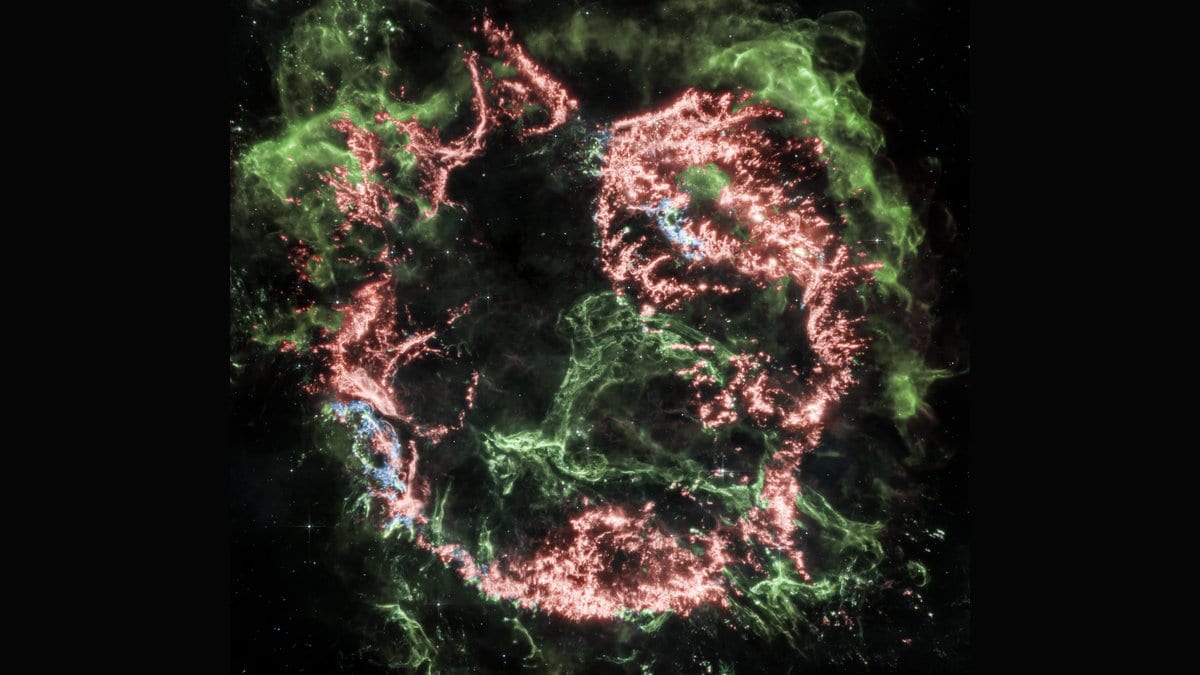
Astronomers using NASA's James Webb Space Telescope have identified the dominant dust in individual clumps of debris in Cassiopeia A, the roughly 350-year-old remnant of an exploded star. Tea Temim of Columbia University and colleagues report silica in one clump and carbon dust in another, in a paper published Nov. 23, 2026, in The Astrophysical Journal Letters.
Exploding stars make and scatter the heavy elements that enrich interstellar space, and the paper uses dust composition as an independent check on which elements sat where inside the star. Earlier mid-infrared spectra of the remnant needed mixtures of several grain types; the authors report those mixtures came largely from separate clumps blending along the line of sight.
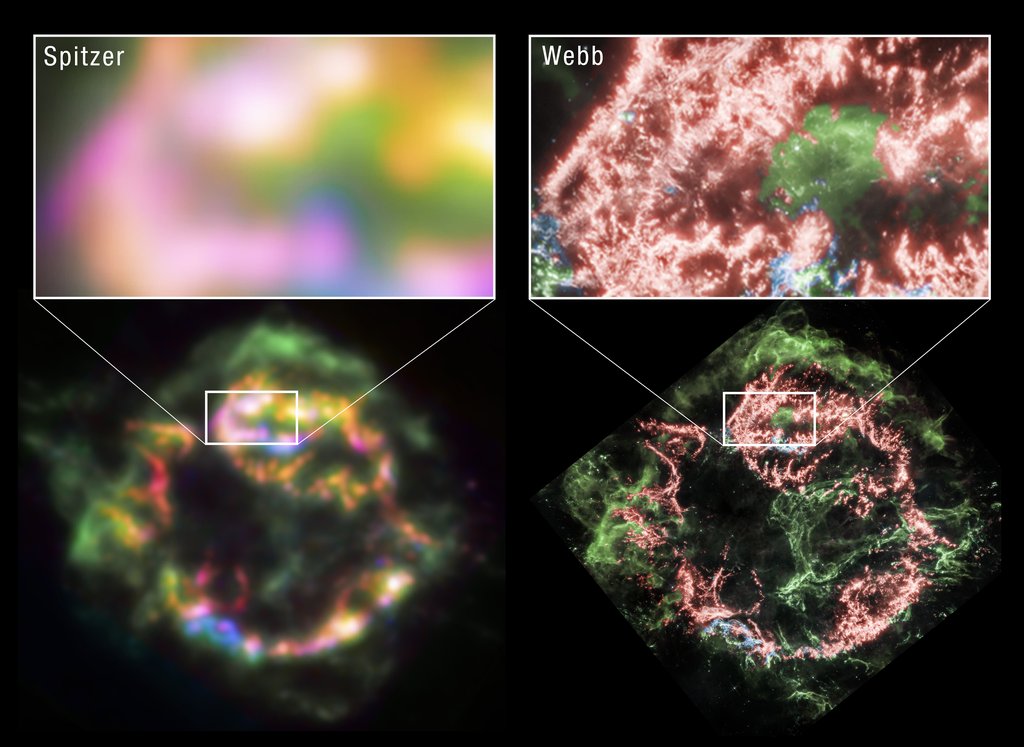
The three regions, observed in November 2022 with Webb's mid-infrared spectrograph, came out differently. Argon-bright debris behind the reverse shock, the inward-moving wave that heats the ejected material, is dominated by silica. A neon-bright region rich in carbon monoxide is dominated by carbon dust. The spectrum of the structure astronomers call the Green Monster fits warm magnesium silicate, whose distribution points to material the star shed before it blew up.
Using those spectra as templates, the team mapped the rest of the remnant, finding the silica signature near 21 microns across much of the shocked debris and the carbon dust in two crescent-shaped regions. The paper then compares the abundances, gas and dust together, with one-dimensional models of how an explosion forges elements, and finds they favor a star whose carbon- and oxygen-burning shells had merged beforehand.
"Material within these shells churns and circulates, which can cause the shells to merge shortly before the supernova explosion," Temim said in NASA's announcement. The authors call the result an addition to growing evidence for a shell merger in Cassiopeia A — and caution that the comparison rests on one-dimensional simulations, with three-dimensional models still needed.
The same approach, the authors write, bears on supernovae in other galaxies, whose mid-infrared light no telescope can resolve. Per NASA's release, the retired Spitzer Space Telescope picked out the three regions for Webb to examine.
Sources
- The Astrophysical Journal LettersPeer-reviewed
- science.nasa.gov