Andean Volcanoes Erupt One Kind of Magma and Keep the Rest Below

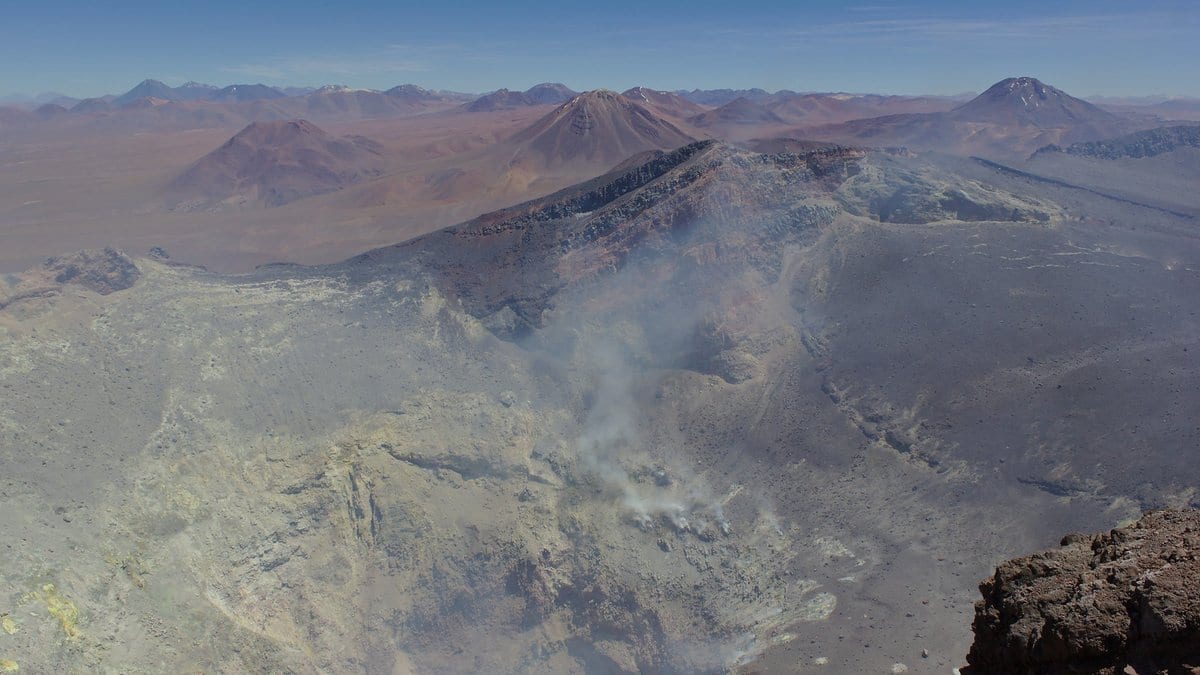
Pick up a lump of andesite at the foot of Lascar, in the Chilean Andes, and the crystals inside that grey arc lava did not all come from the same magma. Some grew in the melt that carried them up the conduit during the climb to the surface. Others are far older, inherited from mush, the crystal-choked magma that can sit in the crust for ages and mostly goes nowhere. They sit side by side in one rock, and telling them apart turns out to be the way into an old question: which magma does a volcano let out, and what becomes of the rest?
Daniela Parra-Encalada, Teresa Ubide and five colleagues at the University of Queensland, with co-authors in Chile and Argentina, collected 28 samples of fresh lava and tephra along a 230-kilometer line across the Central Andes, from active stratovolcanoes such as Lascar to small back-arc cones quiet for millions of years. Their result, published Nov. 9, 2026, in Nature Communications, is that the magma that escapes an arc volcano is remarkably uniform, and that it is a minority of what lies beneath.
Volcanoes of this kind run on hybrids. Hot, dense, magnesium-rich magma rises from depth and mixes with cooler, silica-rich magma already parked in the crust, and the andesite that erupts is a blend of the two. The parent magmas themselves rarely reach the surface: the silica-rich one is too stiff to move easily, the dense one too heavy. The crust works as a filter, passing the middle and holding back both extremes. Silica-rich magma that never erupts freezes in place into granite-like rock, thickening continental crust and gathering metals into ore deposits, and sometimes a body of it empties in a caldera eruption instead.
The window the crust leaves open
Plagioclase, the commonest feldspar in these rocks, makes a good recorder. Its composition tracks the melt it grows in, and elements move through it slowly, so a crystal keeps its history instead of smoothing it away. The team sorted crystals by texture before measuring any chemistry: small microcrysts, grown from the surrounding melt on the way up; large phenocrysts with a core, a mantle and a rim; clusters of small grains; fragments of mush with interlocking, serrated edges; and pieces of already solid rock picked up en route.
Only the microcrysts grew entirely from the melt that erupted, which makes them the one population reporting on it directly. Across every volcano in the transect, their anorthite content, the share of the calcium-rich form of feldspar, averages 61 percent, give or take seven. The paper writes that figure as An61 ± 7 and calls the band the plagioclase eruptibility field. The outer rims of the big crystals, which grew last, fall in the same place.
The band barely moves. It does not shift with the age of a volcano, with whether it erupts gently or explosively, or with its position in the arc, even though the crust beneath the sampled volcanoes roughly halves in thickness from the main arc to the back arc. Those late crystals also hold more magnesium and iron than anything else in the rock, a sign of fast growth in hot magma that had just arrived from below. That arrival is both the trigger these eruptions need and part of what does the filtering.
The half that stayed
The second population never had a route out. The authors put the split like this: "While eruptible plagioclase compositions account for ~50% of the crystals hosted in the rocks from this study, the remaining crystal cargo is dominated by lower-An populations." That carried-along cargo sits dominantly near 43% anorthite, grown slowly inside silica-rich mush, with a rarer calcium-rich population that grew in hotter, magnesium-rich mush instead. Trapped magma is not all one thing.
Two further measurements tie that cargo to a place. Strontium and barium rise from the inside of a large crystal toward its edge, and the strontium isotope ratios run the other way: the cores carry the signature of magma that sat in the crust long enough to take on the chemistry of the rock around it, the rims that of the andesite that carried them out. The cores also match, isotopically, the ash-and-pumice sheets in Lascar's own basement, laid down by the La Pacana caldera in one of the region's past super-eruptions. Some of the cargo in a modern Andean lava comes from the same kind of body that fed those eruptions.
Thermodynamic modeling puts the two environments at different temperatures. The trapped cargo grew in the shallow crust at 750 to 850 °C, in melt cool and stiff enough to lock up into a crystal-rich sludge. The microcrysts and the rims record reheating to between 900 and 975 °C by arriving andesite, at the depth where water dissolved in the magma begins to come out as gas, raising the pressure in the reservoir and setting magma moving.
The same band, in 26 arcs
Does that hold beyond one line across Chile and Argentina? The team pulled published plagioclase analyses out of GeoROC, a public database of other groups' measurements, and found the same peak: An61 ± 14 across 26 arc systems worldwide, with intermediate lavas from the Cascades and Kamchatka averaging almost exactly the Andean value. The worldwide half of the claim rests on those compilations rather than on new measurements; the 28 samples are the new data, and they are one group's.
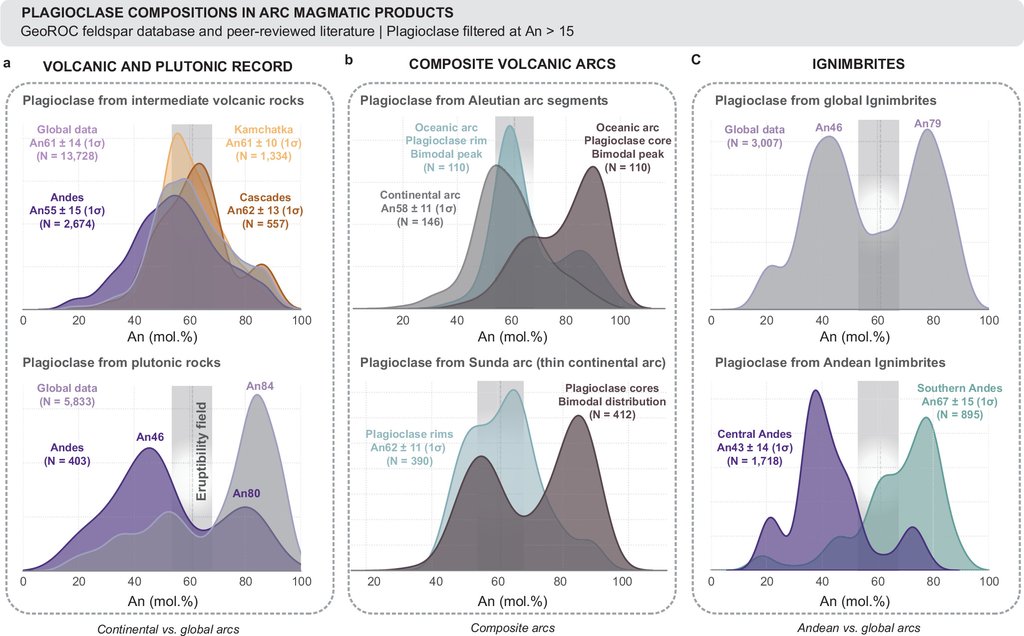
Two details in that comparison matter more than the averages. Where the database records which part of a crystal was analyzed, as it does for the Aleutian and Sunda arcs, the rims fall inside the band while the cores spread into two groups, the Andean pattern exactly. And in plutonic rock, the frozen remains of magma that never erupted, almost no crystals sit in the band at all. The window and its complement both turn up in rock collections nobody assembled for this purpose.
What happens to the trapped half is central to the paper’s argument. Most of it, the authors argue, stays where it is and solidifies, which over geological time thickens continental crust and gathers metals into deposits worth mining. Their summing-up keeps the proportions carefully: the pattern repeats in arcs around the world, "indicating strong eruptive filtering of arc magmas and widespread occurrence of dormant felsic and mafic mushes that, in most cases, contribute to crustal growth; yet exceptionally, felsic mushes can rapidly remobilise to generate super-eruptions." Exceptionally is carrying weight in that sentence. The ancient ash sheets the team sampled show almost none of the recharge signature the modern lavas carry, which points to those enormous eruptions starting differently: a silica-rich reservoir destabilizing on its own, not hot magma arriving from underneath.
The study is peer reviewed and open access, every measurement sits in its supplementary tables, and the global comparison draws on a database anyone can query. The crystals themselves are read out of rock that has already erupted. The authors leave the forward-looking part to later work, writing that texturally constrained analysis of plagioclase "may therefore aid future investigations on crustal growth, eruption initiation, and the influence of magma flux and crustal geodynamics on the drivers of volcanic eruptions."
Sources
- Nature CommunicationsPeer-reviewed