Nobody Had Tested These Ice-Jam Equations on a Real River. Four Quebec Winters Did

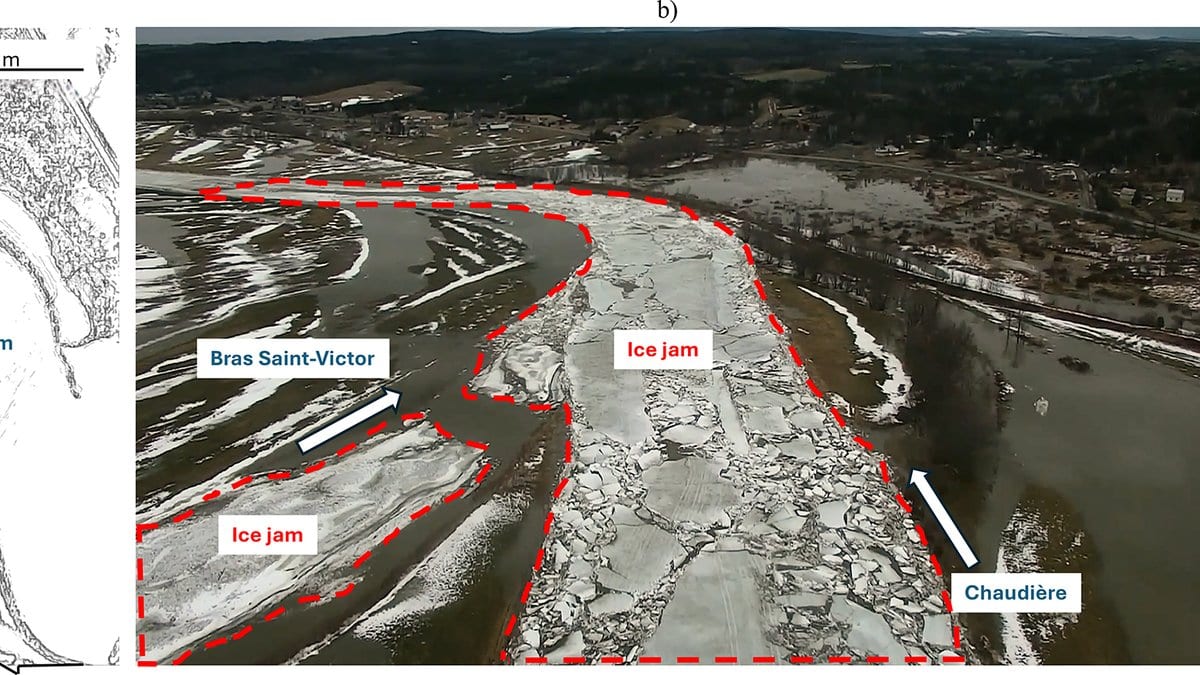
Spring on the Chaudière River does not arrive quietly. The ice cover breaks into slabs, the slabs start moving, and where a tributary empties in they can stop moving all at once: a plug of broken ice that dams the channel and pushes water over the bank and into whatever is standing on it. Quebec's 2019 spring breakup, including the events on the Chaudière, cost an estimated CAD 438 million in government spending. Those events are what directly prompted the peer-reviewed study published Tuesday in Natural Hazards and Earth System Sciences.
How a confluence jams was worked out in detail long before that, indoors. Working from a small-scale hydraulic model built to mimic real junctions, Ettema and Muste described in 2001 seven distinct processes by which ice can plug the meeting of two rivers: an ice run arriving at a stationary cover, slabs arching across the channel, ice-free flow from a tributary shoving the main river's ice aside, ice grounding on a sandbar. For three of those they went further and wrote force-balance equations: add up the drag of the water, the weight and the strength of the ice accumulation, the friction along the banks, and a jam forms when the sum tips below zero. For the rest there was not enough data to derive anything. Then nobody checked the three against a river. As the new paper puts it, "the validity of these simplified equations has never been evaluated with field data."
Twenty-five years later, Laurence Charbonneau, Tadros Ghobrial and colleagues at Université Laval went and did it. From 2021 to 2024 they instrumented four confluences: the Sainte-Anne with the Bras-du-Nord, north of Quebec City, and the rest along the Chaudière, where the Du Loup, the Famine and the Bras Saint-Victor come in. Submersible temperature and pressure sensors sat on the riverbed in sealed housings, mounted on metal plates and chained down so moving ice could not carry them off. Time-lapse cameras watched the surface, drones flew whenever a thaw or a rainstorm made ice movement likely, and Sentinel-2 passed overhead every few days. The whole four winters of measurements have been published as an open dataset.
Each confluence found its own way to jam
On the Sainte-Anne it was flow impact. The Bras-du-Nord cleared its ice first every year (smaller tributaries usually do, being steeper, narrower and warmer), and the open tributary then drove water into the main river hard enough to stop the Sainte-Anne's ice getting past. On the Du Loup it was a stationary ice cover held in place by a dam. At the remaining two, the Famine and the Bras Saint-Victor, it was the shape of the riverbed at the tributary mouth: depositional bars, islands and bridge piers that keep ice from clearing.
The Sainte-Anne is the only site where field data could be pushed all the way through a laboratory equation. Flow impact is one of the three mechanisms with a formula attached, and the confluence geometry was close enough to a case the flume had run for the comparison to carry weight. A calibrated hydraulic model of the reach supplied the velocities and stresses nobody measures on a frozen river in April. Solving the force balance for its one missing term gave bank shear stresses of 1.15 to 16.32 newtons per square meter, a range consistent with what another group has reported for Manitoba's Nelson River.
At the Famine the second testable equation (jamming on the bars and fans of sediment a steep tributary drops where it meets a flatter river) correctly identified where and when jams would form, and then got the ice badly wrong. In every year with ice thickness surveys to test it against, the thickness the equation calculates came out far below the equilibrium thickness the standard relationship gives. The authors' reading is that the calculated version carries no discharge term, while jams of this kind form at low flow, when ice grounds on the raised bed; folding discharge in is the repair they propose.
Two confluences the equations could not reach
The other two confluences could not be tested at all, and for opposite reasons. At the Du Loup the reason is a piece of engineering. The Sartigan Dam, an ice control structure built just downstream of the junction to keep Chaudière ice off the reaches below, holds a stationary ice cover at the confluence through the winter, and ice arriving from either river runs into it and stops. That mechanism is on Ettema and Muste's list, and it has no equation, not because it is too complicated to model, but because it is too plain to need one. "Due to its straightforward nature, no specific predictive equations have been developed, as it is governed by basic principles of ice transport and obstruction," the paper says. In every winter but one, the dam did not so much remove the jam as move it, upstream against its own ice cover and into the mouth of the tributary.
At the Bras Saint-Victor the problem is the opposite kind. Jams there are composites: ice released by a jam upstream travels down, catches at the next constriction and merges into an accumulation that looks like two or three of the laboratory's mechanisms working at once. One of those, arching ice runs, does have an equation, but the tributary had never been surveyed in enough bathymetric detail to build the hydraulic model the equation needs. The comparison stayed qualitative.
What four winters actually settle
By the authors' account this is the first time laboratory-derived ice-jam equations have been checked against natural conditions, and what the four winters mainly establish is how site-specific the answer is. Across the four confluences and the whole study period, most combinations of parameters correlated only weakly with whether a jam formed. The pairing that worked best (the discharge ratio between tributary and main river, set against cumulative degree-days of thawing as a stand-in for how far the ice cover has been weakened) sorts the sites onto separate trends rather than one, and the team calls that analysis preliminary; river-ice hydraulic models able to simulate a confluence at all, they note, have not been developed yet. So the practical yield is a shortlist of what to watch at a particular junction. A force balance written for a flume can survive contact with a real river where the mechanism is clean and the hydraulics are measured well enough, and on four ordinary Quebec confluences that combination came together once.