Where a Dying Algal Bloom Actually Goes

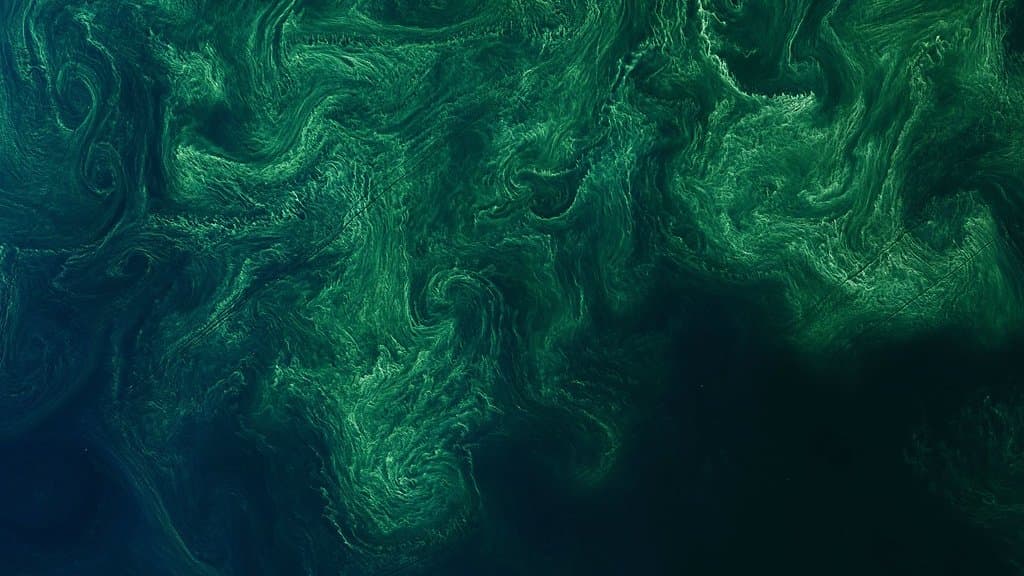
Every summer, the Yellow Sea turns green. A bloom of the alga Ulva prolifera spreads across thousands of square kilometres, the largest recurring green tide on Earth, and by the time mats of it wash onto the beaches of Qingdao, it has become a familiar emergency: crews with front-loaders, ruined tourist seasons, a mess measured in millions of tonnes. But the beaches, it turns out, get only a sliver of the bloom. Most of it goes somewhere far less visible.
A study published on 2 July in Environmental Research Letters by Hu Li, Chengxin Qin and Qian Zhao follows the bloom's death rather than its life. Where most models study how a green tide grows and drifts, this one tracks the decay phase, feeding high-frequency observations from South Korea's GOCI-II ocean-colour satellite into a Lagrangian particle model that simulates where the dying algae are carried and what becomes of them.
The split is stark. Over 90% of the surface biomass, the model finds, sinks to the seafloor within 96 hours, four days, of leaving the surface. Only about 3% strands on beaches, concentrated along the southern coast near Yantai. The rest of the sinking happens offshore, in deeper water and along oceanic fronts where currents converge. In other words, the visible crisis on the sand is a rounding error next to the invisible one on the seabed.
That downward rain of dead algae is where the study's warning lies. Dumping that much organic matter onto the seafloor in a few days delivers a concentrated pulse to bottom ecosystems, and as it decomposes, it consumes oxygen. The authors flag benthic oxygen depletion and localized nutrient regeneration as the likely consequence, an implication drawn from the modelled biomass flux rather than a measurement of hypoxia on the seabed itself. The model tracks where the carbon goes; the oxygen effect is the inference that follows.
Sources
- Peer-reviewedEnvironmental Research Letters