The Alga That Darkens Arctic Ice Was Missing From a Tien Shan Glacier

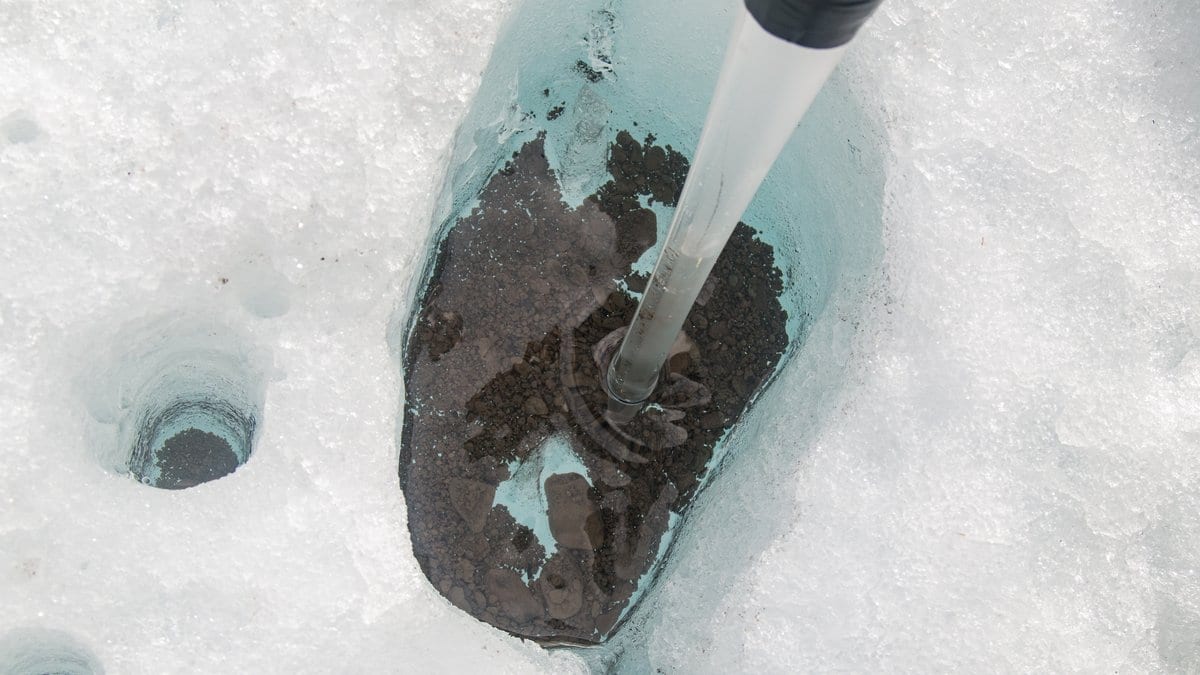
In July and August of 2013, as the snow line climbed uphill on Urumqi Glacier No. 1, a field team climbed up behind it. Five times over those two months they scraped the top centimeter of the surface into a steel scoop at six stations along the glacier's eastern branch, working from the snout in the valley up toward the ridge. What they were collecting was the glacier's living skin — the algae and bacteria that grow on ice, absorb sunlight and hasten its melting.
Polar glaciology would not have predicted this cast. It was published in The Cryosphere by Yunjie Chen of Lanzhou University, Nozomu Takeuchi of Chiba University and their colleagues. Under the microscope the samples held two algae and six cyanobacteria. Snow-covered ground belonged to a snow alga, Chloromonadinia, every observed cell of it in a dormant resting stage. Bare ice belonged overwhelmingly to filamentous cyanobacteria, thread-like cells of the family Oscillatoriaceae, and carried far more life than the snow did. Missing from every sample was Ancylonema, the alga responsible for much of the darkening on Arctic ice.
That absence is the paper's central claim, so here is exactly what produced it. The team identified organisms by eye, under a microscope, counting only cells that fluoresced with chlorophyll, the mark of a live, pigmented cell. No DNA sequencing was done. The finding is therefore that no living, pigment-bearing Ancylonema turned up at any site, on one branch of one glacier, across one melt season. It is not a genetic search of the ice, and it does not settle whether the alga is present elsewhere in Central Asia.
The contrast the authors draw is not only about who is there but about how they behave. Arctic ice darkens in blooms: Ancylonema multiplies fast as the melt season opens, then fades. Nothing on Urumqi Glacier No. 1 did that. Total biomass barely shifted from visit to visit, and where it jumped at the mid-glacier stations it jumped because snow had melted away to reveal cyanobacteria already living on the ice beneath. The authors are careful with the word: those cells were newly uncovered, not newly grown. The dark material they build is cryoconite, sooty granules of mineral dust bound together by microbial slime, and here it lies scattered across the bare ice rather than gathered into the meltwater holes typical of polar glaciers. Granules like these can survive from one summer into the next.
Why the difference? Dust, the authors argue. Urumqi Glacier No. 1 lies downwind of the deserts of western China and receives a heavy load of mineral particles; on the bare ice at the end of the season, more than 88 percent of the material the team collected was mineral rather than organic. That dust shows up in the meltwater chemistry as calcium at concentrations about 59 times those reported for glaciers in Svalbard. Carbonate dust also holds the meltwater in a neutral-to-alkaline range, between pH 7.5 and 8.5, a figure taken from earlier work on this glacier rather than measured here. Ancylonema is an organism of acidic, nutrient-poor polar ice, and those conditions may be physiologically inhibitory, the authors write. The granules may also crowd the algae out physically by leaving little clean ice to settle on. Both are proposals the study does not test.
What the study has instead is correlation. Where the filamentous cyanobacteria were most abundant, calcium, magnesium and potassium ran high and inorganic nitrogen ran low. The nitrogen link is the one to hold loosely, and the authors say so themselves: dense cyanobacterial mats draw nitrogen down as they grow, so the mats may be producing the low readings rather than profiting from them.
The consequence reaches past microbiology. Bio-albedo models, the parts of glacier melt models that account for darkening by life, were built largely on Arctic observations, on blooms that arrive and vanish with the season. If Central Asian ice is darkened instead by a stable, dust-bound cyanobacterial mat that holds the surface all summer, then applying those models here "may lead to significant errors," the authors write, and region-specific ones are needed. That matters downstream in the literal sense: meltwater from the Tien Shan feeds the rivers of a dry region.
Two things bound the result. The study measures biomass and water chemistry, not sunlight; it reports no albedo measurement and no figure for extra melting, so the darkening remains an inference from what the organisms are and how much of them there is. And the fieldwork is old. These samples were collected in 2013 and the paper appeared 13 years later, on a glacier that has been retreating for decades. What is living on that surface now is beyond what this dataset can say.
The broader pattern does have independent support: a 2022 metagenomic study in Microbiome found Asian cryoconite dominated by several cyanobacterial lineages where polar cryoconite is dominated by one. Whether Ancylonema is genuinely absent from these mountains, or only from these samples, is a question for a sequencing campaign that has not yet been run.