A Quantum Network Chip That Leaves the Diamond Uncut

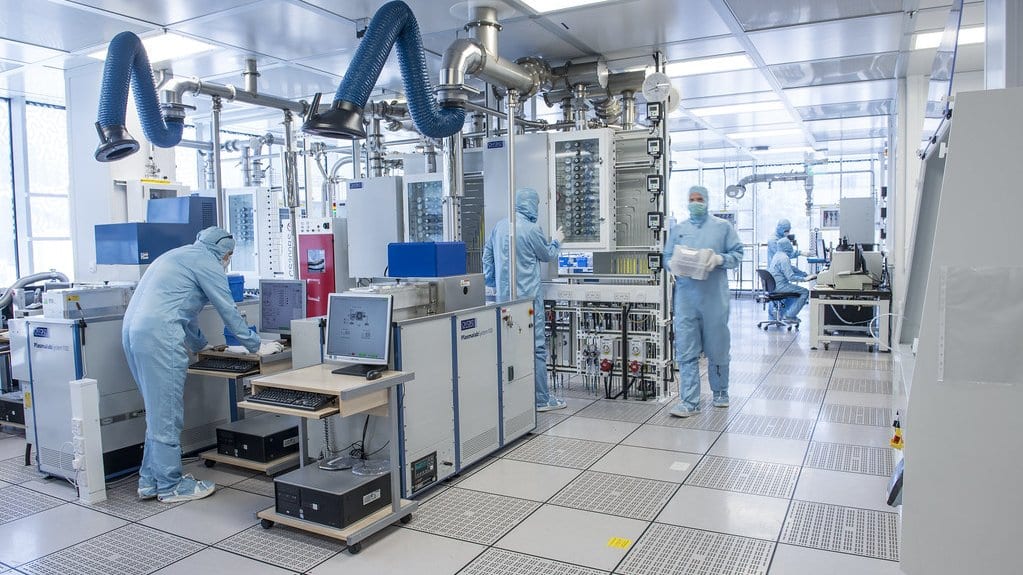
The material physicists most want to build a quantum network from is also the one they least want to cut. Diamond carries a flaw called a silicon-vacancy center: a silicon atom lodged in a gap in the carbon lattice. The flaw holds a quantum state well and emits light cleanly, which makes it a leading candidate for the job any network needs done, handing information between a qubit that stays in one place and a photon that carries it away. Carving the light-guiding structures into the diamond around it is slow, damaging work in one of the hardest substances there is.
Nicholas S. Yama, Kai-Mei C. Fu and colleagues at the University of Washington and Pacific Northwest National Laboratory, with Fariba Hatami at Humboldt University of Berlin, have a way around it: leave the diamond alone. Their paper appeared in Optica Quantum on Oct. 15, 2026.
The light-guiding circuit is etched into a thin film of gallium phosphide, a semiconductor with the strong optical response diamond lacks. The finished film is then dry-stamped onto a diamond chip whose surface is never touched. Silicon-vacancy centers sit implanted just beneath that surface, close enough for light confined in the gallium phosphide above to reach down and find them. By the team's account, that proximity is what earlier work on this pairing lacked: the gallium phosphide layer sat too far from the centers in the diamond for the two to interact strongly.
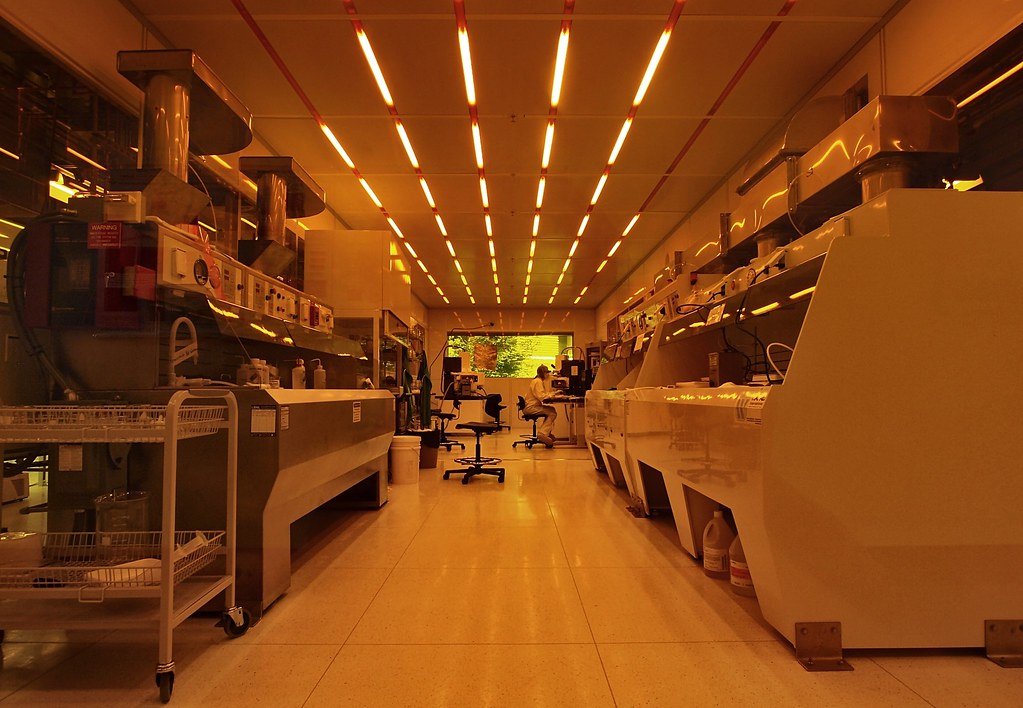
The reason to do it this way is quantity. The team made more than 600 gallium phosphide cavities on one diamond substrate at a 99.5% yield, 637 of 640 devices surviving the transfer. That number describes the move, not the physics: it counts cavities that arrived intact, not finished interfaces that work. Diamond etching does not scale like that, and it is the step this design removes.
On a completed device, the group then measured the quantity that decides whether an interface like this is useful at all: cooperativity, which compares how strongly the center exchanges energy with light trapped in the cavity against every other way it can lose that energy. Below one, a photon and the spin mostly miss each other. Above one, the exchange wins, and light scattered from the center carries off a readable answer about its spin. Cooperativity came out above one, an important milestone in the paper's own framing rather than a solved problem.
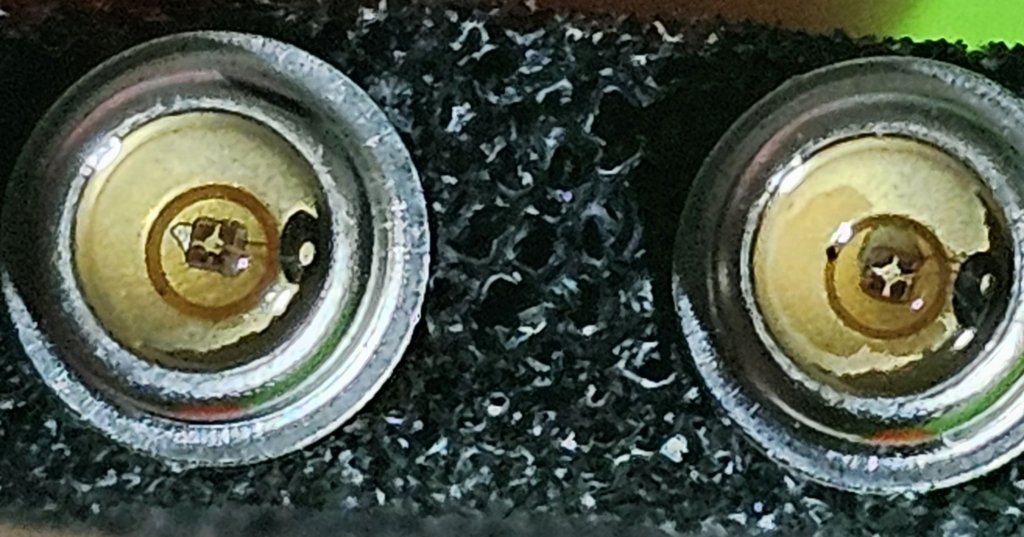
Crossing one is not a record. All-diamond cavities passed it years ago, and by a wide margin. What is new is reaching it on a platform built to be made in numbers, with the diamond left whole. The claim of a first is scoped accordingly: the first high-cooperativity coupling of individual silicon-vacancy spin qubits in a scalable, hybrid gallium-phosphide-on-diamond platform.
Cooperativity above one, together with a spin that keeps its state long enough, gave them single-shot readout: one measurement returns the spin's state, instead of many measurements averaged into an answer. That too is new only on this platform. All-diamond devices did it in 2017, at a fraction of a degree above absolute zero. This one did it at 4 kelvin, with spin-relaxation times above 0.4 milliseconds. Against sub-kelvin diamond experiments that is a brief hold on the state, and the temperature is the notable part, because that temperature is reachable without a dilution refrigerator.
What the paper does not report is a network, or any part of one. No two of these devices have been linked, nothing has been entangled between them, and no information has been sent anywhere. Optica Publishing Group's announcement of the paper names the next step: connecting two or more of them on a single chip into a larger quantum register. Yama's own framing there keeps the conditional in front. "If GaP-on-diamond proves to be a viable path forward, it could be among the most straightforward to realizing quantum networks at scale for practical applications such as secure communications and cryptography," he said.
The authors' broader claim is that gallium phosphide on diamond now qualifies as a scalable, flat platform for quantum networking, helped by the material's strong optical response. The paper is open access, which puts the whole fabrication route in front of any group that wants to copy it. The narrower claim is the one worth holding on to: the hard part of the handover, getting one stationary spin and one traveling photon to talk, works in a device nobody had to cut a diamond to build.
Sources
- Optica QuantumPeer-reviewed
- phys.org