When Silicon Qubits Are Driven Together, Their Own Microwaves Get in the Way

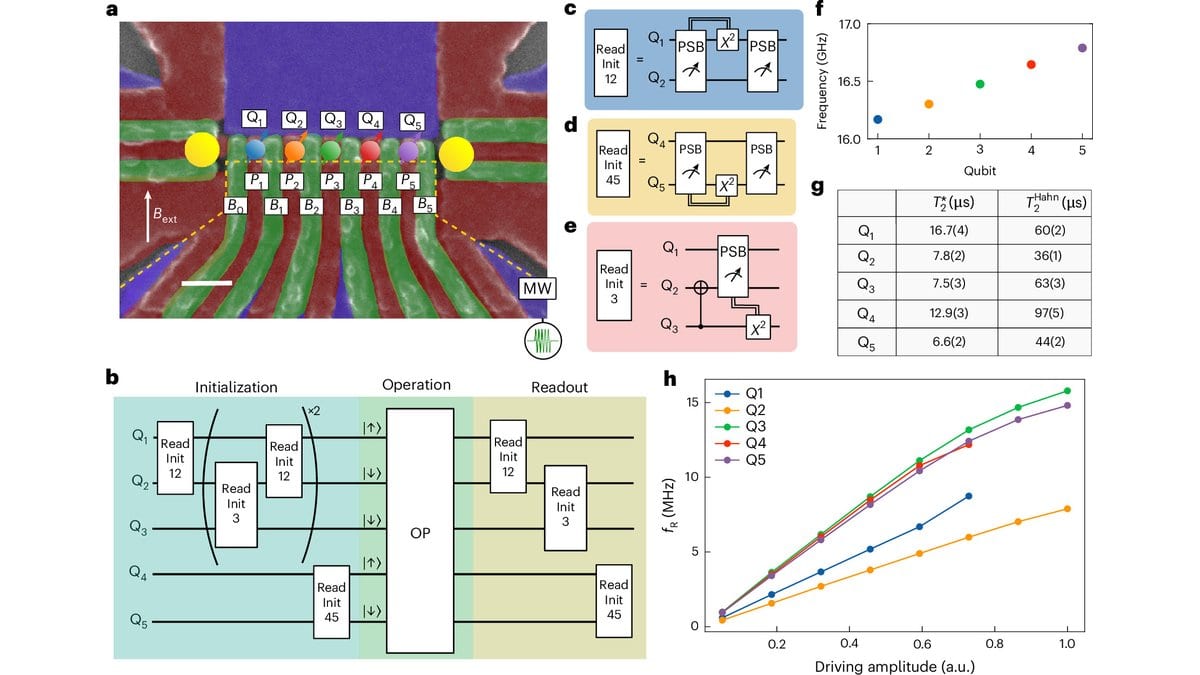
A silicon spin qubit is at its best when it is working. Left idle, the electron spin that holds the information loses track of its phase in about 10 microseconds. While a microwave field is driving it, the spin holds its phase about ten times longer. A processor built from these qubits therefore cannot afford to work through them one at a time, because the qubits waiting their turn are the ones forgetting fastest. Control has to happen in parallel. And parallel is where silicon has been losing ground: in the same silicon-germanium devices used here, accuracy has been reported to fall from 99.95% to 99.5% when only two qubits were driven at the same time, and the reason had stayed unclear.
Writing in Nature Physics on Oct. 15, 2026, Yi-Hsien Wu, Leon C. Camenzind and colleagues at RIKEN's Center for Emergent Matter Science put a name to it. Their chip is an array of five quantum dots in isotopically purified silicon that host five spin qubits, with a cobalt micromagnet on top that spaces the five resonance frequencies out so a single microwave gate can address any of them. One line, five qubits, which is the wiring economy the whole design is after. It is also where the trouble comes from.
A pulse tuned to one qubit does not stop at that qubit. The other four sit in the same field, off resonance, and an off-resonant microwave field shifts a spin's resonance frequency slightly, an effect called the AC Stark shift. A qubit whose frequency has moved accumulates the wrong phase while the pulse is on, and that phase is an error. The team separated this from the obvious rival explanation, microwave heating. Driving one qubit shifted its neighbor's frequency by about 0.8 megahertz, whereas heating accounted for about 0.2 megahertz. The shift also grew with the square of the drive amplitude, the AC Stark signature, and flipped sign depending on whether the neighbor sat above or below it in frequency. Then they canceled it. The correction is an offset applied to the microwave phase of each qubit's own next pulse. In a two-qubit test, the qubit carrying the larger shift had been the limiting one; with the correction, both cleared 99.99%.
The shortcut is to measure qubits two at a time
Because the shift is a plain frequency offset while the qubits are uncoupled, its effect on each qubit can be measured one neighbor at a time and the contributions added up. The authors checked that the addition holds, measuring the phase pushed onto the middle qubit by each of its two neighbors separately and comparing the sum against both driven together. That is what keeps the bookkeeping affordable as arrays grow. For an array of N qubits, the pairwise route needs N(N-1) measurements, against two to the power of N, minus N, minus one, for calibrating every possible combination of simultaneous drives. The first grows with the square of the array; the second roughly doubles with every qubit added.
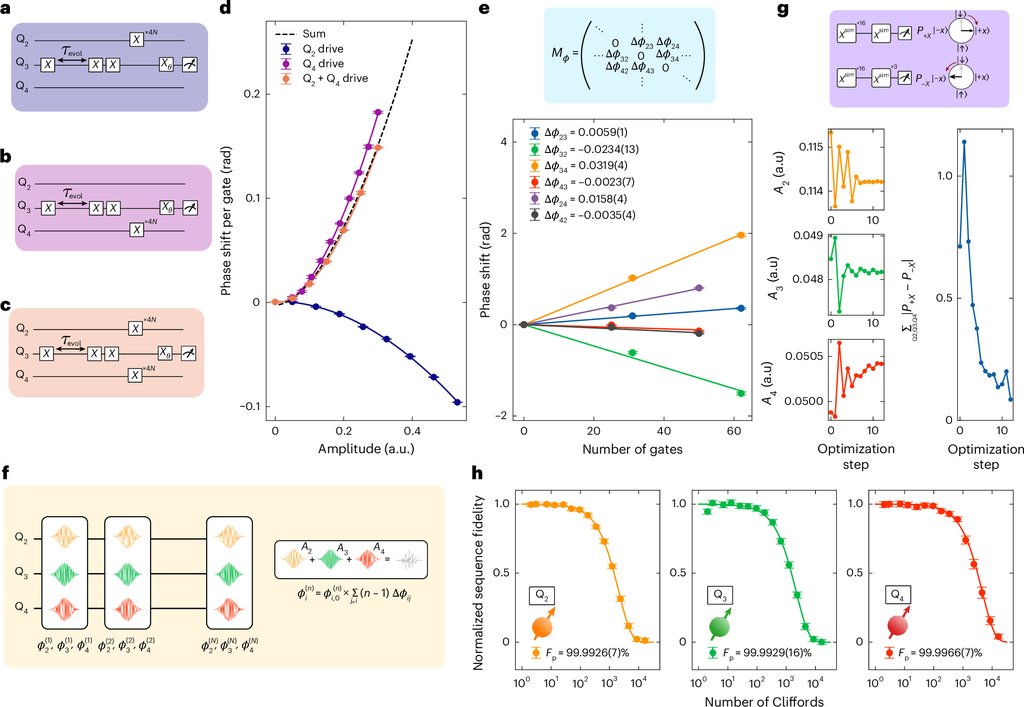
"Rather than requiring an entirely separate calibration procedure for every possible combination of qubits, our method uses calibrations between pairs of qubits to compensate for the unwanted phase shifts," Wu said in RIKEN's announcement of the work.
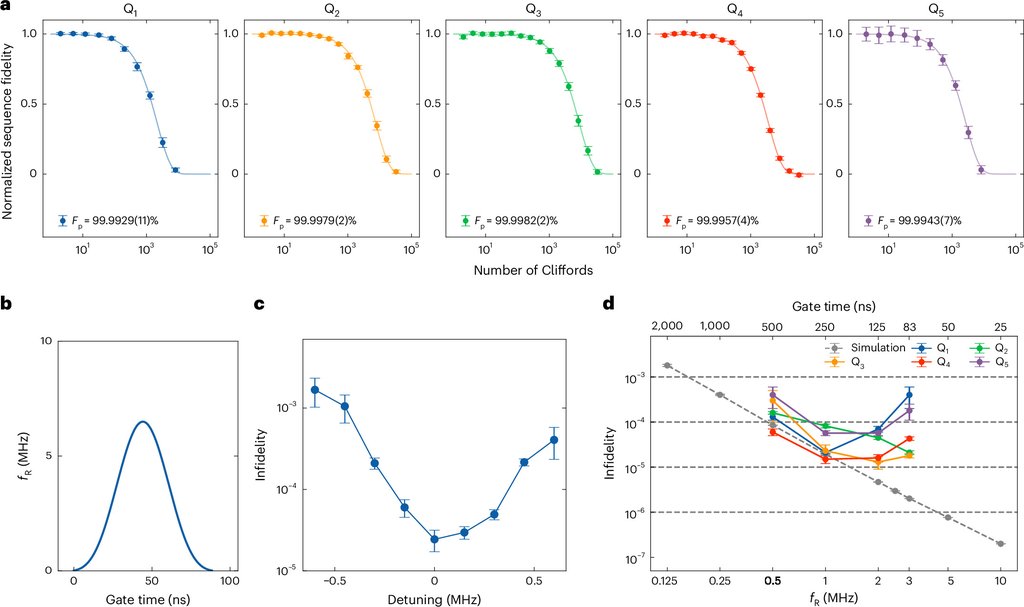
The shortcut was tested against the thing it replaces. The team also ran the full version, measuring the phase on each qubit while the other four were driven, and reports no difference in performance between the two. With the pairwise corrections in place, single-qubit gates on individually driven qubits came in well above 99.99% accurate. With up to three qubits driven together, they held there. With all five driven, four of the five held above 99.9% and the fifth reached about 99.9%, the figure usually quoted as the practical threshold for error correction. Those last two results are separate experiments, on different qubits at different speeds, and the five-qubit one needed a two-pass readout because the chip yields only three bits of information per cycle. The gap between them is the finding, not a rounding.
What that number does not cover
Every gate benchmarked here is a single-qubit rotation. A working processor needs two-qubit gates too, and this device has them. The authors put the fidelity of its CZ gates, which couple two qubits, below 97%, held down by spin-valley mixing, a silicon-specific effect that appears as the coupling between dots is turned up. Nothing in this work moves that number. The pairwise calibration does not reach it either, because it assumes the qubits are uncoupled while the microwaves are on. Two-qubit gates driven by microwaves would need a calibration of their own, the team writes; gates driven with voltage pulses instead, as here, sidestep the problem.
What is left once the phase errors are gone is a trade-off rather than a single flaw. At fast gate speeds the extra microwave power needed to drive five qubits at once increases decoherence, probably through heating or microwave-induced noise, the authors write; at slow speeds the drive is gentler, but the longer gate gives low-frequency noise more time to blur the spin's phase. "This is a limitation, but further improvements to device design could help mitigate this source of error," Camenzind said. The paper's own candidate fix is specific: simulations suggest a thinner gate stack and a narrower gap in the micromagnet would double the field gradient, which would buy faster gates at lower power and fidelities above 99.999%.
Five qubits, and the ones that would come after
Five qubits is five qubits, and useful error correction will need thousands of them. What this paper argues for is an architecture: qubits grouped into subunits of about ten, each on its own shared line. Ten is an expectation rather than a measurement. Fidelities came out much the same with gates of 250 and 500 nanoseconds, so ten qubits driven at the slower speed would draw about as much microwave power as five already draw at the faster one, which is the authors' stated basis for the number. This is also one device, built in a university cleanroom, and the authors attribute the spread between their five qubits to local fabrication, tuning and the material variability academic devices tend to have. That variability makes independent scrutiny important: the paper is open access, the referees' reports are published alongside it, and the data behind every figure are posted at Zenodo.
The case for silicon is still the manufacturing, and other groups have pushed that further by building spin qubits on an industrial chip line. "Our long-term goal is to build a fault-tolerant quantum computer based on silicon spin qubits, and reliable parallel control is an essential step toward that goal," said Seigo Tarucha, who supervised the project.
Sources
- Nature PhysicsPeer-reviewed
- www.riken.jp
- Zenodo