Why the Wind Over the Great Barrier Reef Sometimes Stays Switched off for Days

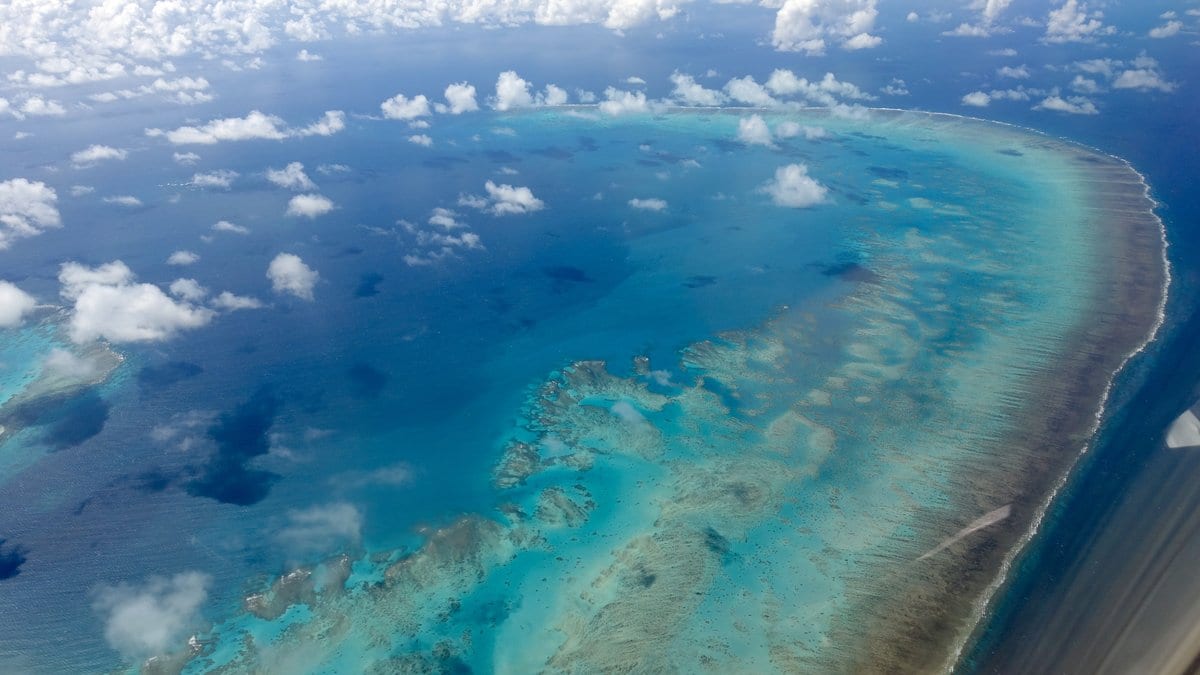
In the austral summer the trade winds come at the Great Barrier Reef steadily out of the east, dragging cooler, drier air across the shallows and pulling heat out of the water. Then, in some summers, they stop. The sea goes glassy, the cloud thins, and the sun pours into a lagoon that is no longer being stirred or cooled by evaporation. Sailors called a calm like that the doldrums. On the reef it is the weather of a bleaching year, and what decides how much harm it does is how long it lasts.
Lara S. Richards, of Monash University and the National Centre for Atmospheric Science at the University of Reading, and six colleagues set out to explain why some of those calms break after a day or two and others run for a week. Their answer, published Oct. 13, 2026, in Weather and Climate Dynamics, is a single low-pressure system passing over eastern Australia, and whether it keeps going.
That the calms begin with a Rossby wave, one of the long meanders in the high-altitude winds that circle the Southern Hemisphere, the same group established in January 2026. The low-pressure half of such a wave, crossing eastern Australia, drives westerly wind over the reef that cancels the trade easterlies. The new paper takes up the question that one left open: not how the wind switches off, but why it sometimes stays off.
The record comes from ERA5, the European reanalysis of past weather. Sorting 29 seasons, each running from December to April, by the state of the atmosphere above a single site, Davies Reef in the central Great Barrier Reef, produced 835 days of weak-wind, doldrums-like conditions. Strung into spells, they gave 155 short events of two days or less and 57 long ones of five days or more, five days being the study's own cut for a long event.
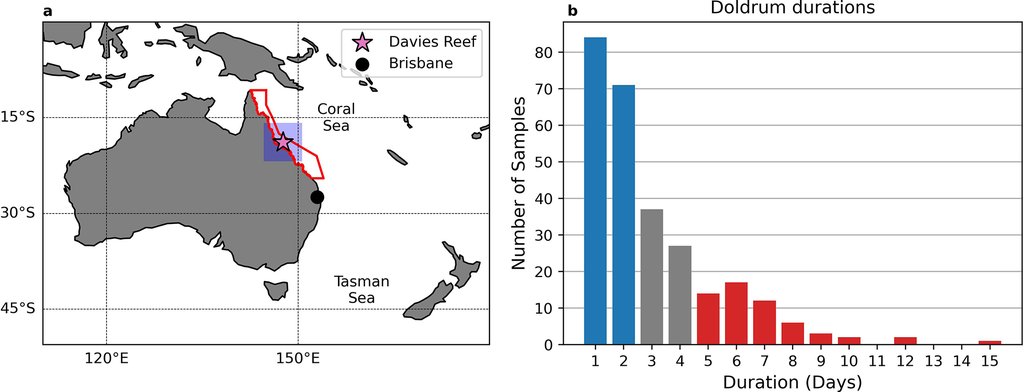
The difference between the two is motion. In the short cases the wave packet carrying the low travels east at roughly 9.6 meters per second and keeps going, and the trades return behind it. In the long cases it crawls at about 6.8 meters per second, hardly propagating at all, and the low parks over the Australian east coast, holding its westerly wind across the reef. The paper's verbs are deliberately soft, and a reader should keep them: the calms tend to cease, or tend to persist. Short and long were defined before the two groups were compared, and no significance test is attached to either speed.
What pins the low in place is the part of the work that is argued rather than measured. In the long cases the upper-level jet over Australia overturns again and again, and a blocking high sits over New Zealand on more days than in the short cases. The authors propose that the repeated overturning helps keep that block alive, and that the block in turn stalls the wave packet, a loop that leaves the reef's westerlies where they are. Their own words for it are could and likely, and no measurement of the upper flow is presented behind them. The conclusions put the length of a calm as related to the stalled low rather than caused by it. The two referee reports and the authors' reply are published alongside the paper.
The tropics have to cooperate as well. During the long calms the active patch of the Madden-Julian Oscillation, a traveling band of tropical cloud, sits east of the reef in the West Pacific, where its circulation adds more westerly wind over the reef instead of easterly. Suppressed tropical waves also linger overhead more often during the long events than the short ones, and the gap widens as the calm goes on, though none of those frequencies is tested for significance.
The second half of the paper follows the air above the reef backward in time. About 1.5 million five-day back trajectories, launched over Davies Reef on each of the 390 long-calm days, trace the dry layer that caps the reef's warm, humid surface air. It arrives from the mid-latitudes. Parcels set out high over the South Atlantic or the southern Indian Ocean and ride the jet stream east. Near southeastern Australia they turn toward the equator and sink over its arid interior, warming by about 40 °C in two days on the way down. Descent rather than rising air has also been proposed for the Atlantic doldrums. The trajectories cover the long events only, and dry intrusions were identified on roughly a quarter of those days aloft and a third nearer the surface.
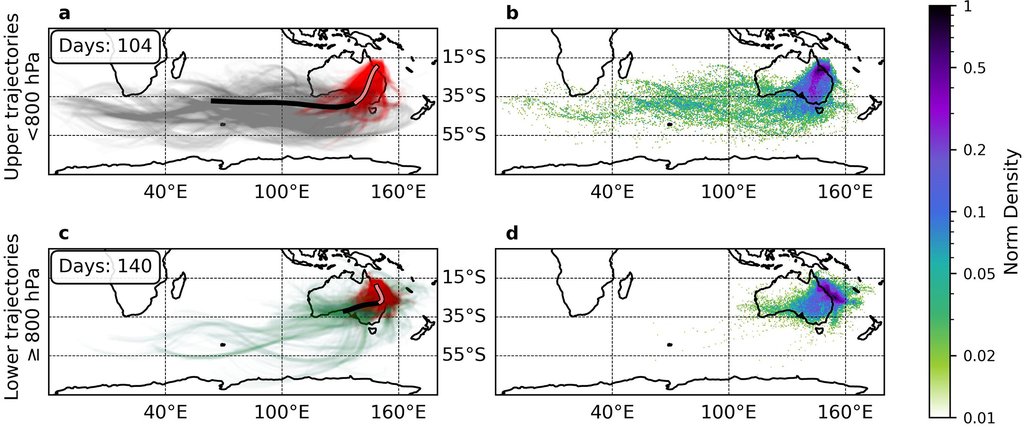
Those paths run close to the ones mapped for heat waves around Brisbane and southeast Queensland, which is where the paper reaches past the water. Dry air capping a hot, humid surface layer suppresses deep convection and lets heat build for days over land as much as over sea. The authors are explicit that they did not test that link, and that the reef's calms have not been connected to land heat waves in the region before. They offer the shared pattern as further support for earlier work finding that marine and terrestrial heat events have the same drivers.
The paper's own reef statement is a list of bleaching years: 1998, 2016, 2020, 2022 and 2024, each showing evidence of repeated doldrums. It carries no bleaching, mortality or water-temperature figure of its own. The study is deliberately weather-scale, and the authors list El Niño among the influences they did not examine. If the length of a reef calm turns on whether a low stalls over eastern Australia, then the makings of a reef heat event are features forecasters already watch over the continent. The caveat the authors themselves raise first sits underneath all of it: every day in the record was classified from one midnight profile at one reef, so some of these spells are probably longer than the record says.