Most Fish Sampled off Oman's Sohar Coast Carried Plastic Particles
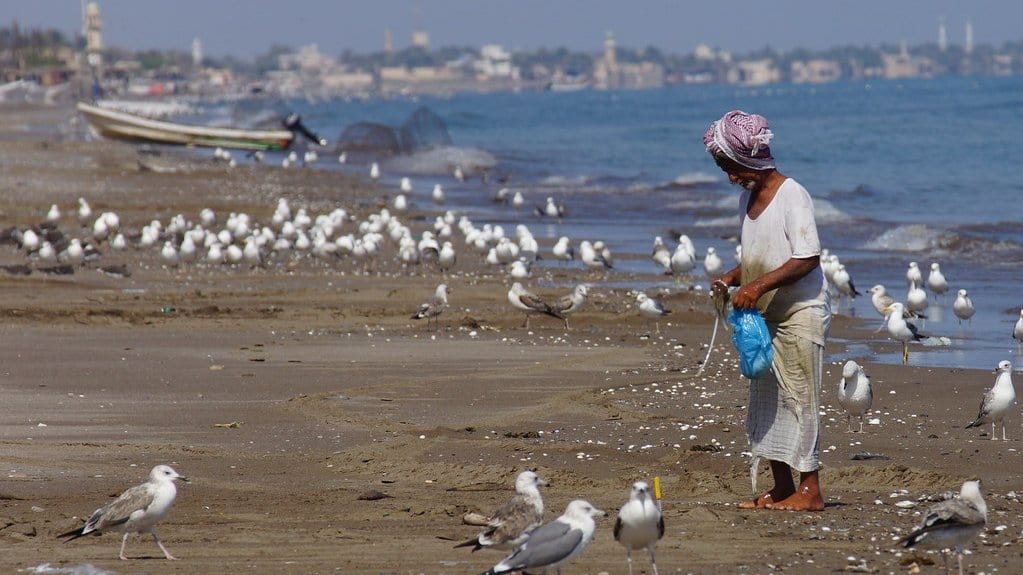
Two marine scientists at Sultan Qaboos University report finding plastic particles in 79.2% of 120 food fish examined from the Sohar coast of the Sea of Oman.
Iman Al Kharusi and Sachinandan Dutta, of the university's Department of Marine Science and Fisheries, write in Scientific Reports that information on plastic in commercially important fish from the Sea of Oman remains limited, and they present the survey as a baseline for the region. It counts particles in fish tissue and tests nothing about people who eat the fish.
The fish were bought after landing at Sohar fishing harbor: Epinephelus areolatus, Lethrinus microdon, Nematalosa arabica and Rastrelliger kanagurta. The gut and the gills were digested in an alkaline solution, and the particles left behind were picked out under a microscope and run through infrared spectroscopy to match each one to a polymer. Fibers were the most common shape, most particles measured under 2 mm, and polyester was the polymer matched most often, ahead of polypropylene.
Across the fish examined, the average was 2.63 particles per individual, with variation between individuals almost as wide. Between two thirds and nine in ten carried at least one, depending on the species.
Total abundance did not differ significantly among the four species, although the concentration in the gut did, and the difference between gut and gills was significant in only two of them, E. areolatus and R. kanagurta. They report no significant association between the amount of plastic in a fish and its habitat group, its sex, or its length and weight. Condition factor, a weight-for-length index, showed none either.
Al Kharusi and Dutta write that the dominance of fibers and polyester points to fibrous synthetic materials as an important part of this exposure, and that polymer identity alone cannot establish where the particles came from; they call for fish to be assessed alongside seawater and sediments. The work was funded by a MoHERI grant in Oman. Scientific Reports published the paper Oct. 17, 2026 as an accepted manuscript, which will be replaced by a final edited version.
Sources
- Scientific ReportsPeer-reviewed