Warming Could Push Northern Peat Fires Deeper Into the Ground

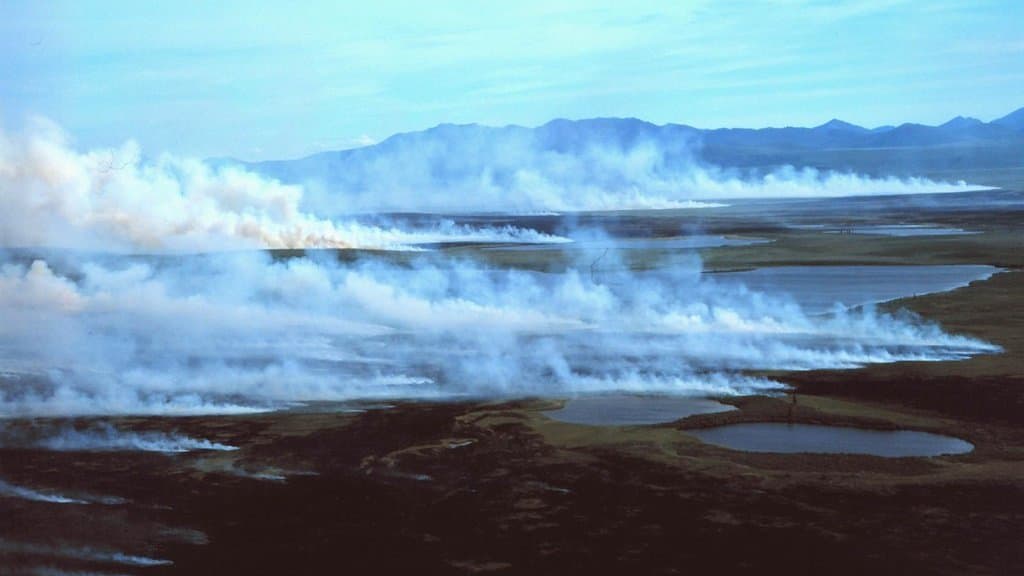
Set fire to a peatland and the flames are the least of it. Below the surface, in ground built from plant matter that never fully rotted, the burning keeps going slowly and without flame. It works down through layers that took thousands of years to lay down. How much northern peatland will burn that way as the climate warms, and how deep the burning will reach, is the question behind a new set of projections.
Peat forms where the ground is too wet for dead plants to rot away. Dead plants pile up instead, layer on layer, and the carbon in them stays put for as long as the water does. The paper's phrase for what is held down there is "vast stores of ancient carbon."
Paul A Moore and colleagues at McMaster University and Nipissing University, in Ontario, set out to put a number on how sensitive that slow burn is to a warming climate. Their paper went online Sept. 17, 2026, in Environmental Research Letters. It is an accepted manuscript, the version that has cleared peer review but not yet had its final edit. What it offers is a projection built from models, not a measurement of anything that has happened.
The paper names three pressures, all of them rising: higher temperatures, thirstier air and more frequent drought. Each dries the peat out, and dry peat burns deeper. Turning that into numbers took a chain of models. Satellite records of burned area trained a machine-learning model, one for North America and one for Eurasia, to predict how often a landscape burns from its land cover and its climate. Climate models supplied the future weather across several emissions scenarios. How deep the fire could reach came from simulated moisture inside the peat, worked out with a soil-water model called Hydrus-1D and run with different starting water levels, drying times, evaporation rates and peat types.
The projected change in how much burns is modest, and the authors call it that: a "moderate increase," from 2.75 million hectares a year in the present-day run to between 3.2 and 3.6 million hectares a year at century's end, depending on the scenario. Both of those numbers come out of the same chain. The present-day figure is not a measurement of what burns now; it is what the model says burns now, which is what makes the comparison a fair one.
Emissions rise faster than the burned area does, because the fires also go deeper. Smoldering carbon emissions climb from a modeled 35.8 million metric tons of carbon a year today to a projected 47.5 to 55.3 million metric tons a year by the end of the century. Those are tons of carbon itself, not of carbon dioxide; the two are different quantities and do not convert one for one.
The two continents do not contribute equally. Eurasia is estimated to account for about 70% of northern peatland smoldering emissions, and the reason is not that its fires burn deeper. Modeled burn severity, which is how deeply the ground burns, came out much the same on both sides. Eurasia has more peatland, and a larger share of it burns in an average year.
The paper's most quotable sentence is also its most carefully written one. The authors write that their end-of-century findings "suggest that, regionally, peatlands have the potential to flip from a net carbon sink to a net carbon source under a high emission scenario." Four hedges sit in that one line, and none is decoration. A sink is ground that takes in more carbon than it gives off. The claim is not that northern peatlands as a whole stop being one. It is that in particular regions, and on the high-emissions pathway, the balance could turn. The model raises it as a possibility, not as an outcome it settles.
That is why the paper ends up arguing about models rather than about peat. The authors' case is that peat burning belongs inside the models used to project the climate. Building it in, they write, would narrow the uncertainty in those projections and help guide efforts to keep the world's peat carbon where it is. Until it is, the projections leave out the part of the fire that never shows.
Sources
- Environmental Research LettersPeer-reviewed