The Thirst of the Air: What Drove Europe's Worst Fire Year Since 2006

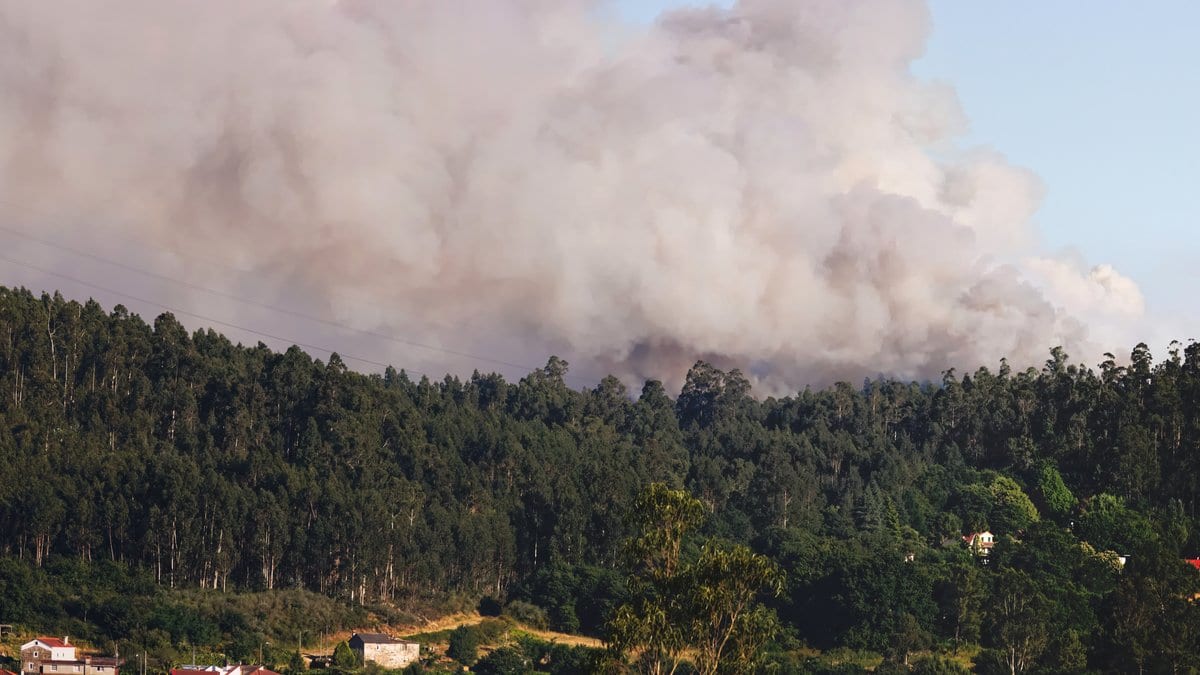
In the first week of April 2025, moorland in western and northern Britain was burning, weeks before the start of the fire season in southern Europe. By August, Galicia had suffered the largest wildfire in its recorded history, and fires in Türkiye had forced tens of thousands of evacuations. Across the European Union and 11 neighboring countries, the year burned more than 1.4 million hectares, the largest area since the EFFIS satellite record began in 2006.
What links a spring drought on a British moor to an August firestorm in Galicia is not obvious, and it is the question a team led by Theodore Keeping, of Imperial College London's Centre for Environmental Policy, set out to answer. Writing in Natural Hazards and Earth System Sciences on August 13, after open discussion and review by two anonymous referees, Keeping, the climate scientist Friederike Otto, and colleagues take five regions that burned hard in 2025 and ask something narrower than whether climate change caused the fires: which ingredient of fire weather has actually moved? The five are northwestern Iberia, western and northern Britain, Occitania in southern France, the eastern Adriatic and Ionian coasts, and northern and western Türkiye, a deliberate spread across fire regimes that behave nothing alike.
Fire weather is a compound of heat, dryness, and wind, and large-scale studies usually collapse the three into one number. That is useful for comparing continents and poor at telling a regional planner what changed; the Canadian Fire Weather Index, the most widely used of them, gives a single score and not a diagnosis. Keeping and colleagues took the compound apart instead, tracking each driver separately in each region, and adding vegetation and land-use trends alongside the weather.
The driver that stands out is vapor pressure deficit, or VPD, a measure of how hard the atmosphere pulls moisture out of soil, leaf litter, and living plants. Warm air can hold far more water vapor than cool air, and the relationship is exponential, so each additional degree widens the deficit faster than the one before it. Wind, by contrast, shows minor and uncertain trends. "Changes in VPD are the main reason why combined hot, dry, and windy conditions have become more frequent than expected from natural variability," the paper concludes.
Where that signal has already stepped outside the range of natural variability depends on what you look at. In ERA5-Land, the observation-driven reconstruction of past weather that the team used as its record, extreme weekly VPD has emerged from natural variability in all five regions. In the study's headline synthesis, which weights that record together with climate model ensembles, emergence holds in three of the five: northwestern Iberia, the eastern Adriatic and Ionian, and northern and western Türkiye. Over Britain and Occitania, the models do not reproduce the trends the observations show.
Britain is the sharpest case. Its 2025 fire peak came in the first week of April, in a spring fire season driven by drought rather than by summer heat, and the study finds no significant trends there in weekly VPD, wind speed, or hot-dry-windy extremes at the 95 percent confidence threshold. The reanalysis on its own does show a statistically significant rise in the likelihood of conditions like 2025's.
For Occitania, the reanalysis makes fire-weather extremes of the kind 2025 produced roughly 460 times more likely than they would have been in a climate 1.3 degrees Celsius cooler. The authors use that cooler counterfactual representing the late nineteenth century. The same comparison run through the climate models gives 2.2. Wherever the two are compared in the paper, the reanalysis gives the larger number.
The authors do not read that as a reason to doubt the observations. Regional models in the EURO-CORDEX ensemble, and the global CMIP6 models behind them, are known to underestimate summer warming over Europe. The shortfall is traced to how they represent the continent's fall in aerosol pollution, since cleaner air has let more sunlight reach the ground than the simulations allow for. Their synthesized attribution, the authors write, "can therefore be taken as a conservative estimate."
In northwestern Iberia, maximum daily vapor pressure deficit stayed near or above 3,000 pascals for 16 days before the fires took hold, the kind of sustained draw that empties dead fuel of moisture.
Not every one of the five had a record year. France's 2025 was its third most extreme year, though it produced the largest French wildfire in 75 years, and Türkiye's was its second worst. Spain and the United Kingdom did record their highest burned area since the EFFIS series began. Britain's spring drought comes out at roughly a one-in-140-year event, with a confidence interval so wide it runs from about two decades to several thousand years. The short fire record is part of the problem: The EFFIS record begins in 2006 and gives, in the paper's words, "limited insight into whether recent fire seasons are truly unprecedented beyond the very recent past."
The work is funded by the Bezos Earth Fund, and one co-author is on the journal's editorial board. The paper says the review was handled by an independent editor.
For fire services in Galicia and prefectures in southern France, the result is a region-by-region account of which part of fire weather has shifted, by how much, and how confidently that can be said.
Sources
- Natural Hazards and Earth System SciencesPeer-reviewed