How a Hot Year or a Volcano Can Reset the Climate's Political Clock

The physics of climate change runs on decades and centuries. Politics runs on the last hot summer. A new modeling study asks what happens when you wire the two together and let the short clock start interfering with the long one.
James Gilroy Larson of Colorado State University, with Patrick Keys of Boston University, Frances Moore of the University of California, Davis, and Jesse Burkhardt of Colorado State, built a model that is unusual in what it couples. On one side sits a physical climate model of the kind that turns emissions into temperatures. On the other sits a social model: a representation of how public opinion forms, how that opinion translates into support for cutting emissions, and how that support feeds back into policy. The two halves talk to each other, so a wiggle in the temperature record can ripple forward into the emissions pathway, and vice versa.
The point of the exercise is that natural climate variability is noisy. Even with a steady long-term warming trend, individual years and decades run hot or cold for reasons that have nothing to do with policy: internal ocean-atmosphere cycles, the occasional big volcanic eruption throwing a veil of cooling particles into the stratosphere. The question the authors put to the model is whether that noise, filtered through human perception, leaks into the century-scale outcome.
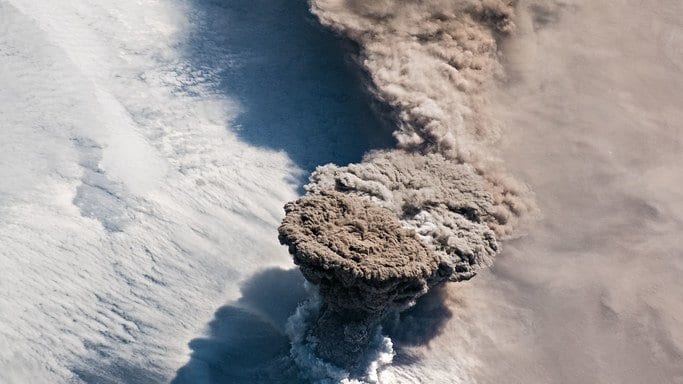
It does. When the model happens to serve up a spell of anomalous mid-century warmth, public support for mitigation strengthens, and the world reaches net-zero several years earlier than it otherwise would. Run it the other way, with a cooler stretch or the temporary chill of a major eruption, and support slackens, pushing net-zero later. Volcanic cooling produced the sharpest effect in their runs, delaying the emissions target by nearly a decade. A quiet climate, in this telling, can breed complacency at exactly the wrong moment.
There is a broader pattern beneath the individual cases. Climates with more year-to-year variability, the study reports, tend to land on higher emissions pathways and run a greater risk of failing to reach net-zero at all by 2100. The steadier the temperature signal, the easier it is for public resolve to hold; the noisier it is, the more that resolve gets buffeted by weather that has little to do with the underlying trend.
The result is provocative precisely because it treats human response as part of the climate system rather than as a fixed external dial. But that framing is also why it warrants care. The heart of the finding is a claim about society, how people read the weather and how politics converts that reading into emissions, rather than a claim about the atmosphere or ocean. The causal chain it traces, from natural variability to perception to policy to the timing of net-zero, is long, and every link carries its own uncertainty. This is a modeling result, not a measurement, and the social half of the model rests on assumptions about human behavior that are far harder to pin down than the physics.
Sources
- Environmental Research LettersPeer-reviewed