Wood Smoke Does Not Just Carry Smog Ingredients. It Makes One

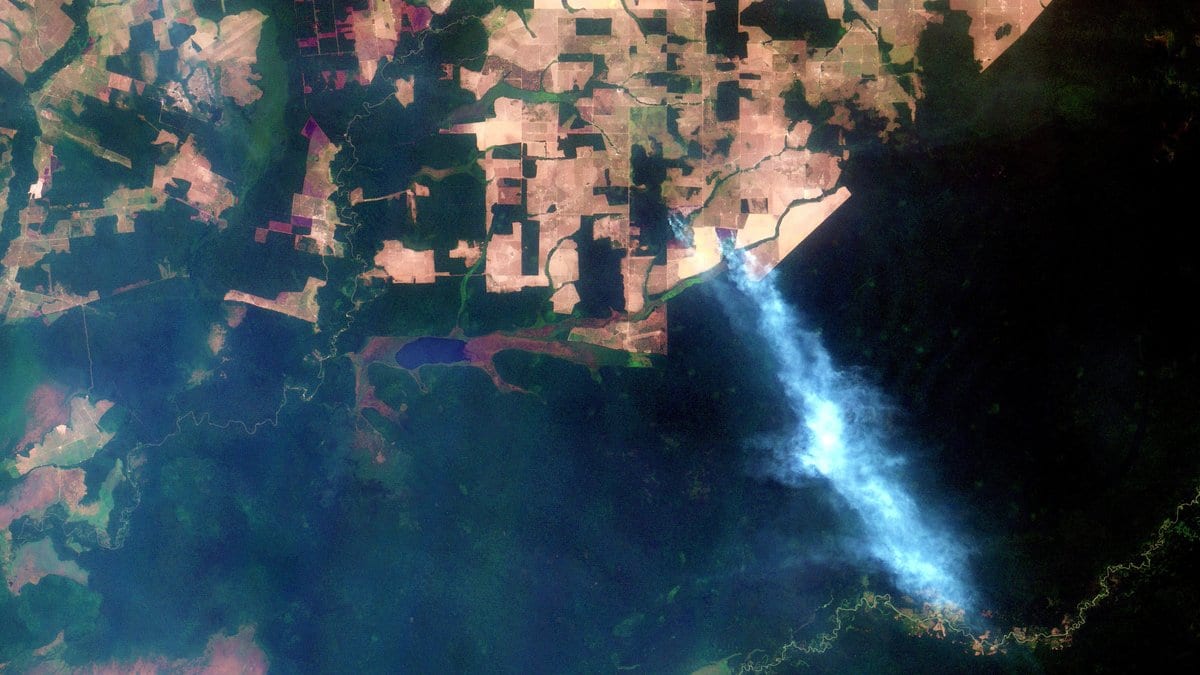
Fly an instrumented aircraft through the smoke of a large wildfire, and you find more of one gas than the chemistry allows. Nitrous acid shows up in smoke plumes hours and even days downwind of the fire, long after direct emissions should have run out, and in quantities that known reactions do not come close to producing. Something inside the aging smoke is making it. For years nobody could say what.
A team at the Paul Scherrer Institute in Villigen, Switzerland, now has a candidate, and it points at the part of smoke that gives smoke its color. Fengxia Bao, Markus Ammann and colleagues at ETH Zurich and Nanjing University published the work in Science Advances on Nov. 11, 2026. Brown carbon is the light-absorbing organic material that makes smoke look brown, and they report that it does more than sit in a particle beside the nitrate that accumulates there. Nitrate builds up in an aging plume, a product of the fire's own nitrogen oxides. Under light, brown carbon hands the nitrate an electron, and nitrous acid comes off as a gas. Nitrous acid matters because sunlight breaks it apart into hydroxyl radicals, the fragments that start most of the chemistry making ozone and haze.
What went under the lamps was not whole smoke, and the distinction sets how far the result reaches. Beech wood was burned in the stove facility of the Atmospheric Simulation Chambers and Reactors at the institute, and the smoke was pulled onto quartz filters during the smoldering phase. The team washed those filters with pure water, kept the organic material that dissolved, and spread the solution as a thin film inside a glass tube with air flowing through it. Two simpler stand-in compounds, benzophenone and 3,4-dihydroxybenzaldehyde, were run beside it. The film has roughly the surface-to-volume ratio of a coarse smoke particle, the authors argue, and they state their own limit: the conclusions are "robust within the context of smoldering-phase emissions from beech wood combustion," which is one tree species and one phase of one fire.
Take away the hard ultraviolet and the nitrate goes quiet
The cleanest evidence came from removing light rather than adding it. Nitrate absorbs ultraviolet strongly only at short wavelengths, so the team filtered the lamps to cut those out. In the sample with no brown carbon, nothing happened that the instruments could see: nitrous acid (HONO) and nitrogen oxides both stayed below the detection limits. In the sample with brown carbon, both appeared. Under the fuller lamp setting, the smoke organics roughly tripled the rate at which nitrate turned into gas compared with nitrate alone.
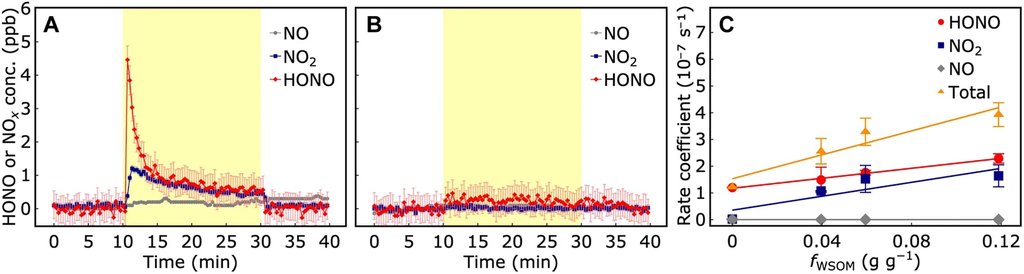
The chemistry the authors propose begins with brown carbon absorbing light and ejecting an electron into the water around it. Nitrate is an efficient scavenger of loose electrons. It takes one, breaks down to nitrogen dioxide, and that in turn gains an electron and a proton to become nitrous acid. Chemists call the overall conversion renoxification, nitrate turned back to gas. One step the paper deliberately leaves open is which excited state of brown carbon releases the electron; the published literature is split between two, so the authors write that equation from a generic excited state, "without ascribing it to either."
The global numbers are arithmetic over someone else's model
Bao and colleagues fitted a straight line through their laboratory rates and applied it to output fields that a global atmospheric model, GEOS-Chem, had already produced for 2018. This is the point where such work is usually oversold, and the paper is careful: the global figures are arithmetic laid over an existing model run, and the authors describe them as a first-order estimate of the pathway "rather than an implementation of the mechanism in the GEOS-Chem chemical solver or a simulation of atmospheric HONO concentrations."
On that basis, the estimate is that brown carbon lifts surface nitrous acid production about fivefold worldwide, with wide scatter around that average. The factor approaches ten in a handful of places: the Amazon Basin, Africa, Southeast Asia and parts of northern India and eastern China, where burning is frequent and the air is hot. Ten is the regional ceiling rather than the typical value, and it sits well above the threefold the flow tube measured.
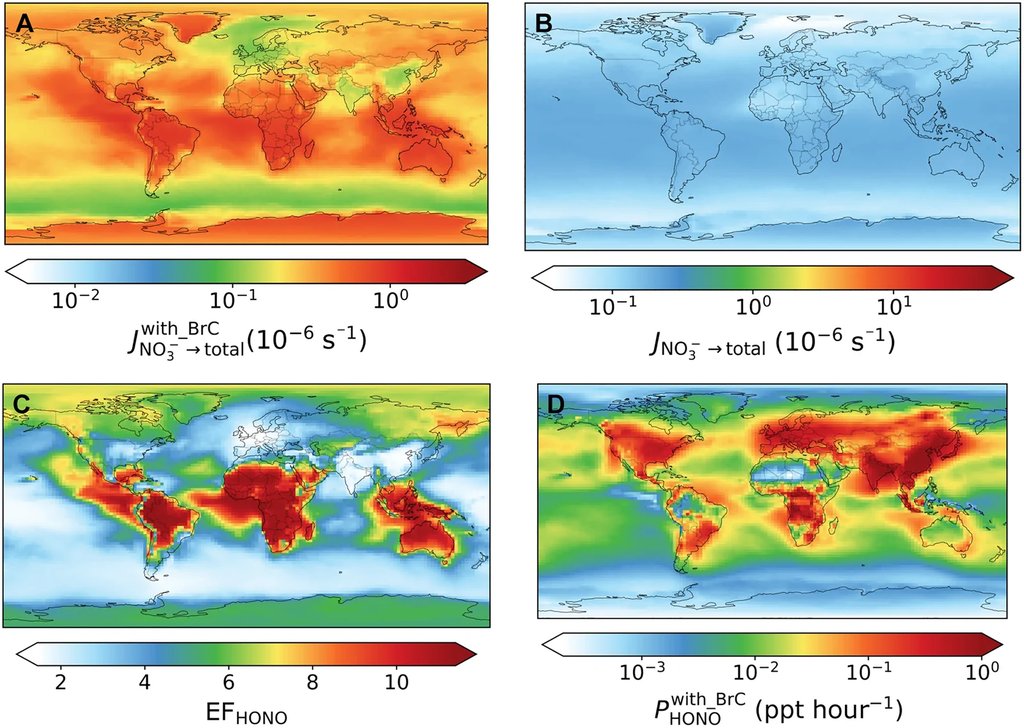
The paper's other headline number, surface production above one part per trillion an hour where particles carry plenty of nitrate, reads larger than it is. It is a global annual mean, and the paper puts it in proportion itself: measurements find tens to hundreds of parts per trillion an hour in ordinary daytime air, and of order ten thousand inside a wildfire plume, so an annual mean "falls well below these local rates."
The wildfire flights still find far more
The most informative test in the paper is the one that does not flatter it. The team applied the same relationship to aircraft transects flown through real wildfire plumes, using the nitrate and organic fractions those flights measured. Adding brown carbon raised the predicted nitrous acid production by a factor of 8.2, which sounds decisive until you see what it is closing: the gap between prediction and the source the flights inferred narrows from roughly a factor of 700 to a factor of 86. The pathway accounts for a slice of the missing nitrous acid and leaves most of it unexplained. It did track aged plumes much better than fresh ones, which is what a mechanism that builds up as smoke ages should do. The authors note that both sides of the comparison carry uncertainty, and they settle on calling the global figure "a conservative first-order estimate of this pathway."
The direction of the effect has support from outside the group. In Environmental Science & Technology, Ruifeng Zhang, Yong Jie Li and Chak K. Chan report enhanced nitrous acid production when they illuminated nitrate together with organic material from fir-wood smoke. Their paper appeared online Oct. 19, 2026, from a different laboratory using a different technique on different wood. Their enhancement is smaller, and it does not keep climbing: above a certain ratio of organic material to nitrate, the production fell away almost completely. The mechanism has now been seen twice; its size in real smoke has not been settled.
What the work puts in a modeler's hands is a usable number for a step that had none, and that is what the authors ask for. They close on a wider claim: beyond the immediate harm fires do, this work "highlights their long-term effects on air quality and climate through the long-range transport of emissions and reactive species."