A Warmed Southern Ocean Cooled Back in 40 Years. The Ice Took Centuries

Most climate experiments ask how much warming it takes to break something. A study of Antarctica published Nov. 2, 2026, in The Cryosphere asks the question from the other side: give the heat back, and what returns? Pierre Mathiot and five colleagues at the Institut des Géosciences de l'Environnement in Grenoble, France, built a model in which the Southern Ocean and the Antarctic ice sheet hand each other new information once a simulated year. They shoved the atmosphere abruptly to conditions typical of the year 2300, held it there for 55 years, set the air back to the present, and watched what recovered.
The two halves of that coupled ocean and ice-sheet experiment recovered at completely different speeds. Most of the ice-shelf cavities, the pockets of seawater trapped under the floating ice, cooled back within decades. The grounding lines, where ice resting on bedrock begins to float, needed centuries. Most work on Antarctic tipping points asks where the threshold sits and how fast the forcing arrives at it. This paper starts after the forcing stops.
The push itself is deliberately violent. The anomalies come from one climate model under the highest-emissions pathway, and they arrive all at once: a far warmer and wetter atmosphere over the Southern Ocean, with stronger westerly winds. Nearly all of the September sea ice goes, dense salty water stops forming in winter, and the barrier that keeps warm deep water off the continental shelf disappears with it. Melting beneath the ice shelves rises roughly tenfold. Shelves thin by more than 200 meters in places. A thinner shelf pushes back less against the ice behind it, so the streams feeding it speed up and their grounding lines retreat inland. About half of that extra melt happens in patches the model has already worn down to its floor of 1 meter, where, in the authors' words, "there is no mass conservation".
The water came back first
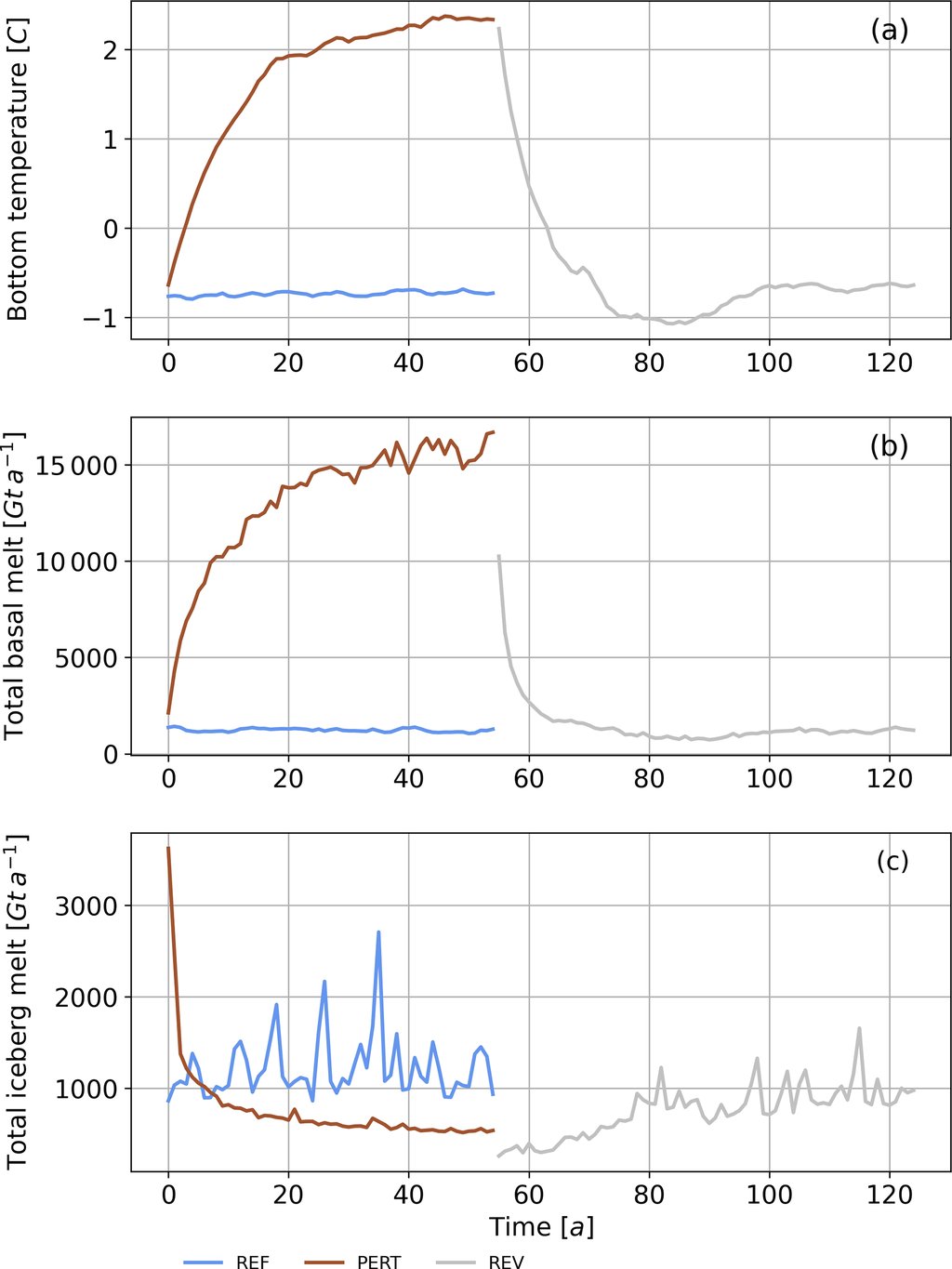
Switch the atmosphere back and the ocean turns around almost at once. Sea ice re-forms, winter freezing rejects salt again, the dense shelf water rebuilds, and the density barrier that held the warm deep water offshore returns with it. The authors report that this reversal takes approximately 40 years for most shelves, though not all: melting under Thwaites, Getz and Amery does not come back to its reference value. Two of the experiment's own conditions sit under that number. The atmosphere is restored instantly, which the team notes is not realistic, and the ice-shelf fronts are pinned in their present positions throughout, so nothing that a weakening or collapsing shelf would do to the water is in the run.
The reversible ocean is also a live argument in the literature. It matches what a different group found for the Filchner-Ronne cavity, an agreement the paper notes itself, and it cuts against two earlier model studies in which that same cavity stayed warm once it had switched. It also sits awkwardly beside a Geophysical Research Letters paper reporting irreversible transitions in cavity circulation. The perturbation methods differ across all of them, and Mathiot and colleagues write that they cannot explain the discrepancy.
The ice keeps its own time
On the ice side there are two clocks, not one. The flux across the grounding line, the amount of ice crossing each year into the floating part, takes more than 100 years to settle. The position of the grounding line takes more than 500. Only the first 125 years of that are a coupled run. Beyond it the ice model runs on its own, with the melt rate frozen at the last year of the reversibility experiment, so the long tail shows ice adjusting to a fixed ocean rather than two systems still talking.
Inside that long tail sits the number this paper will be quoted on. Fourteen ice streams, in the Ross, Amundsen, Filchner, Ronne and Dronning Maud Land basins, "appear to undergo irreversible retreat" centuries after the atmosphere was restored. That phrase has a narrow and specific meaning, given in the same sentence. Irreversibility is measured on one quantity, the volume above flotation, which is the ice that would add to sea level if it went, and a stream qualifies when there is "a growing difference in VAF between the reference and reversibility experiments over time." The gap between the run where nothing happened and the run where the heat was taken away keeps widening. It is a diverging line on a graph, not an observation of ice. Measured another way, though, the same streams look different, and the paper says so: "reversibility is dependent on both the timescale and the metrics used." On the flux metric, "With the exception of Thwaites, all the aforementioned ice streams show reversible fluxes at the grounding line" inside the 500 years. Most of them retreat inland for the first 200 years and then steady or re-advance. Seven keep going to the end, and of those the authors say only that they "might have entered a self-sustained grounding-line retreat".
The cascade that did not happen
The experiment was built to look for a cascade: could a changed ice landscape push the ocean into a second stable state and hold it there? "In our modelling framework, we have not identified circumstances in which an irreversible change in the ice landscape would cause the ocean to tip to a different stable state," the authors conclude. The next sentence of the paper is theirs as well: "However, this conclusion must be interpreted with caution." The pinned ice fronts are the reason. A shelf that weakened or broke apart would open water to the air, and what the atmosphere would then do to that water is outside the model.
Which streams the model picks out matters when the paper is read against other work. Parts of East Antarctica, including the Aurora and Wilkes subglacial basins, show signs of recovery over several centuries here, and the Aurora basin "shows no signs of instability in our simulations." A study published Oct. 20, 2026, pointed the other way, putting Aurora and Recovery among the basins likely to tip. The reason is in the design: this experiment's 55-year push strips a small fraction of the ice that would have to go before the coastal plug holding the Wilkes basin gives way. Pine Island Glacier, West Antarctica's best-known candidate for runaway retreat, does not retreat at all in these runs, which the team calls a longstanding problem in its ice model.
What the two clocks leave behind is a commitment. By the time the water in the model is cold again, the ice is still rearranging itself, and it goes on rearranging for centuries, on a handful of streams in a direction that never turns around inside the simulation. The model code and the scripts behind the figures are posted publicly; the input data stay on the lab's machines and go out on request. The next group can test the asymmetry rather than take it on trust.