Slow-Rising Bedrock Could Let Two East Antarctic Basins Retreat on Their Own
The Recovery and Aurora basins in East Antarctica can be pushed into retreat that then sustains itself, at less warming than has been thought necessary, a modeling study published Oct. 20, 2026, in Nature Geoscience reports. What decides it is how fast the warming arrives, not only how far it goes.
Jan Swierczek-Jereczek and Marisa Montoya of the Universidad Complutense de Madrid, with colleagues at the Alfred Wegener Institute in Potsdam, Germany, tested whether Antarctic sectors already known to be unstable can tip through what they call rate-induced tipping. The mechanism is a lag. As ice thins, the rock beneath it rebounds, lifting the ice clear of the ocean and holding the retreat in check. Where the mantle is stiff, that rebound is slow, and the ice can retreat onto bedrock that deepens inland before the rock catches up. Retreat there feeds itself.
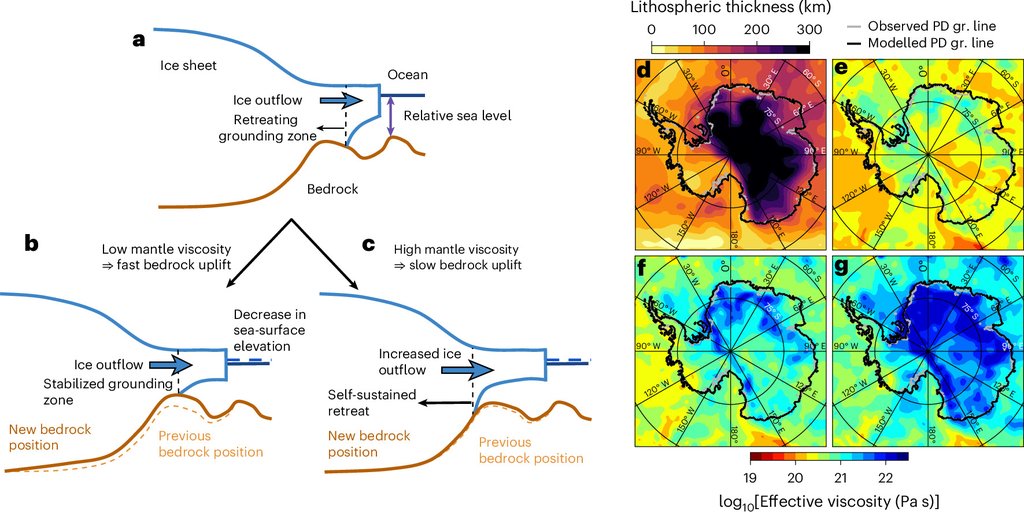
The authors report that slow bedrock adjustment weakens that brake in their model, lowering the warming at which retreat becomes self-sustaining by as much as 0.5 K, half a degree Celsius, depending on how stiff the mantle is. They coupled an ice-sheet model to a model of the rebounding bed and ran five versions of the mantle's stiffness, spanning the range current estimates allow.
West Antarctica does not do this in the model. It has a threshold of its own, but the mantle under it is soft enough that the bed keeps pace with the ice, and the rate effect came out at zero for every mantle stiffness tested. The finding applies to the two East Antarctic basins.
The rate that matters turns out to be a slow one. For the Recovery basin the effect reaches its full size at warming of about 0.07 K per century, far below the roughly 1 K per century the paper gives for the average since the pre-industrial era; the ice sheet's own response time limits how fast it can retreat, so quicker warming adds nothing. On that basis the two basins are likely to make the transition even at warming rates lower than those measured today.
Sources
- Nature GeosciencePeer-reviewed