When Melting Speeds up, Slow Bedrock Stops Protecting the Ice

Bedrock behaves a little like a mattress. Put a kilometer of ice on top and it sinks. Take the ice away and it springs back. In Antarctica that spring is a safety feature. As the ice thins, the rock beneath it lifts, the water under the floating fringe gets shallower, and the retreat slows down. The catch is that rock takes time to rise. A group at the Potsdam Institute for Climate Impact Research has now worked out what happens when the melting arrives faster than the rock can answer. The ice can tip while the melting is still below the level it could otherwise have survived.
Johannes Feldmann and Ricarda Winkelmann, with two colleagues at the institute's Earth Resilience Science Unit, published the result Oct. 28, 2026, in The Cryosphere. The paper is open access and came through the journal's public review. Their glacier is not a real place. It is a synthetic, deliberately simplified outlet glacier in a trough, built to resemble the fast-flowing ice streams that feed an Antarctic ice shelf. The ice in it is all one temperature. Melting is spread evenly under the shelf. There is no sea-level model, and the properties of the ground are the same everywhere and never change. Stripping it down that far was the point: it isolates one interaction, between the flowing ice and the deforming ground, from everything else a real ice sheet does.
They ran that glacier 16 times, once for each pairing of two properties of the ground beneath it: how readily the mantle rock flows, and how thick Earth's rigid outer shell is above it. In every run the melting was turned up punishingly slowly, by one meter a year every 100,000 years, so ice and bedrock stayed nearly in step. On a bed held fixed, the glacier began its runaway retreat once melting reached 0.8 meters a year. On the stiffest and slowest grounds, which are the kind found under East Antarctica, it held until 1.3 meters a year. On the weakest and fastest, the kind found under West Antarctica, the threshold rose by as much as a factor of ten. That last figure is an upper estimate, since for grounds that weak the authors evaluate their modeled rebound as an upper bound.
The protection has a speed limit
That is the picture when melting creeps up. The main result is about what happens when it does not. In half of the 16 runs, melting that was switched on abruptly pushed the glacier into irreversible retreat at a level it had comfortably withstood under slow change. Physicists call this rate-induced tipping, meaning tipping caused by speed alone.
The two effects point the same way. Weak, quickly rebounding ground of the West Antarctic type does not merely raise the slow-melting threshold the most. It also keeps up with a fast retreat, and across most of that part of the range it prevented rate-induced tipping outright. The early tipping belonged to the other corner. Strong, thick, slowly rebounding ground of the East Antarctic type answers a change in ice load over thousands of years or longer. Melting that climbs over decades leaves it behind, so the uplift that would have slowed the retreat arrives only after the retreat has run away.
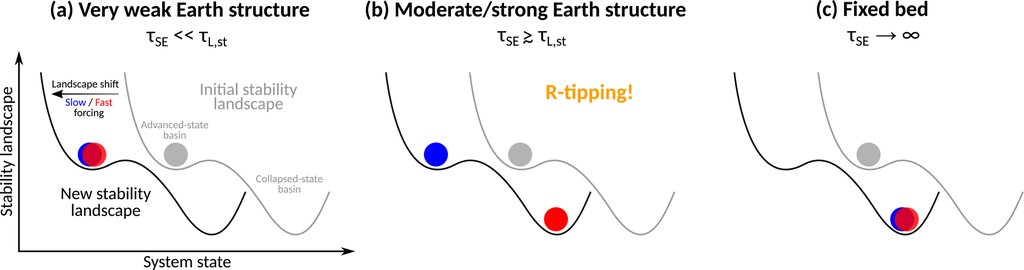
How far the threshold moves down depends on the pairing. The reduction runs 7–40% for the realistic combinations, where mantle stiffness and shell thickness go together as they do in nature. Across the full set it reaches 62%. The largest reductions, though, sit in a corner of the grid the authors themselves call rather unrealistic, so 40% is the top of the plausible range and not a typical value.
Once it starts, nothing catches it
One finding in the paper has no range attached at all. Whatever the ground was made of, and however fast it rose, the rebound never halted a retreat that had already begun. The authors write: "In none of our simulations bed uplift can stop a MISI once it is triggered," using the standard name for the self-reinforcing collapse of an ice sheet grounded below sea level. The reason is a mismatch of clocks. Once the retreat is running, the ice crosses the bed faster than any mantle in the set can lift the bed up.
How fast is fast enough
The authors' own bridge to the real world runs through West Antarctica. Warm water reaching the Amundsen Sea shelf has been warming at about 0.2 °C per decade, a figure they flag as subject to considerable uncertainty. Run through a published relation between water temperature and melting, that implies melting rising by something close to a meter a year per decade. Against the slowest increases that triggered tipping in the model, which were thousandths to hundredths of a meter a year per decade, real rates come out at least two orders of magnitude higher. That is an estimate, not an observation of tipping.
The rate idea is not theirs alone. The paper names one earlier study of it, published online Oct. 20, 2026, in Nature Geoscience by Jan Swierczek-Jereczek and colleagues. That work went the other way, modeling a realistic present-day Antarctica down to two named East Antarctic basins. The two studies agree on the part that matters here. The realistic model also finds East Antarctica more likely than the West to tip on rate, at warming rates below today's.
One corner of the set produced something stranger. Where the outer shell was at its thinnest, 20 kilometers, and the mantle beneath it stiff, the glacier never settled anywhere. It collapsed. The bed rebounded, the ice grew back over the risen ground, and the new load pressed the bed down again. Then the collapse repeated, indefinitely, under a melting rate that had stopped changing. The cycles resemble Heinrich events, the bursts of iceberg discharge recorded from the last glacial period. The authors say plainly that their mechanism should not explain those events, and that estimates for the old North American ice sheet do not match that corner.
The work hands the people who project Antarctica's future a reason to watch a quantity they do not usually track. Most projections ask how much warming the ice sheet gets. This one argues the schedule can matter as much as the total, and that whether it does turns on properties of the deep rock rather than of the ice. The glacier in the paper is a deliberate cartoon of a real one, and the study forecasts nothing about any actual Antarctic sector. What it does say is that the ground's response time belongs on the list of things that set where the threshold sits.
Sources
- The CryospherePeer-reviewed
- Nature Geoscience