On Hot Days, Delivery Emissions Grow Faster Than Delivery Orders

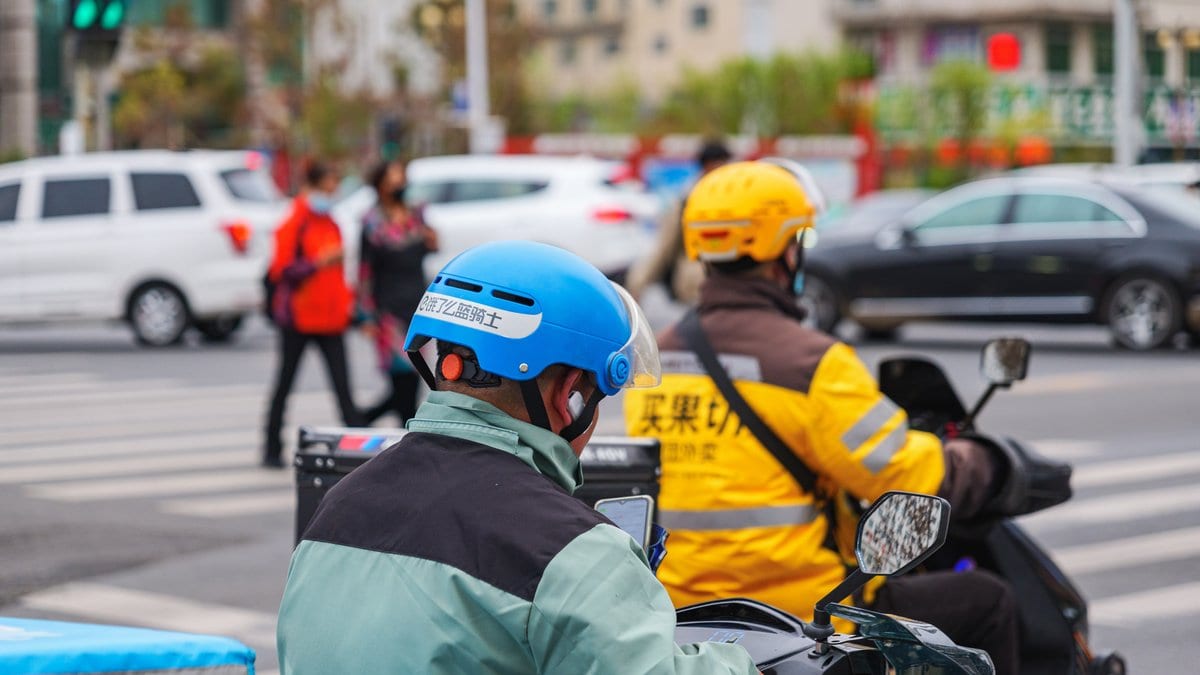
The hottest hour of a summer day in a Chinese city tends to arrive around lunchtime, which is also the hour when several million people decide what to eat. For a growing number of them the answer is to stay where the air is cooler and let someone else cross the street in the heat. It is a small decision, and an individually sensible one. It is also, a new study argues, a decision that moves a burden rather than removing it.
Fangtao Qin of the Chongqing Academy of Governance, working with colleagues there and at Chongqing University, set out to put a number on something the field had mostly described. Writing in Environmental Research Letters on Oct. 13, 2026, the team drew on order-by-order food-delivery records from 100 Chinese cities, covering 2017 to 2019 and again in 2023. The records confirm a pattern that has been seen in them before: heat shocks set off surges in delivery demand that grow out of proportion to the heat and are concentrated in the midday peaks.
That half of the picture was already on the record. A different group had published it in Nature Cities on Jan. 2, 2025, under the title "Urban food delivery services as extreme heat adaptation." Yunke Zhang and colleagues treated the midday delivery order as a form of heat adaptation in its own right. What the Chongqing team adds is the step after that one: an accounting of what those orders cost the city that fills them.
They built that accounting across the whole system, pairing each order with the last-mile trip that carries it and the packaging it arrives in. The carbon dioxide in this paper is therefore a derived quantity rather than a measured one. No instrument sampled the air above a delivery route; the figures are what the order records imply once the trips and the wrapping are counted.
The headline number is a rate rather than a total. Delivery-related carbon dioxide, the authors report, rises more than twice as fast as demand volume: whatever growth the orders show, the carbon attached to them grows by more than twice as much. That is a relationship between two curves, not a doubling of anyone's emissions, and the paper states it at the level of a city rather than a person.
The authors attribute the gap to the combined influence of the two things they count: the last-mile transport and the packaging. They also report where the gap grows wider: in cities where digital services are most widely used, where the electricity is more carbon-intensive, and where packaging standards are inefficient. It is a gap that widens with those attributes, not a league table of worst offenders.
Qin and colleagues give the imbalance a name of their own: the Urban Green Paradox, which they define as individual heat avoidance achieved by shifting burdens onto material-intensive infrastructures. That is the paper's argument in a sentence. The heat a person escapes does not leave the city's books; it moves onto the vehicles and the containers that carry the escape.
On what to do about it, the paper offers a direction rather than a result. Targeted measures, the authors suggest (among them enforcing reusable packaging and electrifying delivery fleets), could bring digital convenience back into line with the resources it consumes. That is their recommendation, offered as a pathway rather than as a finding.
What the study establishes is narrower than a prescription, and more awkward than one. A behavior already understood as heat adaptation carries a carbon cost, and that cost does not scale with the behavior one for one. It is one team's accounting, across 100 cities in one country, built out of the most mundane record a city keeps of itself: what people ordered for lunch, and when.
Sources
- Environmental Research LettersPeer-reviewed