A Mirror in the Scene, and Seven Robot Policies Finished Fewer Tasks

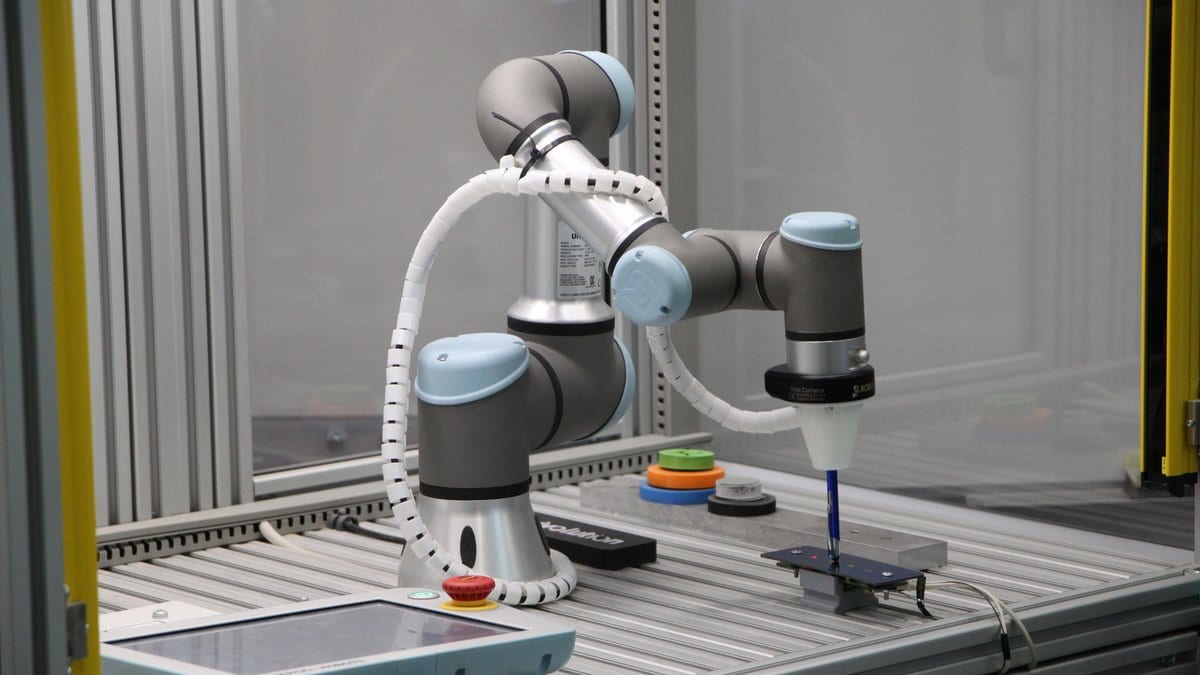
A robot arm swings out over a mirrored tabletop, lines its gripper up beside a tube, closes on empty air and lifts. The tube has not moved. Nothing failed mechanically: the arm did what its controller asked of it, and the scene the controller was looking at held two tubes, one of them a reflection with nothing in it to pick up.
Episodes like that one fill a preprint posted to arXiv on Nov. 24, 2026, which has not been peer reviewed, and in which Xuanchen Liu, Hejun Zhang and six colleagues at Peking University describe what happened when they put mirrors into a robotics benchmark and re-ran other groups' systems inside it. The benchmark they started from, RoboDojo, is a public evaluation suite for general-purpose manipulation with both simulated and real tasks and a policy leaderboard. Their mirror version keeps the tasks, the instructions, the scoring and the trained systems themselves exactly as they were, and changes one thing — the room now has a mirror in it.
Policy is the field's word for the trained software that drives the arm. Five of them were run on a shared set of eight tasks: covering blocks with cups, folding clothes, picking up an object, pressing a numbered button, inserting tubes, a swap task, stacking blocks and stacking bowls. Each was run under four scene conditions: no mirror, one upright mirror near the table edge, a pair of mirrors on adjacent sides, and a tabletop whose surface was swapped for a reflective finish. Layouts and random seeds were matched across conditions, so every comparison is a policy against its own mirror-free self and not against its rivals. The five cover three designs the field keeps apart: software that maps camera views and an instruction straight to motion, software that also predicts what the scene will look like next, and one agent that reasons between calls to robot tools.
Even without mirrors, none of the five finished more than about three-quarters of its tasks: "All five policies achieve mirror-free success rates of 60.8–72.5%, and every mirror configuration reduces their aggregate success rates," the authors write. Averaged over the three mirror conditions, the fall ran from 10.8 to 56.7 percentage points, and the biggest single drop was was Rex-M1 Preview over the mirrored tabletop: 66.7% of episodes finished without mirrors, 4.2% with one. The quantity that moved is the share of episodes a task's own scorer counted as done. Nothing crashed, shut down or refused to move, and the fall was not uniform: GPT-6 Astra, the only AI agent among the five, still finished 47.5% of its episodes in the worst condition, and the paper rules out the comparison a reader will want to make anyway. "Since execution budgets differ across policies, these aggregates should not be interpreted as a controlled cross-policy ranking," it says.
Whether the problem is the glass or what the glass shows
A mirror is also an obstacle, and the arms did hit it. To separate the obstacle from the optics, the team re-ran two of the five policies, WALL-OSS and Awomo-0.5, against non-reflective panels of matched shape and position, then looked at the episodes the mirror alone spoiled. Between 50.0% and 87.5% of those mirror-specific failures happened with no recorded contact with the panel in either run. The paper puts it carefully: "Matched panel controls show that direct collisions alone cannot explain the performance degradation." But that check didn't cover the condition with the worst results. It covers two of the five policies and only the single- and dual-mirror conditions; for the mirrored tabletop, the condition that caused the biggest drop in simulation, and, as the real-arm tests later show, complete failures on one task. "No corresponding control is used for the mirrored tabletop."
What the trajectories showed instead
Based on contact logs and recordings of the arm's movements, the authors describe the failures cautiously: "Behavioral diagnostics reveal patterns consistent with phantom targeting and spatial mislocalization." Phantom targeting is their name for a policy aiming its actions at a reflected object; mislocalization is reaching for the real one in the wrong place. Neither is presented as established. In a dedicated grasping diagnostic over a mirrored tabletop, the gripper of one policy, VPP2, closed and lifted with nothing inside it in 95.6% of episodes, against none at all on the same tasks without the mirror: "almost every mirrored episode contains closing and lifting without enclosing the physical target." Astra's score on those tasks was identical with and without the mirror, while its empty closes and unconfirmed lifts both went up, so a success rate on its own would have hidden the behavior.
On a real arm, in the same direction
The last experiment left the simulator. Two further policies, π0.5 and FastWAM, neither of them among the five, were run on a Franka arm across four tasks at 10 trials per task and condition, which makes seven distinct systems in the paper. π0.5 finished 77.5% of its trials without mirrors, 52.5% with an upright mirror beside the table and 27.5% over a mirrored tabletop; FastWAM ended at 10.0%. With only 10 trials per task, one success or failure moves the score by 10 points, so the individual numbers are rough: π0.5 still held 90.0% on produce placement under the upright mirror, while both policies failed every attempt at block stacking over the reflective surface.
Nothing about the size of these effects is unusual for this class of system. LIBERO-Plus, presented at the 2026 Computer Vision and Pattern Recognition conference, perturbed object layouts, camera viewpoints, lighting, backgrounds and a robot's starting pose, and reported success rates falling from about 95% to below 30%. And in a mirror benchmark for vision-language models accepted at NeurIPS 2026, Hao Yin and colleagues found that models confuse reflected objects with real ones, and that handing them depth measurements made their spatial reasoning worse.
What the preprint offers other groups is a procedure more than a verdict. The mirror conditions sit on top of the original tasks, instructions and scoring; the code is public; and the stated aim is to "establish reflection robustness as a concrete target for evaluating and improving robot policies." The title it travels under is the authors' framing, not a measurement: it borrows the mirror self-recognition test from animal cognition, and the paper takes care to say that is not what is being run here. "We investigate a different operational setting: generalist policies performing external-object manipulation under controlled mirror configurations." None of the robots tested is on sale to households, but the mirrors that tripped them up are in most homes.
Sources
- arXivPreprint
- github.com
- arXivPreprint