Busy Neurons in Mice Recruit Their Own Inhibition Through an Identity Gene
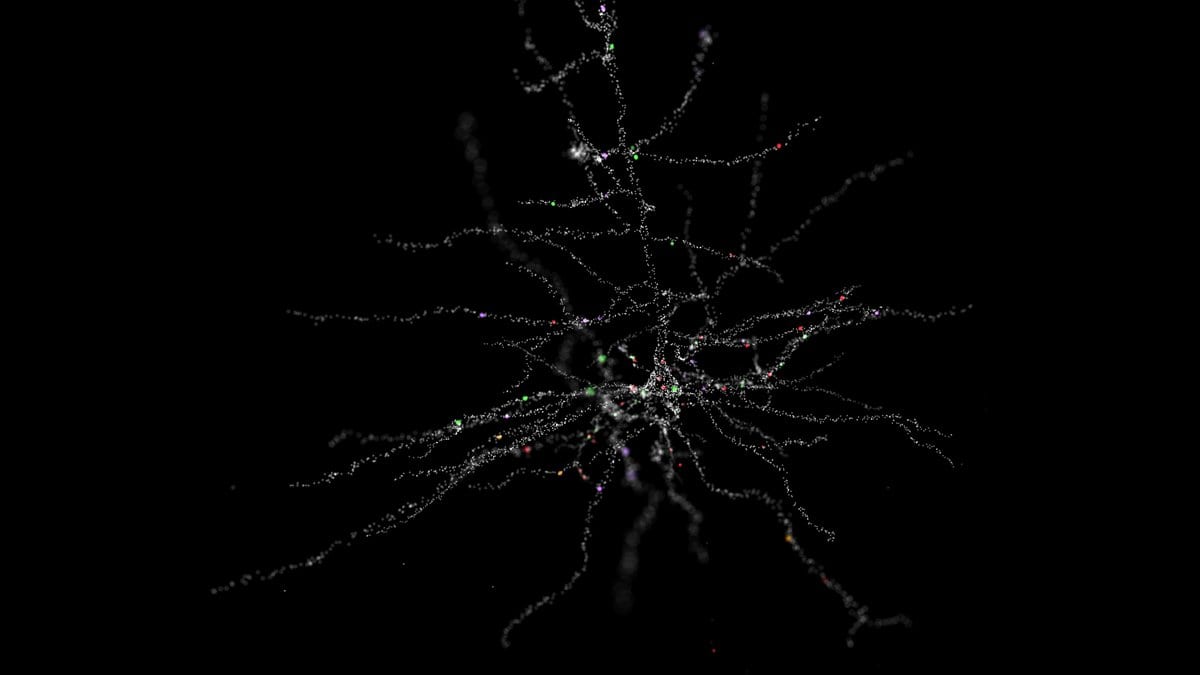
In mice, a gene that fixes one type of cortical neuron's identity before birth is put back to work after birth to set how much inhibition that same neuron receives, neuroscientists at King's College London and collaborators in Spain report in Nature Neuroscience. The paper appeared Nov. 26, 2026.
Excitatory cells in the cortex take on inhibitory synapses in proportion to their activity. The authors write that how each kind of cell gets the amount it needs was unknown, and they read their result as the answer: the gene that says what a neuron is also governs how activity reshapes its inputs.
The gene is Fezf2. Before birth it sets the identity of layer 5 extratelencephalic pyramidal cells — deep cortical cells whose output leaves the forebrain. Tim Kroon, Beatriz Rico and colleagues report that after birth electrical activity raises Fezf2 in those cells and in no other pyramidal type. Damping their excitability with an added potassium channel left 32% fewer inhibitory contacts from parvalbumin interneurons, a common inhibitory type, on their cell bodies at 10 days old. Raising their activity chemically pushed Fezf2 up by 24%.
Fezf2 codes for a transcription factor, a protein that controls other genes, so it does not itself reach the inhibitory cell. Screening what else changed with activity, the group landed on Cdh22, which encodes Cadherin-22, a surface protein neurons use to hold onto one another; it fell 44% when activity was lowered. Knocking Fezf2 down reduced the inhibitory synapses, and supplying extra Cdh22 restored them, which the authors take as evidence that Cadherin-22 carries the gene's effect.
"We were surprised to find that Fezf2 is regulated by neuronal activity, given that its role in determining the identity of ET neurons during embryonic development was already well established," said Kroon, the paper's first author, in the university's announcement. "It was exciting to discover that it has another role in fine-tuning the connections of these neurons after birth."
The King's group worked with the Institute of Biomedicine in Valencia and the Institute of Neuroscience in Alicante. King's says the Wellcome Trust funded the work.
Sources
- Nature NeurosciencePeer-reviewed
- www.kcl.ac.uk