Robots That Grab Each Other and Become a Chain

In one of 11 videos filed with the paper, a single robot leans over a bunch of grapes, closes a claw on one and sets it in a container, reaching the high fruit and the low by stretching and bending its own body. In another, three of the same robots roll over rocky soil to a stream, cross on a log lying over the water, and pick out a piece of trash with their claws. The robot is called TeCoBot, and it was built by Mahmud Hasan Saikot, Sydney Spiegel and colleagues at the Adaptive Robotics Lab at Colorado State University, with Jianguo Zhao supervising the work.
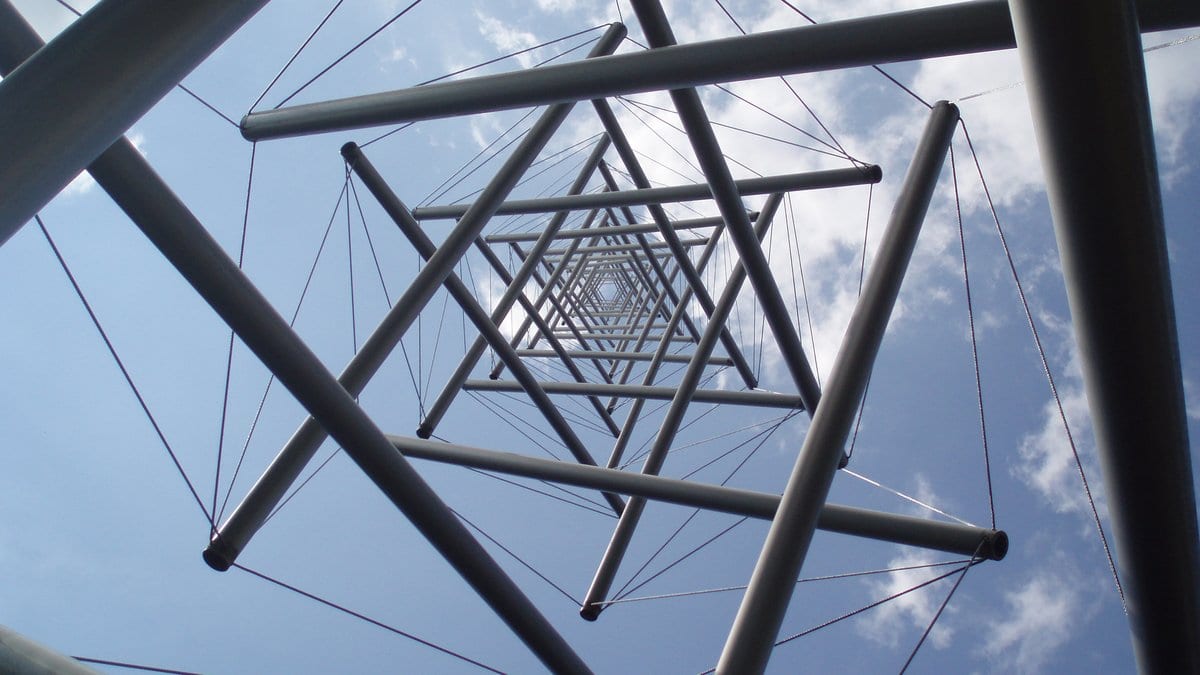
Its body is built from tensegrity units: stiff rods held apart by cables pulled tight between them, a structure that gives a little under load instead of pivoting at a joint. At each end sits a claw, and the claw is what grips a grape and also what grips the next robot. The paper describes the design as combining "a tensegrity-based compliant body with claw-based connection mechanisms," and that is the unusual part: one piece of hardware does the handling and the joining.
The authors' starting point is a gap with two halves. Robots built to dock and rearrange are mostly made of rigid blocks, which the team says leaves them with limited capabilities, while robots with flexible bodies do give under load but, in the paper's words, "they cannot self-reconfigure into task-adaptive multi-robot configurations." That second half is the authors' framing of their field rather than a settled verdict on it, and their own reference list is the reason to hold it loosely: it cites a Science Advances study of self-reconfigurable continuum robots published Aug. 21, 2026, and a 2025 Nature Communications paper on tensegrity blocks that assemble themselves into structures.
Most of the paper is about what these robots can do. On its own, one unit moves six ways: stretching and compressing along its own axis, inchworming, crawling on its claws, rolling, turning and climbing inside a pipe. The claws that grip objects do some of the driving too, and one clip runs a faster version of the stretch-and-compress gait on smooth wood with quicker claw motors. A single robot was also sent across sidewalk, grass, rocky gravel, hay, rocks, soil, smooth wood and low-pile carpet, which is more variety than a laboratory floor.
Docked together, they switch between shapes the paper labels a chain, a loop, a loop with a branch, an H, a plus and a Y, and each shape suits a different job. The manipulation videos show them lifting, pulling a cork, pouring from a test tube, tearing tissue, taking a lid off a container and turning a lettered cube to the face the operator wants. Others climb inside a duct or roll as a loop over a large pipe. In one of them a group tidies a desk, putting a stray pen in its holder and passing scrap paper down to a bin.
None of it runs itself. The paper says the demonstrations are teleoperated, with a person driving the robots over a wireless link, and docking is the one step it shows happening without that. Supplementary Video 11 covers three trials: one on pre-scripted motions, and two in which a robot uses its own camera and a printed pattern it can recognize to line up on its partner, move in and close the claw. The code released with the paper includes "the autonomous visual docking implementation." That is enough to show the step can be automated, and not enough to say how reliably.
The paper's opening figure sets TeCoBot against other modular robots on how much each can manipulate and how well each can move. The scores behind that comparison are published as source data, and the authors assigned them, the ones for other groups' machines included, so the figure is their reading of the field rather than an outside benchmark.
The team has published both its code and its design files, so other researchers can check the results. The firmware and the docking code are on GitHub under an MIT license, and the measurements behind the figures are deposited on figshare with a file-by-file README giving column definitions and units. Four of the six authors are also named inventors on a patent application related to the work, which the paper declares, and the funding is a National Science Foundation grant together with an Advanced Industries proof-of-concept grant from the Colorado Office of Economic Development and International Trade.
The paper’s claims are careful. It describes “broad potential applications in manufacturing, space exploration and search-and-rescue operations,” but none of the robots has yet been used for real work. The videos give a clearer picture of where the hardware stands. On the climb back from the stream, for example, the robots reached their torque limits.
Sources
- Nature Machine IntelligencePeer-reviewed
- figshare