A Star Is Slowly Eating a Brown Dwarf, and It Could Take Billions of Years

The shape was wrong. A light curve, the record of how a point of light brightens and fades, is supposed to look like a bell or a wave. This one looked like a triangle, and it repeated. Kevin Burdge, an assistant professor of physics at MIT, had pulled it out of the Zwicky Transient Facility, a sky camera at Palomar Observatory in California built to catch things that change fast: supernovae, gamma-ray bursts, colliding neutron stars. Nothing in that catalog makes triangles.
"I remember first looking at this and thinking: Stars don't make triangular waveforms like this," Burdge says in a statement released by MIT. He and his colleagues suspected a black widow binary, in which a dense, spinning neutron star slowly consumes a much smaller companion star. But the light from a black widow wobbles, as the small object whips around the heavy one, and this light did not wobble that way. "And this weird triangle just sat for years."
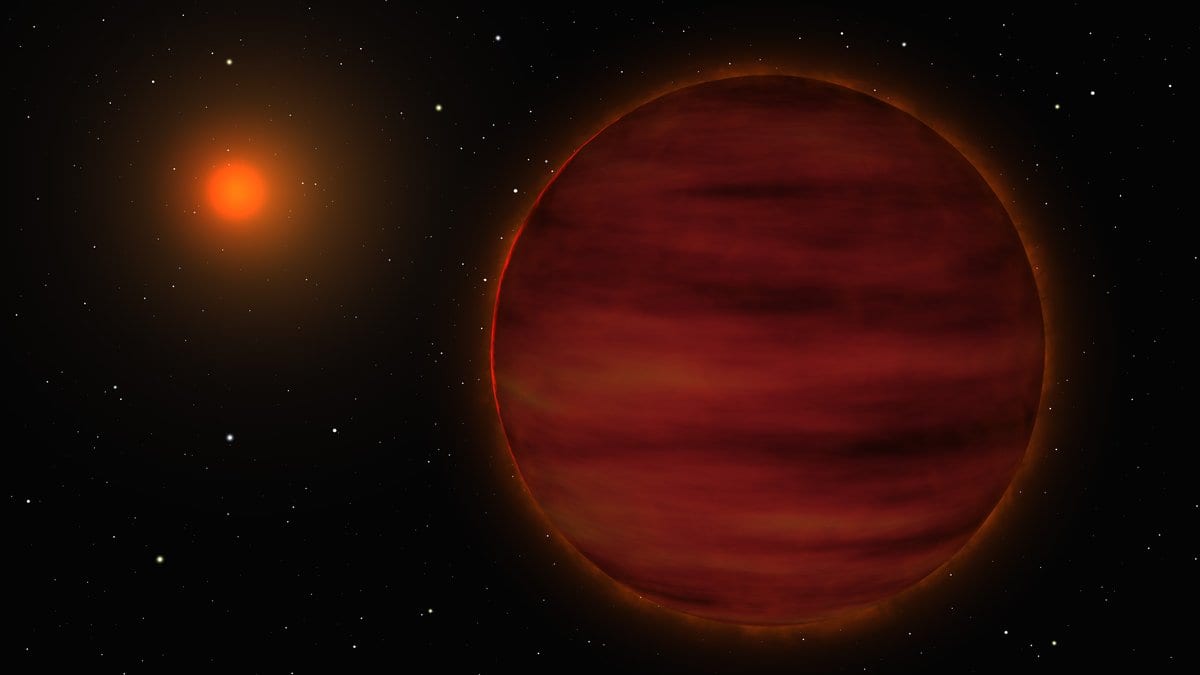
The answer appeared Oct. 5 in Nature Astronomy. Aaron Householder, Burdge and twelve colleagues identify the source as ZTF J0440+2325: a brown dwarf, heavier than a planet but too light to burn hydrogen, spilling gas onto the small red star it circles every 87 minutes. Theory had allowed for that kind of long, steady feeding, the authors write, although such accretion has not been observed. What they report is the first direct observation of a brown dwarf steadily feeding a living, hydrogen-burning star.
Light companions have been seen feeding dead stars for decades: brown dwarfs transferring mass to white dwarfs, and stripped-down partners orbiting neutron stars in the black widow systems Burdge's group already knew well. The paper cites those classes itself. What had not been observed is a donor like this one feeding a star that is still running on hydrogen fusion rather than the cinder left when that fuel runs out.
The wobble that ruled out a black widow
Householder and Burdge went back to the triangle. They put several telescopes on the source and measured how much the star itself moves, the small to-and-fro that betrays the mass of whatever is pulling on it. The wobble was there, but much smaller than a black widow's, which meant the two objects were closer in mass than a neutron star and its victim. "That was the real clincher for this system," Householder says in the MIT statement. "When we measured that wobble, we found we were not seeing a black widow. This was a low-mass star that's orbited by a brown dwarf. The wobble was too small in amplitude to be anything else."
The numbers that make the system vivid come from the authors' own announcement of the work, published by MIT on Oct. 5: roughly 300 light-years from Earth, a star about 85 times the mass of Jupiter and a brown dwarf about 25 times, and an orbit tight enough to fit inside the diameter of the Sun. That gap is what the paper turns on. One object is heavy enough to burn hydrogen; the other is not.
The gas has nowhere to spiral
Material falling from one object onto another, which astronomers call accretion, is usually studied around things that are heavy and tiny: black holes and neutron stars, which pull the infalling gas into a flat, glowing disk. A red dwarf is nothing like a tiny black hole. "The difference here is: The thing absorbing matter is not a tiny black hole but a star, which is relatively big in size," Burdge says. "So matter just pummels directly onto the surface, at very high speeds, like an asteroid hitting the moon."
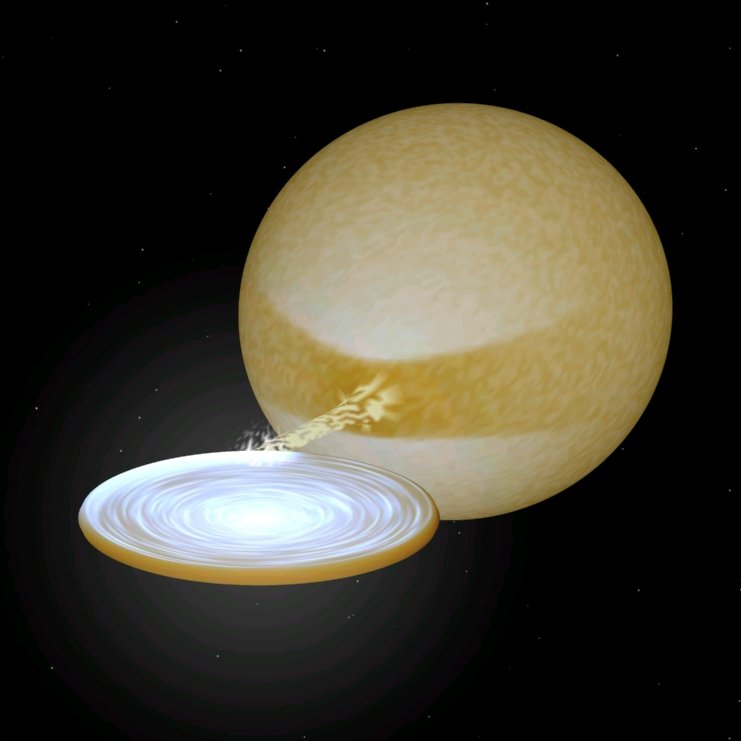
The team tested that with simulations, following test particles off the brown dwarf under the system's own gravity. The paper's second figure plots the result: ballistic stream trajectories, paths that run into the star instead of circling it. "When we track those test particles, we see they indeed fall right onto the surface of the star," Householder says. Where the stream lands, it heats one bright patch, and as the two objects swing around each other that patch turns in and out of sight. Hence the triangle. "It's like you've got this continuous fireball onto one of the objects, and as one orbits the other, that hotspot comes in and out of view, and the peak of the triangle signal is when you're looking right at the fireball," Burdge says.
The rate is slow for something that sounds so violent: about one hundred-thousandth of the Earth's mass each year, the researchers estimate in the same announcement, a trickle against the bulk of a brown dwarf. That is why the meal can last. The authors write that the fate of "some substellar objects is not rapid engulfment and destruction, but instead gradual consumption for potentially billions of years."
The Earth is still on the other track
The paper predicts the opposite outcome closer to home. When a star swells and a planet comes into contact with it, the planet is swallowed, and the authors name that as the expected end for the Earth and the other rocky planets of the Solar System. The slow channel is an alternative found in a different kind of pairing, not a reprieve for ours. Burdge draws the same line: "This is what will happen to the Earth when the sun becomes a red giant. But here, we've found an alternative: Instead of swallowing the thing up, the star can gradually eat it, for billions of years."
Alongside ZTF J0440+2325, the paper presents a second object, ZTF J1444+4820, on a 67-minute orbit, as a strong candidate for the same kind of feeding, with a third star further out. It is a candidate, not a confirmed case, and one firm system is a thin base for a new class. The work is peer-reviewed, with the referee reports published alongside it, and the reduced light curves, the spectra and the analysis code are open under an MIT license, so another group can repeat the analysis and go looking for its own triangles.
The paper carries a dedication. Co-author Thomas R. Marsh, of the University of Warwick, died before it appeared, and the record of who did what credits him and Burdge with first developing the idea that systems like this could exist: "We dedicate this paper to our late co-author Tom Marsh for his early work on understanding these systems."
Sources
- Nature AstronomyPeer-reviewed
- Zenodo
- news.mit.edu