Why Most Iron Meteors Melt Away Before They Can Land

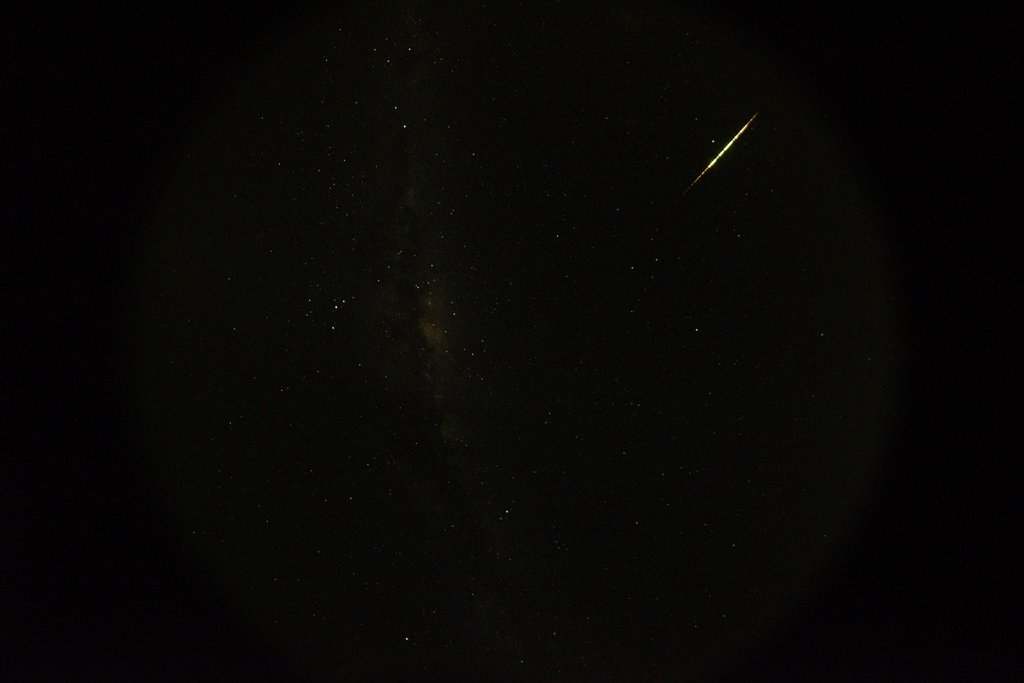
On the evening of April 17, 2026, a fireball crossed central Poland slowly enough to watch for a full seven seconds, and thousands of people did. One of the cameras recording it, hundreds of kilometers to the south in the Czech Republic, was fitted with a grating that splits light into colors, so what it caught was not a streak but a chemical readout: line after line of iron, one line of nickel, and no trace at all of the sodium and magnesium that are the brightest features of almost every fireball spectrum.
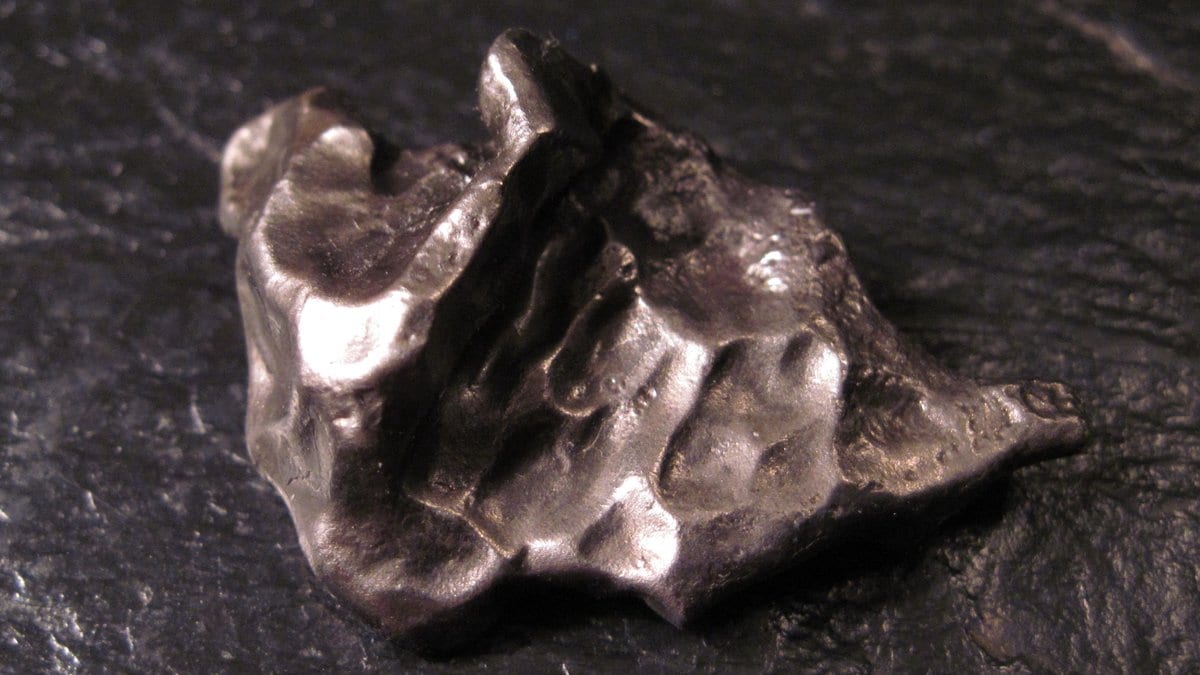
Five days later, searchers dug a 2.9-kilogram lump of iron out of a pit in a grass meadow near the village of Zadzim, close to the point the fireball's own slowing had marked for it. That much was announced in April 2026, when the meteorite was recovered, and the claim made for it then is repeated in the paper: Zadzim was "the first iron meteorite which was known to be iron from the fireball spectrum before it was actually found."
What the April announcement did not carry is the reason the fall was worth the trouble. On Nov. 24, 2026, Jiří Borovička, Pavel Spurný and Lukáš Shrbený of the Astronomical Institute of the Czech Academy of Sciences posted the flight analysis the recovery had been collected for. The fourth author, Mateusz Żmija, is at Poland's Skytinel Network, whose cameras caught the fireball from close range. It is a preprint; its authors state that Astronomy & Astrophysics accepted it on Nov. 19, 2026, and no journal version has appeared. Its subject is not the meteorite but how an iron body loses itself on the way down.
There is almost no data behind that question. Fewer than 4 percent of witnessed meteorite falls have been irons, and until a fireball over Sweden dropped one near Ådalen in 2020, no iron fall had ever been recorded by instruments. Zadzim was caught eleven times over, by all-sky cameras, videos and light sensors in Poland, the Czech Republic and Slovakia.
The pressure that should have broken a stone
For a stony meteoroid, an entry is a story about breaking. Borovička's group has shown that ordinary chondrites, the commonest kind of stony meteorite, split in two separate pressure stages, and that most of their mass loss follows from the splitting: each break exposes fresh surface, and fresh surface burns. Zadzim did none of it — its slowing fitted a single unbroken body from start to finish, the videos showed no fragment large enough to see leaving it, and the greatest aerodynamic pressure it met on the way down was 5.2 megapascals.
That figure is a floor under the iron's strength, not a measurement of it. A body that does not break tells you only what it withstood. Fresh iron meteorites can take hundreds of megapascals in a laboratory press, and the authors write that, on the evidence available, large solid irons usually hold together until the pressure reaches at least about 20 megapascals, which only a much heavier body would meet.
What melting costs an iron
An iron that does not break still arrives much lighter than it started. Zadzim entered the atmosphere weighing about 19 kilograms, with an effective size of 17 centimeters, and 2.9 kilograms of it reached the meadow. The accounting for the rest sits in one quantity, the ablation coefficient: how many kilograms of itself a body spends for each megajoule of kinetic energy it gives up.
One value, about 0.005, fits stony meteoroids of every kind, from fragile cometary dust to ordinary chondrites. Zadzim's never held still. It rose and fell as the surface melted unevenly, touching 0.08 at its worst, and settled late in the flight at about 0.023, four to five times the stony figure. The authors read that gap as the difference in what it costs to turn metal rather than rock into vapor.
The seven other iron fireballs the team modeled, none of them larger than about 13 centimeters across, put Zadzim at the comfortable end of a range. In the smallest, the coefficient climbed toward 1 kilogram per megajoule, far above anything measured for even the most fragile stony meteoroids. Those bodies ran out of material while they were still high up, which is what gives small iron fireballs their signature — not a fading trail but a light that stops.
The authors' explanation turns on iron's ability to move heat. Metal carries heat inward from its own surface far faster than rock does, so a body only a few centimeters across is warmed right through early in the flight; after that, the incoming heat has nowhere to go but into melting more surface, and ablation speeds up. A body of Zadzim's size keeps a cool interior to conduct heat into, and its ablation rate stays moderate. The authors offer this as the probable reason and say plainly where it stands: "More detailed theoretical or experimental work is needed to confirm this scenario." The heating-and-melting modeling that would settle it sits outside this paper.
Iron shines brighter than stone
One more quantity had to move before any of this fit together. A fireball's brightness becomes a mass only through its luminous efficiency, the share of lost energy that leaves as light. Fed the standard curve for stones, the model could not make Zadzim shine as brightly as it did. The fit needed nearly three times as much light per unit of energy. That reaches beyond this one fall: every iron fireball ever weighed by its brightness was weighed on the wrong curve, and the networks now have one built for irons.
There is one check on that from outside the group. A separate team worked out the same quantity for the Swedish Ådalen iron from the low-frequency sound that fireball pushed through the air (a different fall measured a different way), and the value they got sits close to the new curve. The curve itself is pinned only across the low speeds those two falls provided; faster than that, the authors fit an assumed shape and label it as one.
The brightness and slowing-down measurements for Zadzim and all seven comparison fireballs are posted openly under a license that allows reuse, so another group can refit them against a different model of a melting metal sphere. The meteorite itself is still being analyzed and the paper gives it no classification. What the paper does give is the number the Zadzim fall was collected for: a measured rate at which an iron spends itself, taken from a body heavy enough to survive doing it.