Planetary Systems Fall Into Two Families, and the Host Star Decides Which

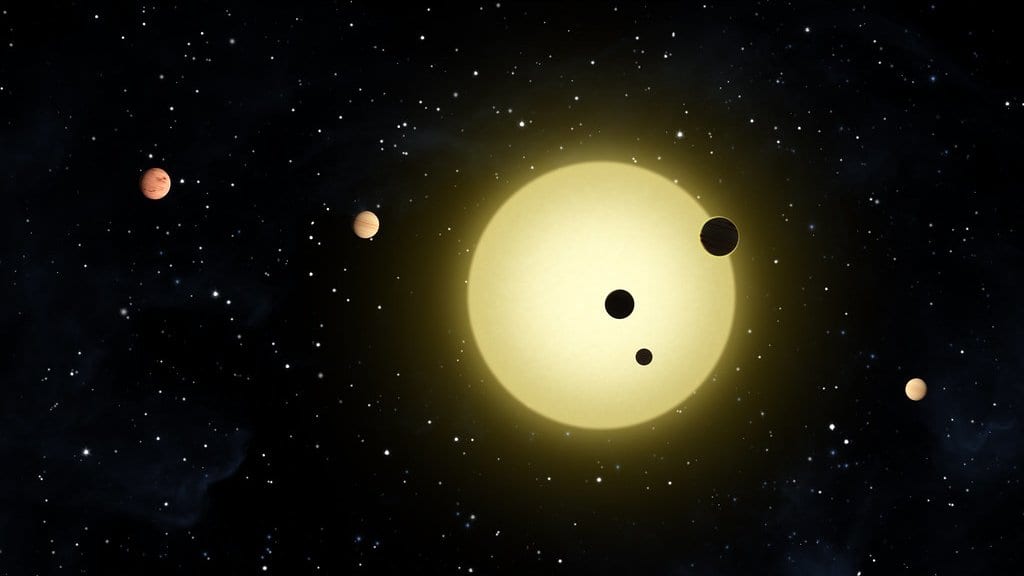
Every planetary system astronomers find gets measured against ours. It is the only one we can examine up close, so it became the ruler: eight planets on nearly circular orbits, nearly in the same plane, with the giant planets outside and the small rocky worlds in. A study published Oct. 13 in Nature Astronomy argues that the ruler itself is part of the problem.
The study was led by Diego Turrini of Italy's National Institute for Astrophysics and Camilla Danielski of the University of Valencia, who share first authorship, along with 10 colleagues from other institutions. The team analyzed 298 of the best-characterized multiplanet systems using nine measures designed to compare systems independently of their specific orbital arrangements. These included the total planetary mass relative to the host star's mass, the orbital period of the outermost planet, the number of planets, how the planetary mass is distributed among them, orbital spacing, dynamical excitation, the host star's mass and metallicity, and the amount of solid material available in its planet-forming disk. The researchers repeated the analysis three more times using samples selected by different criteria to test whether the results held up.
The systems were drawn from the NASA Exoplanet Archive and represent 28% of the more than 1,000 known multiplanet systems. The result that held up across all four samples was a clear split. Total planetary mass does not vary smoothly across the sample; instead, the distribution has two peaks separated by a gap. The authors report that statistical tests consistently supported this bimodality. Scaled to a star with the Sun's mass, the lower-mass family contains about 80 Earth masses of planets or less, while the higher-mass family contains about 400 Earth masses or more. Systems falling between these thresholds could belong to either family, so the authors excluded them from subsequent comparisons of the two groups.
The two families differ in more than total mass. Lower-mass systems tend to be compact, with their outermost planets often orbiting within 1 astronomical unit, roughly the distance between Earth and the Sun. Their planets also tend to have a more similar distribution of masses. The authors say this is compatible with the pattern astronomers call "peas in a pod," in which neighboring planets in the same system tend to have similar sizes. They qualify that comparison because more than half of the lower-mass family consists of two-planet systems. Higher-mass systems extend farther out, yet the paper's orbital-spacing measure indicates that they are at least as gravitationally compact as the lower-mass systems. In other words, their wider reach does not necessarily mean their planets are more loosely packed dynamically.
What the star hands down
The sharper difference is in the stars themselves. The light family sits around stars of the Sun's mass and below, with a metal content close to the Sun's. The heavy family sits around stars of solar mass and up, whose metal content peaks about 1.5 times higher. Neither gap looks dramatic on its own. But a heavier star forms with a heavier disk of gas and dust around it, and a more metal-rich star with a more metal-rich disk. The two effects pull the same way: the authors calculate that the disks that built the heavy family held roughly three times more solid material, the dust and ice that planets are assembled from.
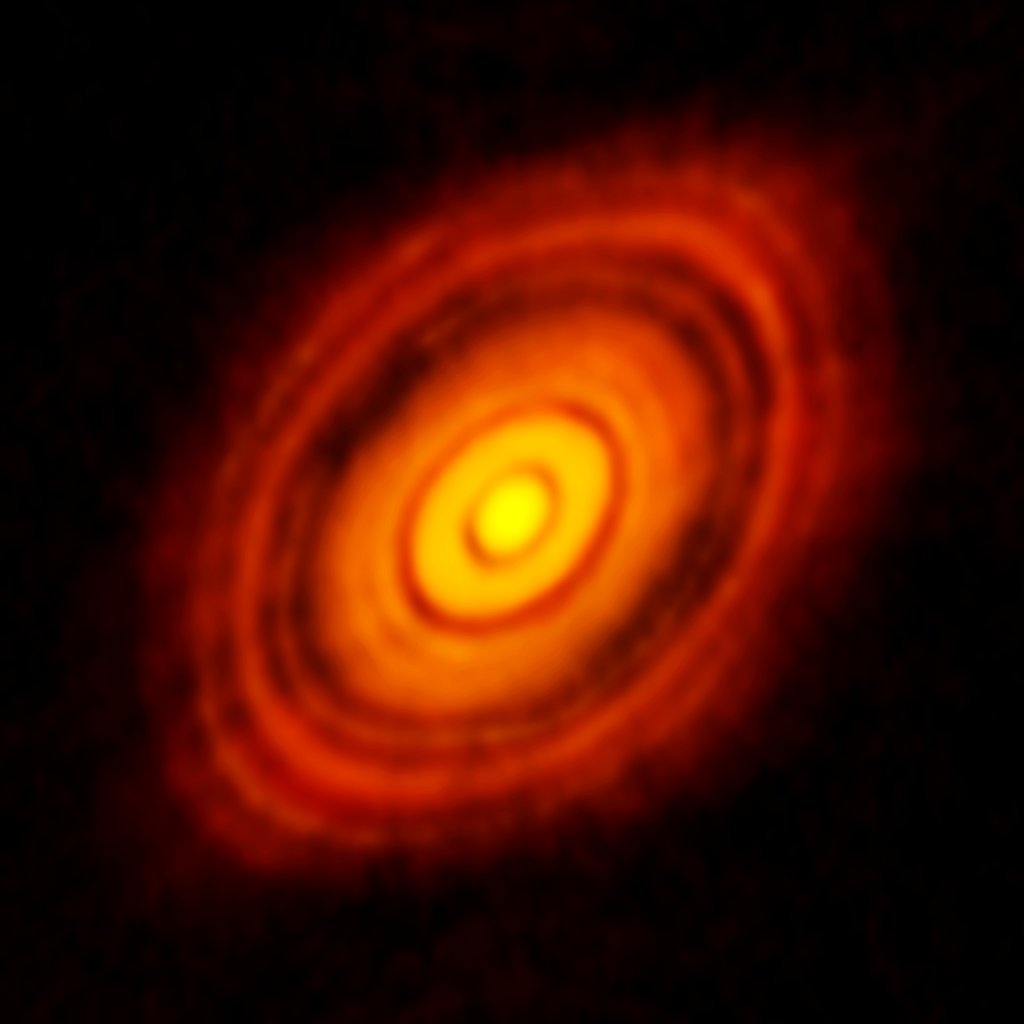
That is enough to change what gets built. In a thin disk, planets drift inward faster than they grow, which leaves them tightly spaced; where they grow by sweeping up pebbles, it also leaves them much alike in mass. In a disk three times richer, growth outruns the drift, so planets get large and they get large farther out. The chain running from a star's chemistry to its planets' final arrangement is the paper's central claim, and the authors call it a genetic link between a star and the system it hosts.
How hot a system runs
The measure doing most of the work here is what astronomers call dynamical temperature: how far a system's orbits depart from a flat, circular arrangement. Hot means eccentric, tilted or otherwise dynamically disturbed. On this scale, the high-mass family stands apart, and the paper provides two points of comparison. These systems are about an order of magnitude more dynamically excited than both the lower-mass family and the Solar System. The authors interpret this as evidence of a more violent past, involving system-wide instabilities and planets scattering off one another, but present this as an interpretation supported by the data rather than a settled account of each system's history.
The paper does not conclude that the lower-mass family is as dynamically calm as the Solar System. Both families, the authors write, include substantial fractions of systems that are more dynamically excited than ours. The similarity is more limited: in the main reference sample, the most common dynamical temperature among lower-mass systems is close to the Solar System's value. However, most orbital eccentricities in that sample are estimated rather than directly measured, using a correlation identified by the Kepler mission between a system's number of planets and their orbital eccentricities. In the subset of 89 systems where every eccentricity was measured, the peak shifts to a higher dynamical temperature.
Where the split could still be an illusion
To ask how a system gets that hot, the team ran what it calls an exploratory campaign of simulations, starting with four types of initial configuration. Systems that began unstable, or in a chain of orbits locked into simple period ratios but with one link missing, ended up about as dynamically excited as the observed systems. Systems that began stable did not, even when a passing star disturbed them. Most simulations that reproduced the observed architecture
s lost at least one planet along the way.
The harder question is whether the two families are real or partly an artifact of observational limits. At large distances from a star, current detection methods are more sensitive to massive planets, making wide-orbit systems with lower-mass planets harder to detect. The authors acknowledge this bias. They suggest that the division in planetary mass and the difference in system extent may be linked to observational selection effects, and therefore base their classification on mass alone.
"The main difficulty during the data analysis was determining whether the two families of planetary systems were real or just an illusion created by the technological limits of current observational techniques," Danielski said in the release announcing the study. Selection effects, she added, "acted as the tip of the iceberg, revealing the existence of much deeper structural diversities between these systems."
The closest precursor is the team's earlier study of how planetary-system architecture varies with host-star mass and metallicity among candidates for the European Space Agency's Ariel mission. The new paper extends that work using much larger samples. The authors conclude that both families have properties that distinguish them from the Solar System, and argue that planetary systems should be studied in the context of their host stars rather than measured against the Sun and its planets as a universal template.