300 Million Lab Tests Point to an Abrupt Body-Wide Shift at Menopause
Dozens of routine laboratory tests change abruptly at a woman's last menstrual period rather than drifting over years, according to a reconstruction of 300 million test results from more than 1 million women, published Oct. 12, 2026, in Nature Medicine.
The paper notes that menopause is usually described as a gradual transition because the studies that follow women closely are small and measure few things. Large medical databases hold millions of results but rarely record when a woman's periods stopped, so the moment is smeared across different ages. Glen Pridham, Uri Alon and colleagues at the Weizmann Institute of Science borrowed a correction from astronomy, where a blurred image is sharpened by undoing the telescope's own distortion, and used it to pull the timeline back out.
The method was applied to two datasets: the U.S. National Health and Nutrition Examination Survey and records from Clalit, an insurer covering about half the Israeli population. The authors report that 52 of 90 laboratory tests in the U.S. survey showed a significant step at the final period in women, while the same tests in men changed gradually. The steps appeared not only in sex hormones but in bone, liver, kidney, blood and blood-fat measures, and the two datasets agreed closely on their size. The authors call the pattern a physiological cliff.
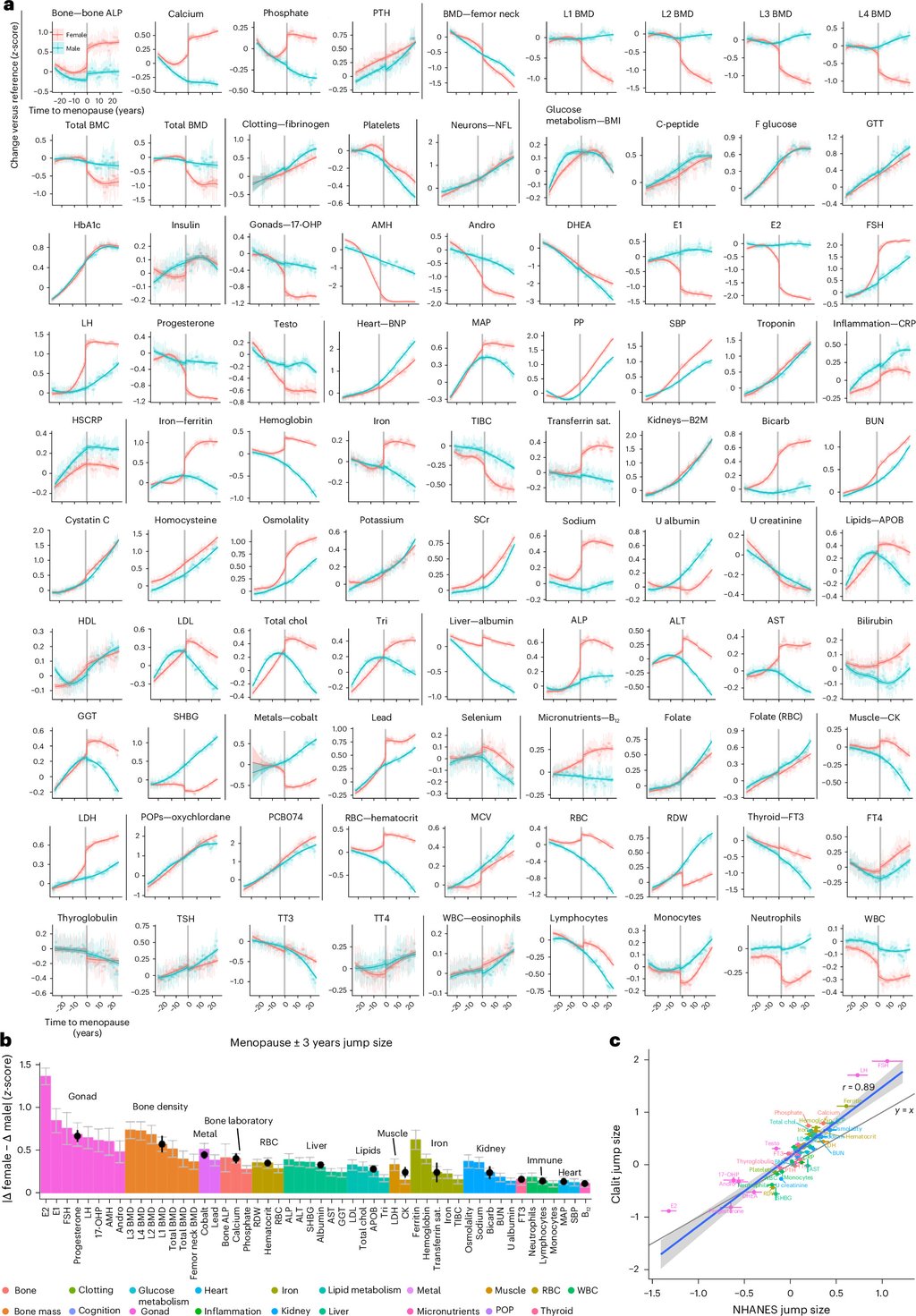
The drift started long before the last period. The authors report that follicle-stimulating hormone began rising faster about 14 years ahead of the final period, and that estradiol, the main form of estrogen, began falling faster about 12 years ahead. Both are earlier than previous studies had documented.
Women in the U.S. survey who reported taking menopausal hormone therapy showed smaller steps, an association in the roughly 9% of participants using it rather than a trial result. The authors adjusted for income and lifestyle, and report the same direction in the Israeli records.
The analysis code and aggregated data are posted on GitHub, and the U.S. survey's individual records are public; the Clalit records are not.
Sources
- Nature MedicinePeer-reviewed

Medical Disclaimer: This content is provided for general informational and educational purposes only. It is not medical advice and should not be used as a substitute for professional medical advice, diagnosis, or treatment. Always consult a qualified healthcare professional regarding any medical condition, concern, symptom, or treatment decision.