A Malaria Drug Holds Growing Crystals Still, and Makes More of Them Start

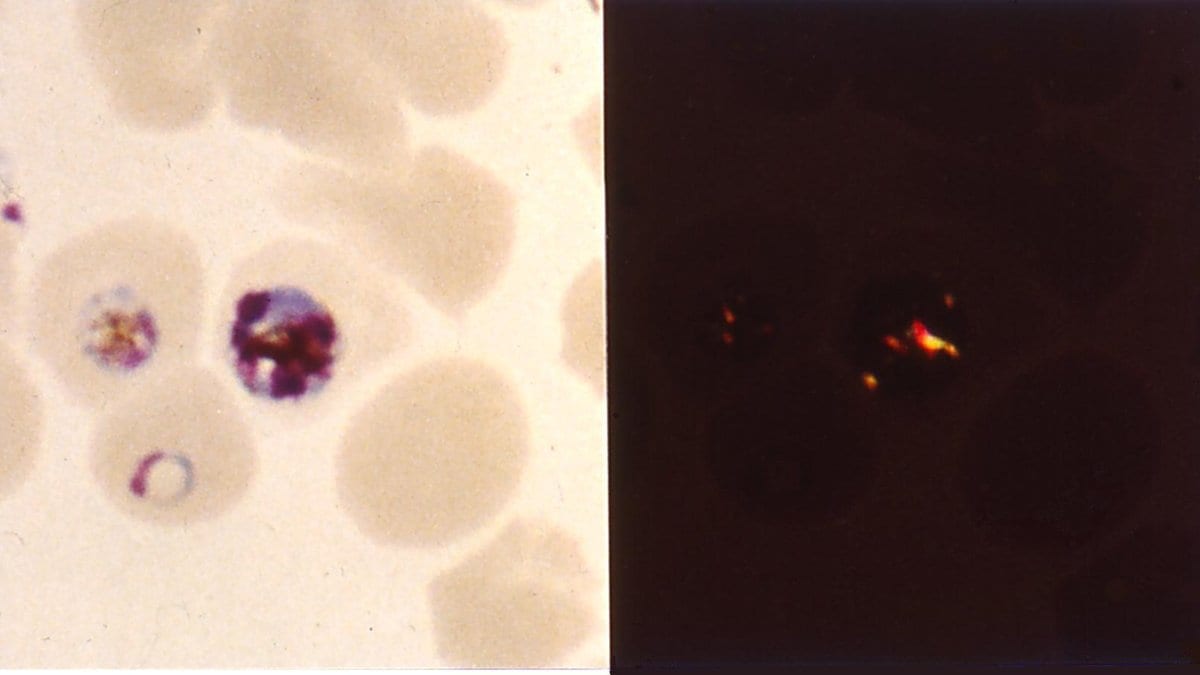
A malaria parasite spends its working life inside a red blood cell, eating the hemoglobin around it, and the meal is also its problem. Breaking hemoglobin down releases heme, the iron-bearing core that carries oxygen in the blood, and loose heme would poison the parasite that freed it. So the parasite puts the poison out of reach. It packs the heme into hard, dark crystals and leaves them sitting inert inside its own digestive compartment.
That piece of housekeeping is what several antimalarial drugs interfere with. A paper published Oct. 12, 2026, in the Proceedings of the National Academy of Sciences follows one of those drugs all the way to a crystal's edge. Huan-Jui Lee, Peter G. Vekilov and colleagues at the University of Houston and Johns Hopkins worked on lumefantrine, one of the popular components of the combination treatments now used against malaria.
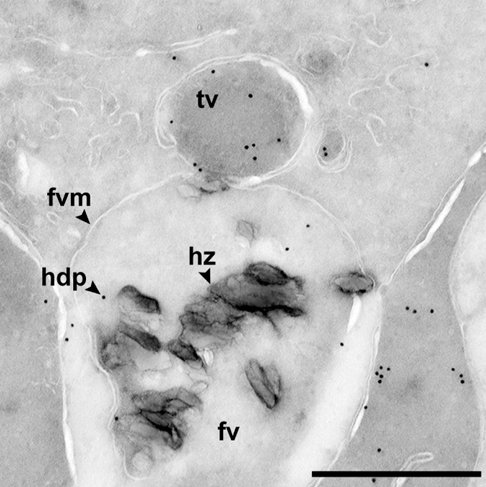
Lumefantrine's broader pharmacology is not in doubt. That it binds free heme and gets in the way of the parasite's disposal of it is long-established. The authors write that what has stayed unclear is how the antimalarials now in clinical use change this crystallization at the molecular level. A growth rate can tell you that a crystal slowed down. It cannot tell you where on the crystal the drug was sitting.
A crystal does not thicken evenly all over. Its faces are terraced, like a hillside cut into steps, and a new molecule joins the stack at the edge of a terrace rather than in the middle of one. Each edge then travels sideways across the face, and the face climbs by a layer once an edge has crossed it. Hold those edges still and the crystal grows more slowly.
So the team looked at the surface with a microscope that reads it by touch, trailing a needle-sharp tip back and forth across the terraces. At that resolution, atomic force microscopy can pick out a single molecule. Individual lumefantrine molecules were sitting on the step edges themselves, physically holding the edges in place. The team calls the action step-capping and describes it as previously unreported.
The idea that an antimalarial works by latching onto one of those growing crystals is decades old, and so is the catalog of ways it might do that. The same Houston group reported in PNAS in 2017 that quinoline drugs act through specific contacts at particular sites on the crystal surface, holding steps back and blocking the kinks where arriving molecules normally dock. Step-capping adds an entry to that list rather than opening the subject.
The capping does not stay at the scale of one molecule. As the capped steps slowed, they broadened and crowded closer together, and the whole surface roughened. The crystals in the dish are beta-hematin, the laboratory stand-in for what the parasite makes. Under conditions built to imitate the chemistry the parasite works in, their growth slowed markedly.
Then the same drug does the opposite. Lumefantrine also makes new crystals start faster rather than slower. It does that by encouraging small, dense clusters of heme to form, far larger than a single molecule and far smaller than a crystal. Scattering and microscopy together caught them. In a 2025 paper in Communications Chemistry, the same laboratory had already shown that crystals are born inside such clusters. It also reported that a substance interfering with that first step either suppresses it, speeds it up or leaves it alone. Lumefantrine speeds it up. The possible outcomes were already mapped; what is new is which one this drug produces.
On its face that should help the parasite. More crystals starting means more places to stow the heme. The answer the paper gives is that the new crystallites do not stay out of the way. They attach themselves to the surfaces of larger crystals, and where the two meet, the interface is strained, which impedes the growth of steps further still. Nonclassical is the paper's word for the whole sequence, meaning it does not follow the textbook route from dissolved molecules to a finished crystal.
In cultured Plasmodium falciparum, pulsed exposure to lumefantrine suppressed the parasite at both of the stages tested. Those were the early ring form and the later, feeding trophozoite. All of it is bench work: parasites in culture, crystals in a dish. Nobody was treated.
Almost all the earlier research on this question comes from the same pair of laboratories, the chemical engineers in Houston and the malaria group at Johns Hopkins, who between them produced most of the earlier work on how antimalarials mark these crystals. A review of the non-textbook routes by several of the same authors, published in Advanced Functional Materials, argues that those departures from the classical picture are where a new inhibitor could be aimed. Once a mode is pinned to a drug, the thing a chemist designs against stops being a crystal in general and becomes a step, a kink or a cluster.
Sources
Medical Disclaimer: This content is provided for general informational and educational purposes only. It is not medical advice and should not be used as a substitute for professional medical advice, diagnosis, or treatment. Always consult a qualified healthcare professional regarding any medical condition, concern, symptom, or treatment decision.