A Black Hole's Third Giant Flare in 36 Years, Caught in the Act

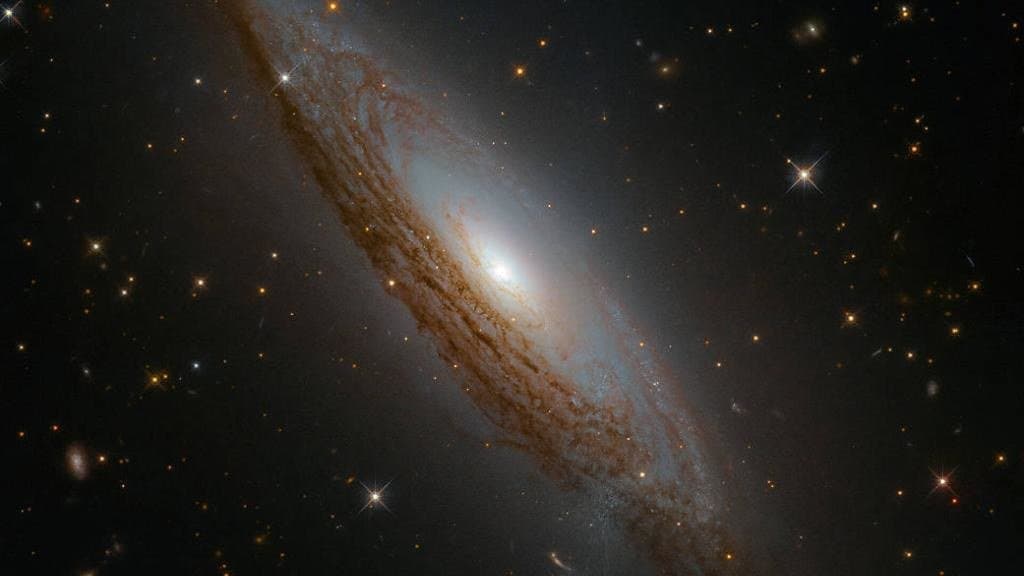
Twice before, astronomers had found IC 3599 already ablaze (once in 1990, once in 2010), each time by luck, and each time after the fireworks had largely passed. The galaxy's central black hole would blaze more than a hundredfold in X-rays, then subside, leaving researchers to reconstruct an event they had never actually watched begin. The obvious question lingered: was the black hole keeping time?
This time they were ready. A team led by Dirk Grupe had been quietly monitoring IC 3599 for years with NASA's Swift satellite, and when the X-rays began to climb again, they saw it live. Within days to weeks they triggered a cascade of follow-up observations. It was the first coordinated, real-time look at one of these giant outbursts. Their report is available as a preprint on arXiv, submitted in July 2026 and not yet peer-reviewed.
What "changing-look" means
IC 3599 belongs to a rare and unruly class known as changing-look active galactic nuclei. An active galactic nucleus is simply a supermassive black hole that is actively eating: gas spirals inward, heats to enormous temperatures, and radiates. In most such galaxies that glow is roughly steady over human timescales. In a changing-look object it is anything but: the light can transform dramatically, and in IC 3599's case it does so in enormous, recurring bursts.
The outbursts here are also "supersoft," a spectral fingerprint that turns out to be a clue. The X-rays coming off IC 3599 during a flare are almost entirely low-energy; the team found essentially no photons above 2.5 kiloelectronvolts. Alongside the X-ray surge, optical spectra lit up with bright coronal emission lines, features that were faint or absent when the black hole was quiet, and that flared in response to the outburst like an echo.
Ruling out the clockwork
The real payoff of watching an outburst in progress is timing. Several leading ideas for what drives these flares predict a metronome. One imagines a star being repeatedly stripped of gas each time it swings close to the black hole; another invokes a second, smaller black hole plunging through the inner disk on a regular orbit. Both would tend to produce outbursts separated by a fixed interval.
The new observations don't fit that picture. Caught in the act and pinned down in time, this third flare is inconsistent with any scenario demanding constant, clockwork spacing. What survives, the authors argue, is a radiation-pressure instability in the accretion disk itself (a runaway in which the disk's own light pressure destabilizes the flow of gas), provided that local conditions in this particular long-lived disk help set when each new instability tips over. In that view the black hole isn't keeping a schedule so much as periodically losing its balance.
A flicker within the flare
Buried in the XMM-Newton data is the most intriguing detail. Over the short span of the observation, the X-ray brightness appeared to rise and fall in a repeating pattern reminiscent of a quasiperiodic oscillation, a near-rhythmic flicker on a timescale of hours. The team is careful here: they describe the signal as apparent and candidate, not confirmed. If it holds up, it would be a rare window onto the innermost regions of the disk, where gas orbits at a sizable fraction of the speed of light.
Decadal giant outbursts, an emission-line response that flares in sympathy, and a possible hourly heartbeat together make IC 3599 genuinely unusual among active galaxies. The authors frame it as a natural laboratory for studying how matter behaves when it is pouring onto a black hole near the Eddington limit, the point at which radiation pushes back as hard as gravity pulls in.
Even though the most eye-catching claim, the hourly oscillation, is explicitly tentative, the leap here is real: after three and a half decades of arriving late, astronomers finally got to watch this black hole flare from the beginning. The next time it stirs, they will know far better what to look for.
Sources
- arXivPreprint