Skip to content
See the World Through ScienceA project of ALLATRA
Source: Peer-reviewedPhysical Review Letters1 source

A Nanoparticle in a Laser Beam Feels Single Molecules Hit It
Science

Republish this story

Our work is licensed under Creative Commons BY-NC 4.0. You may republish this piece for free — with credit to ALLATRA Media and a link to the original, unedited beyond length trims, and not for commercial use.

Read the full license

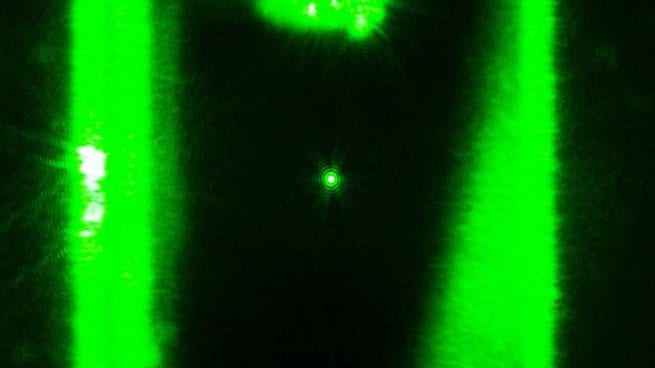
A tiny bright point of scattered light between two vertical green laser beams: a nanoparticle held in an optical trap.
Held by light alone, the particle glows as a single point between the beams, with nothing physical supporting it (illustrative)."Levitated nanoparticle" by StephTr, via Wikimedia, CC BY-SA 4.0

Yu-Han Tseng, David C. Moore and colleagues at Yale University and Lawrence Berkeley National Laboratory report that they have detected the momentum transferred by single gas molecules as they strike a nanoparticle held in a laser beam, one collision at a time. The measurement was published Oct. 19, 2026.

The group writes that counting those individual hits measures the pressure of the gas directly, and presents the result as a proof of principle for a pressure sensor built on single collisions. The authors also write that the sensitivity reached is what precision measurements of fundamental particle interactions would require. Both are stated as prospects, not as instruments already built. The paper appears in Physical Review Letters.
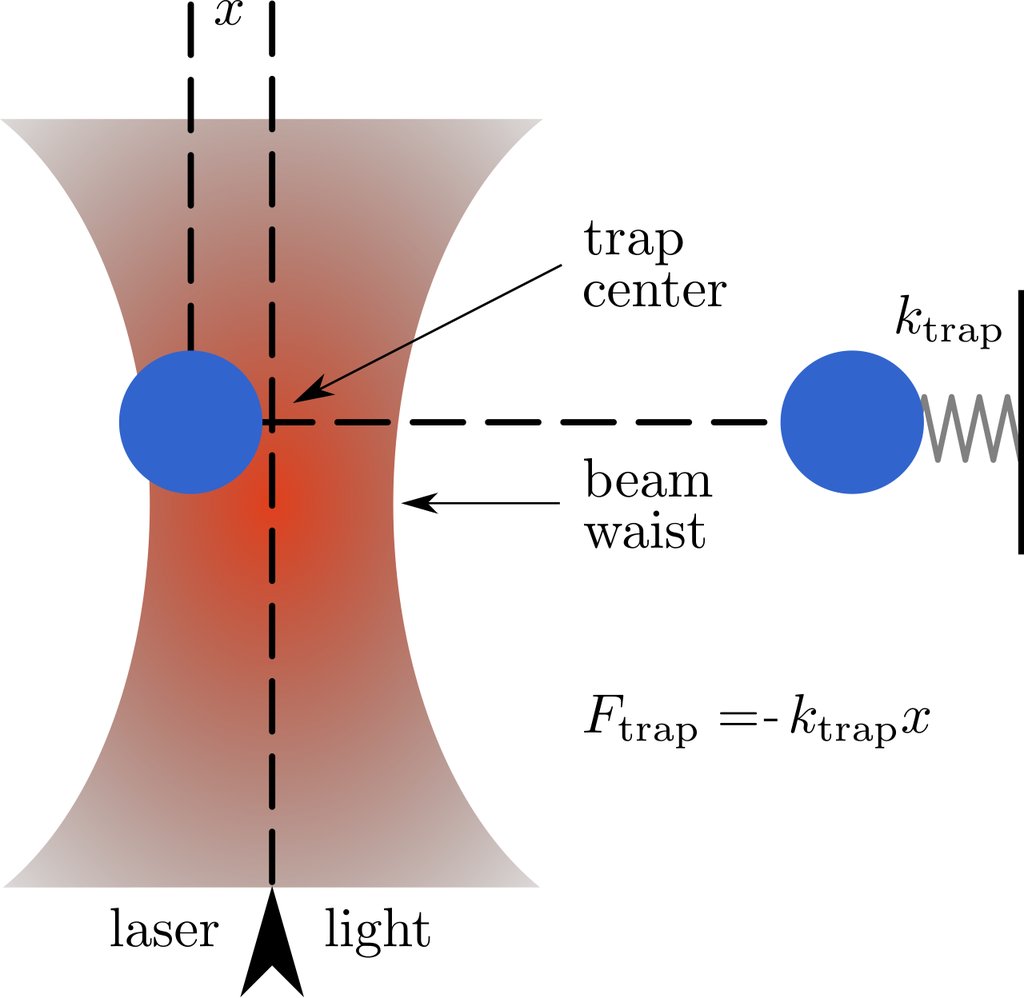
Diagram of an optical trap: a bead sits at the narrow waist of a focused laser beam, with an inset showing it pulled back toward the trap center like a mass on a spring.
The light is focused to a waist, and a particle that drifts off center is pulled back with a force that grows with the offset (illustrative). "Optical trap principle formula edit" by Cr4sZz, via Wikimedia, CC BY-SA 4.0

The particle is held in place by light alone, with no physical support. Three gases were used: krypton, xenon and sulfur hexafluoride. The authors report good agreement with theoretical expectations. They say the rate of detected events accurately measures each gas's own share of the pressure, its partial pressure. The shape of the spectrum they measure, they add, is a sensitive probe of the nanoparticle's surface, including its temperature.

The smallest impulse signal the group reconstructed was 200 keV/c, a momentum unit used in particle physics: an energy in thousands of electron volts divided by the speed of light.

Sources

By Oli KotykManaging Editor, Writer

Spot an error?

Spot an error?

Report an error

Spotted a mistake on this page? Tell us what's wrong and our editors will take a look.

What kind of problem?

Only if you'd like us to be able to follow up. We won't use it for anything else.

We correct mistakes openly. Select any text to flag it. Fixes are logged under our Corrections Policy.

Report an error

Reporting on

A Nanoparticle in a Laser Beam Feels Single Molecules Hit It

What kind of problem?

Only if you'd like us to be able to follow up. We won't use it for anything else.

We read every report. Corrections are logged publicly.