Cold Turns Worm Muscle Into a Factory for a Life-Extending Molecule

Move an adult roundworm from a 20 °C dish to a 15 °C one and it will live noticeably longer. Biologists have known some version of that trick for more than a century, and for most of that time the explanation looked dull: cold slows chemistry down, so a cold animal uses itself up more slowly. It is not dull. The worm's muscles read the drop in temperature and start making a small molecule, which they then ship out to the rest of the body.
That is the finding Hyun Ju Lee, David Vilchez and colleagues at the University of Cologne published Oct. 21, 2026, in Nature, peer-reviewed and open access. The molecule is dihydrobiopterin, or BH2, a stable stand-in for a short-lived helper that the body's enzymes need. Muscle makes it in the cold. The gut and the nervous system take it up and convert it, and the worms that do this live longer and hold off the protein clumping that marks an aging cell.
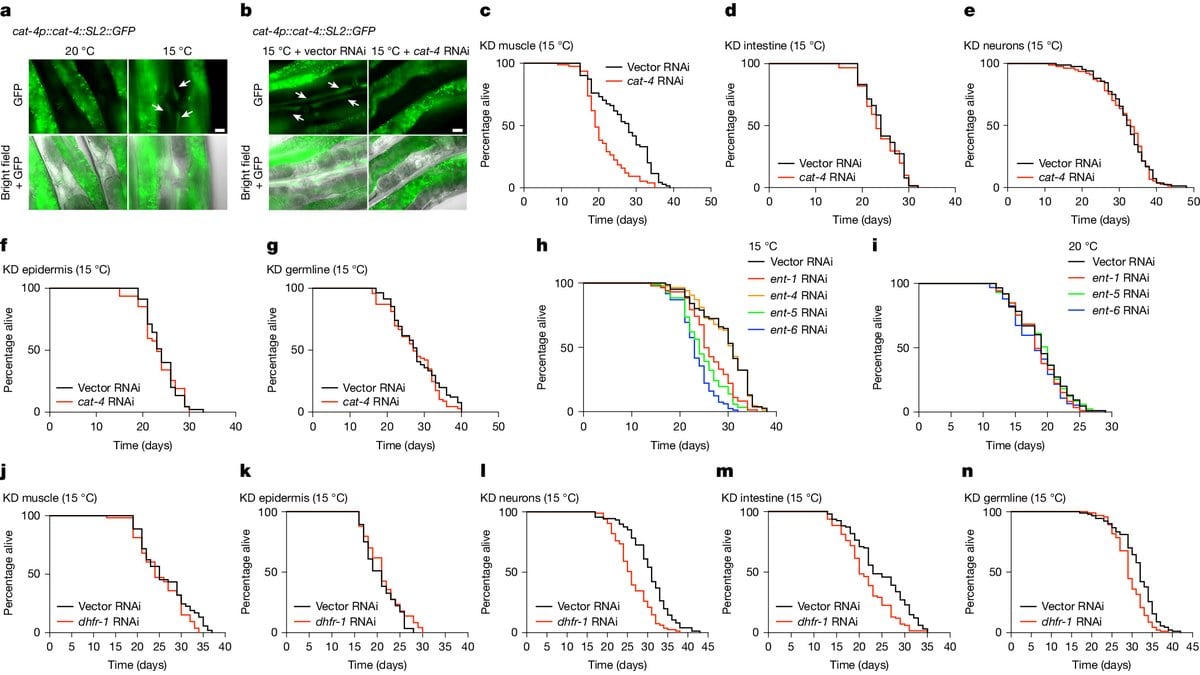
The search started without a candidate. Adults were moved to 15 °C or warmed to 25 °C, against others held at the standard temperature, then screened for every metabolite the instrument could see. Forty-five of them came out reliably higher in the cold across two independent experiments, and BH2 was among the strongest. The enzyme that starts BH2 production, called CAT-4 in the worm and GCH1 in people, was also one of the most strongly induced proteins in the cold. That last point rules out the dull explanation: a passive slowdown does not switch a gene on. Worms lacking TRPA-1, the channel that senses cold, raised their BH2 anyway.
The muscle turned out to be the factory
A fluorescent tag on the worm's own cat-4 gene showed where the enzyme was working. At standard temperature it was barely visible in muscle. In the cold it blazed there. So the gene was switched off one tissue at a time, in groups of 96 worms. Silencing it in muscle alone wiped out the cold's benefit to lifespan. Silencing it in the intestine, in neurons, in the skin or in the germ line did nothing at all.
The oddity is that muscle has no use for the product. The enzymes that depend on the active form are not made in muscle cells. The route out is a set of transporters: silencing three of them, the proteins that carry BH2 across cell membranes, shortened life in the cold and left it untouched at standard temperature. The enzyme that converts BH2 into its active form mattered in neurons, in the intestine and in the germ line, but not in muscle itself. Made in one tissue, spent in another.
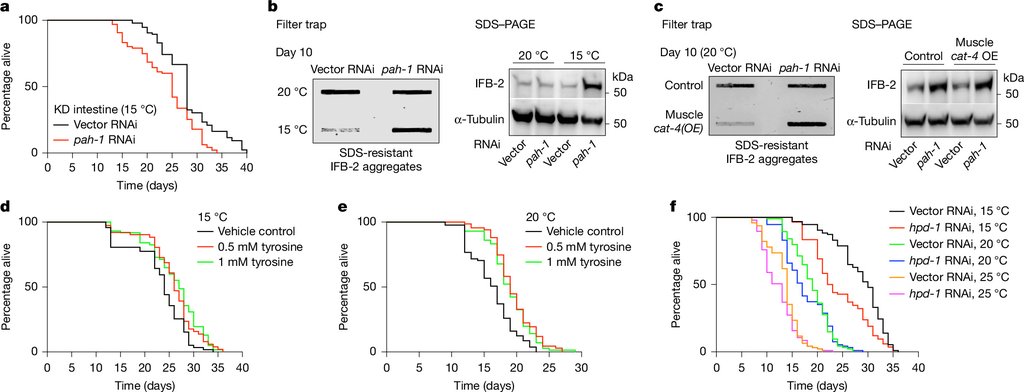
The chain then ends somewhere unexpectedly ordinary. The active form works as a helper for an enzyme that builds tyrosine, one of the common amino acids. Feeding worms plain tyrosine extended their lives both in the cold and at standard temperature, and it restored the cold's benefit in worms whose BH2 enzyme had been silenced.
Getting the benefit without being cold
If the molecule carries the signal, the obvious question is whether you can supply it and skip the chill. Genetically, yes. Worms engineered to make extra CAT-4 in muscle alone lived longer not only in the cold but at standard temperature and in the warm, at 25 °C, and they did so even without the cold-sensing channel. Muscle had the strongest effect, though it was not the only tissue that worked: raising the same enzyme in the intestine or in neurons extended life as well, which the authors describe as partially mimicking the muscle result.
Feeding the worms BH2 is a different proposition, and it mostly failed. Neither dose tested changed lifespan at standard temperature, though supplementation did delay the age-related loss of movement there, and it added a little in the cold. C. elegans absorbs biopterins poorly, which the paper gives as the reason. What works at normal and warm temperatures is the genetic change, not a supplement.
What the extra BH2 bought the worms was order. In animals making more of the enzyme in muscle at standard temperature, an intestinal structural protein that normally piles up and clumps with age stayed where it belonged, and the aged gut let in far fewer bacteria. In worms carrying a Huntington's-type protein in their neurons, the clumps shrank at standard temperature and in the warm. Those animals also kept abilities they normally lose with age: following a smell, and backing away from a touch on the nose. Silencing one subunit of the cell's protein-folding machinery abolished the protection completely.
The same molecules, tried on human cells in a dish
The human arm of this paper is cells, and only cells. In human kidney cells made to carry a mutant huntingtin fragment, three days of 10 µM BH2 sharply cut the clumping without changing how much of the protein was present. Nothing is cleared away. It simply stays soluble. The same treatment prevented the clumping of TDP-43 and FUS, mutant proteins that cause ALS. Tyrosine reduced clumping too, but the experiments test it only against the Huntington's protein.
In motor neurons grown from stem cells, both BH2 and tyrosine reduced a marker of cell death, and BH2 also cut a marker of a second way cells die. Those neurons did not come from an ALS patient. The team took a healthy donor's cells, edited the FUS mutation into them, and compared the result against the unedited line.
How far any of this travels is a question the authors put themselves. Oxidative stress abolished BH2's protective effect in the dish, while tyrosine's survived it. In mammals, unlike worms, the active form is also needed by the enzymes that make nitric oxide in blood vessels, and the team writes that its experiments do not directly address what an upset in that balance would do inside a living animal. Hyun Ju Lee and David Vilchez are co-inventors on a pending patent covering the use of these molecules to prevent and treat motor dysfunction, declared in the paper, which also states that the funders had no role in the work. "These findings suggest that specifically targeting a single tissue, such as muscle, could provide organism-wide protection," Vilchez said in the University of Cologne's announcement of the study. The tissue in question belongs to a worm about a millimeter long, whose body temperature is simply the temperature of its dish.
Sources
- NaturePeer-reviewed
- www.eurekalert.org
Medical Disclaimer: This content is provided for general informational and educational purposes only. It is not medical advice and should not be used as a substitute for professional medical advice, diagnosis, or treatment. Always consult a qualified healthcare professional regarding any medical condition, concern, symptom, or treatment decision.