A Gripper That Runs on Algae and Daylight, With No Motor and No Battery

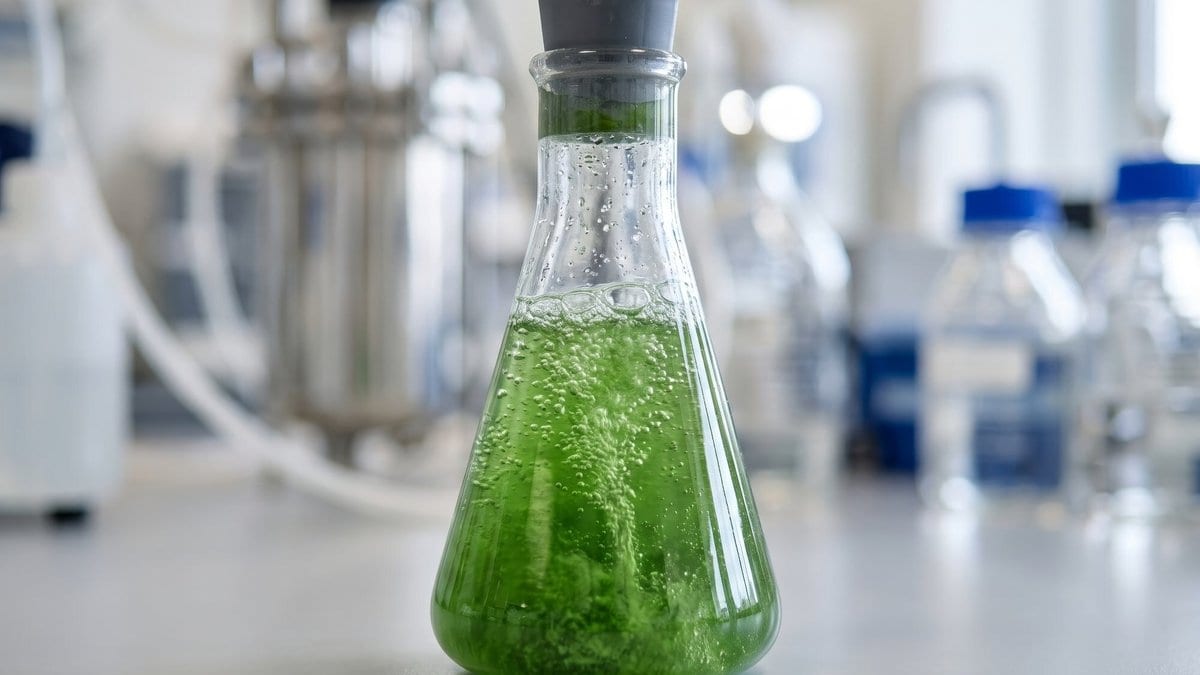
Leave a slab of clear gel in a flask of pond algae for a week and it turns green. In most laboratories that would be a cleaning problem. In one at Delft University of Technology it is the manufacturing step, and the green film that grows there is the only power supply the finished device will ever have.
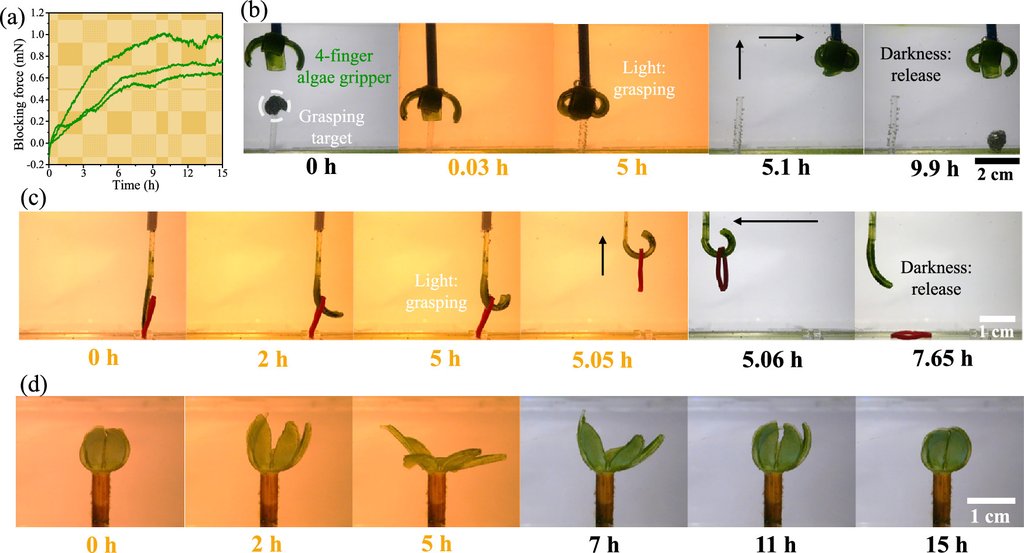
What grows is a lawn of Chlamydomonas reinhardtii, a single-celled green alga found in soil and fresh water, over a strip of water-swollen jelly 20 millimeters long, 5 wide and 1 thick. Switch a lamp on and the strip curls. Switch it off and it uncurls. Fan Jiang, Marie-Eve Aubin-Tam and four colleagues describe it in a paper published Oct. 22, 2026, in Nature Communications. They built two things out of it: a four-fingered gripper that closes on a hollow metal ball and lifts it off its support, and a hook that picks up a rubber ring. Neither has a motor, a battery or a wire in it. The only control is the light.
Nothing in the strip pushes. The motion is chemistry, and the algae drive it by changing the acidity of the water in their immediate neighborhood. In light they photosynthesize and pull nitrate out of the medium to build amino acids. Both processes consume hydrogen ions, so the water right at the cell surface turns alkaline. One of the gel's two layers carries chemical groups that take on a negative charge once that happens. Like charges push apart, the polymer mesh opens up, and the layer drinks in water and swells. The other layer is plain gel and ignores the whole business. A sandwich in which only one side swells has no option but to curl.
In darkness photosynthesis stops and respiration continues, releasing carbon dioxide. The water close to the cells turns acid again and the charged groups give the charge back. The swollen layer contracts, and the strip straightens out.
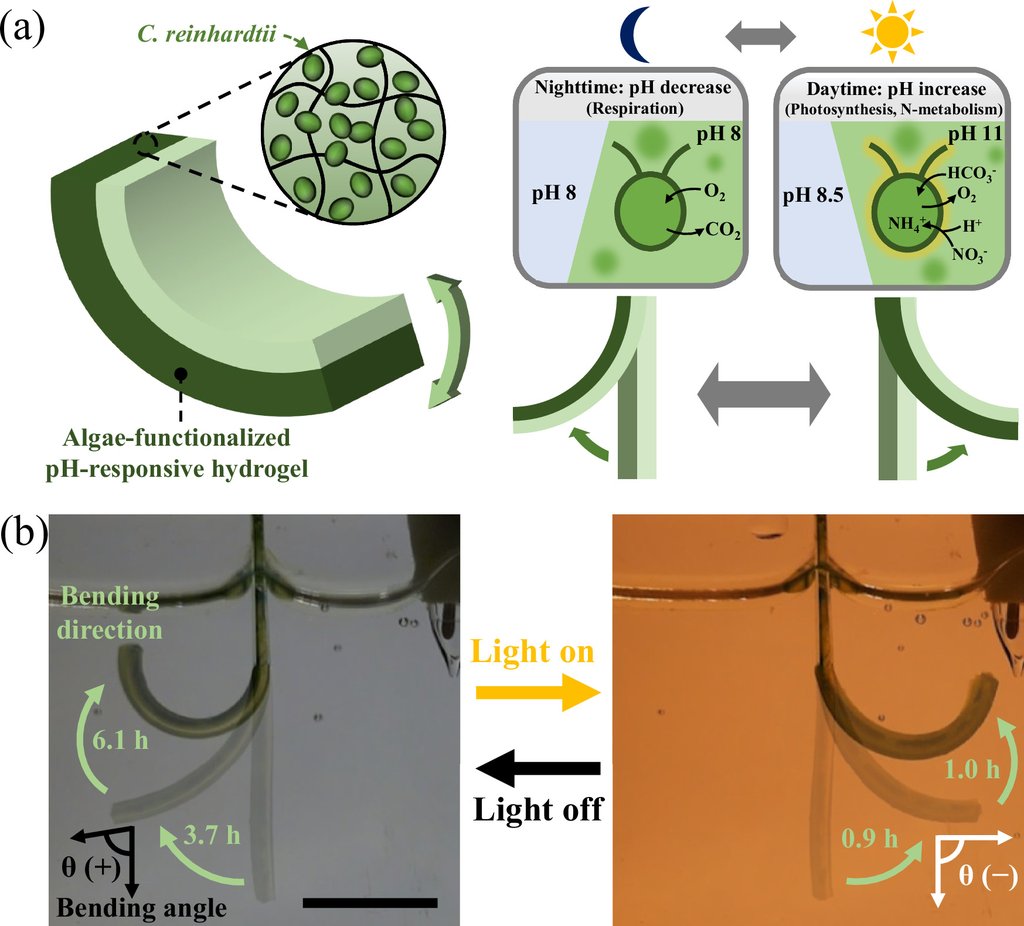
Making one is mostly waiting. A freshly cured strip sits in a flask of algae culture for a week, and the cells colonize it. They do so unevenly, and in the useful direction: the film grows about twice as thick on the layer that does the swelling.
The useful trick is how local all of this stays. Earlier gels of this kind were driven by lifting them out of an acid bath into an alkaline one. Here the inside of the gel swung between roughly pH 7 and pH 11 while the water in the chamber around it moved by less than a single unit. The strip makes its own chemistry and leaves the pond alone. That is the property the team points to when it calls the approach promising for underwater robotics, where changing the pH of the surroundings is not acceptable. None of this went underwater: every run took place in a sealed acrylic chamber a few centimeters across.
It would be easy to suspect the gel of responding to the lamp on its own. Jiang and colleagues closed that off four ways. A bare two-layer strip with no algae on it ignored the light completely. Algae killed by heat did not move it either, and the same strip started bending again once it was put back into a live culture. A dose of DCMU, a compound that blocks photosynthesis, reversed the bend while the light was still on, and nothing responded afterward. Adding a buffer, which holds pH steady, stopped the motion altogether.
Then there are the numbers that set the scale, and they are modest. Motion starts fast: within 10 seconds of the light going off and about 20 seconds of it coming on. Everything after that is slow. A full stroke takes up to 18 hours, and the hardest push the strip managed, 0.8 millinewtons, needed 15 hours of continuous light to build. That lifts the 18-milligram metal ball, or the 53-milligram rubber ring, and not much more. A flower-shaped version opens and closes over the course of a day.
The paper's introduction names poor staying power as the main weakness of machines driven by living cells, and this is where the result is strongest. After 60 days of continuous operation the strip was still bending in response to light, and the discussion states that it "maintains functionality after at least 2 months of continuous cycling in the same culture medium." A standard chlorophyll measurement showed the algae staying healthy over the test, and few of them leaked into the surrounding water.
What is absent from the device matters as much as what is in it. The strain is CC-1690, the Chlamydomonas Resource Center's standard wild-type reference, and no gene in it has been touched. The authors make the absence their selling point, writing that the system "requires no external energy inputs, no complex mechanical components, and no genetic modifications, circumventing biosafety concerns associated with the environmental release of engineered organisms." All the engineering in this paper is in the polymer. The alga is used exactly as it arrives from the collection, as an energy converter that happens to be alive.
The group did not build it for anything in particular. "We didn't start with a specific application," Aubin-Tam said in Delft's announcement of the work. "Our goal has always been to bring the research of living materials to new levels." The paper lists underwater robotics, agricultural devices, fluid control on laboratory chips, artistic pieces and the mechanical stimulation of living tissue as places the motion might go. It is peer-reviewed and open access, the referee reports are published alongside it, and the measurement data and the cell-counting code sit in a public repository, so another laboratory can check the numbers or grow one of its own.
Sources
- Nature CommunicationsPeer-reviewed
- www.eurekalert.org