Where the Ice Meets the Sea, an Ocean World's Chemicals Could Pile Up

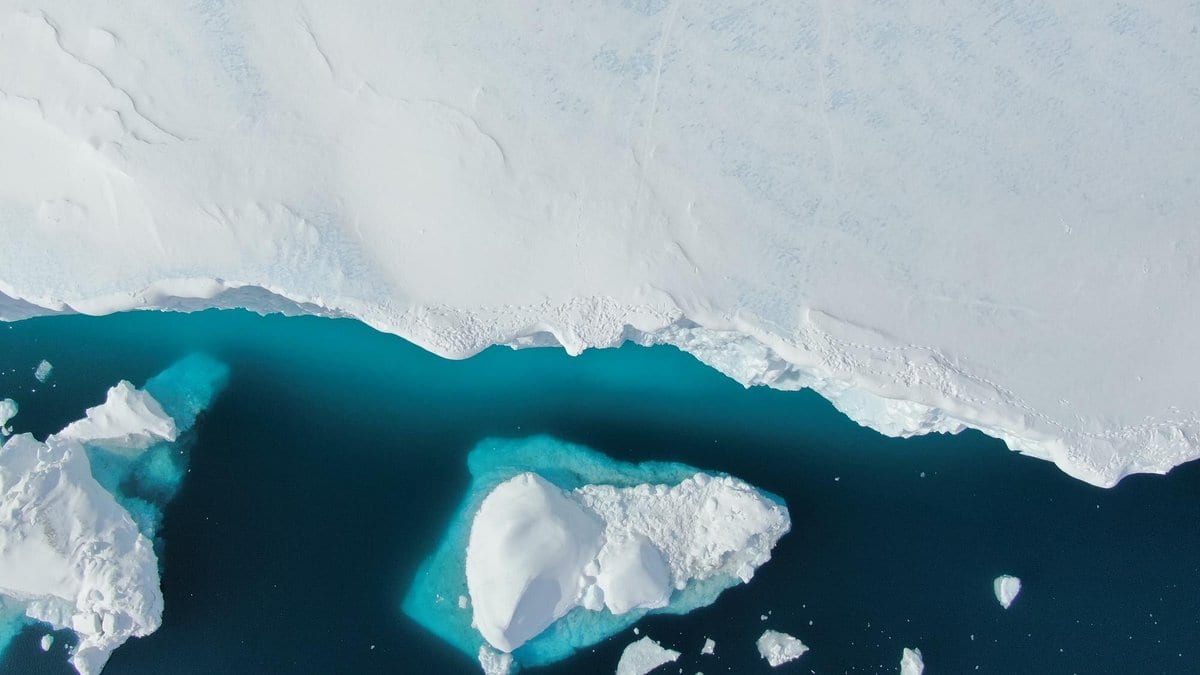
Freeze a bucket of seawater and the salt does not freeze with it. Ice crystals grow out of nearly pure water and shove everything dissolved (salt, minerals, whatever organic molecules happen to be drifting there) into shrinking pockets of brine trapped between them. It is one of the more ordinary facts about winter, and it may be the most interesting thing that can happen on a planet buried under a global ocean.
That is the argument of a paper by Edouard Barrier and Nikku Madhusudhan at Cambridge's Institute of Astronomy, working with Frances Rigby at Imperial College London, accepted by the Monthly Notices of the Royal Astronomical Society on Sept. 3 and posted to arXiv four days later. It starts from an awkward corner of exoplanet habitability. A deep water world has everything the textbooks ask of a habitable place: an energy source, a supply of nutrients (meaning chemical building blocks, not food) and a solvent. Then the ocean takes away something that is not on the list. The chemistry that runs before anything is alive needs its ingredients crowded together at millimolar concentrations, which is crowded indeed by the standards of a whole-planet ocean. And a global ocean is extremely good at keeping everything dilute, especially when it sits on a floor of high-pressure ice that seals off the rock beneath.
The place they point to is not the sea floor but the surface, at the boundary between open water and the ice shelf covering the permanently lit half of a tidally locked world. To find out whether such ice can exist, they ran ExoCAM, a climate model of a whole planet, on three cases. TRAPPIST-1 e is one, because its measured mass leaves it looking less dense than Earth, which can mean extra water. LHS 1140 b, a habitable-zone planet recently caught losing helium to space, is the canonical ocean world. The third is K2-18 b.
That one needs a sentence of its own. It appears here as a modeled case, not an established world: reading K2-18 b as "hycean" (Madhusudhan's own term for a planet with a hydrogen-rich atmosphere over a liquid ocean) is disputed, and so are the hints of possible biosignatures his group reported in its air. The paper cites those objections itself.
Freezing water sorts out everything dissolved in it
What the model produces is a band they call the perifreezing zone, the ring where the surface temperature wanders above and below the freezing point of seawater. Ice at the ocean's edge averages about half a meter thick there, and temperatures swing by 5 to 30 kelvin over tens to hundreds of days. That variability is the engine. Every time a patch of seawater freezes, it rejects almost everything dissolved in it into the liquid left behind; the colder it gets, the less liquid remains and the more concentrated it becomes. Chill an Earth-like brine ten degrees below freezing and it roughly triples. The model's ocean, though, is a motionless slab with no currents and no drifting ice, and the smooth, steady-state way it treats ice thickness, the authors write, "will break down in the perifreezing zone," the one region the whole argument depends on.
Then comes the more speculative step, offered as an optimistic vision rather than a prediction. Waves and collisions splash seawater onto the rough top of a drifting floe and leave a small pool. The pool partly freezes and concentrates. More seawater splashes in, and it freezes again. Repeat that cycle enough times and the pool works as a slow pump, drawing an effectively unlimited supply of dilute ocean water into one small volume. The weakness is in exactly the same place. If the ice ever warms enough to turn porous, meltwater flushes the pockets and the contents drain back into the ocean. The team calls this "the most significant potential flaw with this concentration mechanism," and says how old, cold sea ice behaves under fluctuating temperatures is something nobody has measured.
A general circulation model cannot resolve a single floe, so the team built a stripped-down sea-ice model and drove it with the climate their simulations produced. A block a meter thick, drifting straight across the perifreezing zone on the TRAPPIST-1 e case, melted from below in about fifty days. A second, riding along the edge of the zone rather than across it, was still there 330 days later. On the first track the surface swung by tens of degrees, which would cycle a pool between roughly one and ten moles per liter: molar, where the chemistry needs millimolar. On the second the swings were milder and the ice lasted, trading intensity for time.
Meteorite fragments could offer a second workbench
The second mechanism asks nothing of the ice except that it hold. Stony asteroids break up in the atmosphere into fragments of a few kilograms at most, and 40 centimeters of ice is enough to stop a one-kilogram piece, so most of that debris would sit on the surface rather than sink. Extrapolating Earth's present-day impact rate over the age of a planet gives about 10 kilograms of fragments per square meter, a small but steady share of it landing inside the perifreezing zone. Each one is a patch of concentrated carbon, nitrogen, iron and phosphorus on a clean white bench.
Nobody knows what chemistry would run there
What would actually happen in those pools is the largest open question. Laboratory work on Earth is encouraging in a general way: RNA-like molecules link into long chains through freeze-thaw cycling, and cold protects fragile molecules that warm water would pull apart. None of that tests the exoplanet claim; it only makes the physics behind it familiar. Most meteoritic organic matter, similarly, arrives as tough, insoluble material nothing obvious could use. And the best-developed origin-of-life schemes include steps needing hot, dry conditions an ice sheet cannot supply, which is why the paper reaches instead for water-formamide and water-urea mixtures, and adds that the origin of life on Earth is itself unsolved.
What the work shows is narrower, and it is framed that way: dayside sea ice is possible on plausible atmospheres for these three planets, and where it exists, it would concentrate whatever the ocean contains. Whether such atmospheres are common, whether the pools survive, and whether any chemistry gets past its first steps are all still open. The paper has not yet appeared in the journal, so the version to read is the openly licensed preprint on arXiv.
Sources
- arXivPreprint