Optical Modulator Hits 180 Gb/s With No Digital Signal Processing
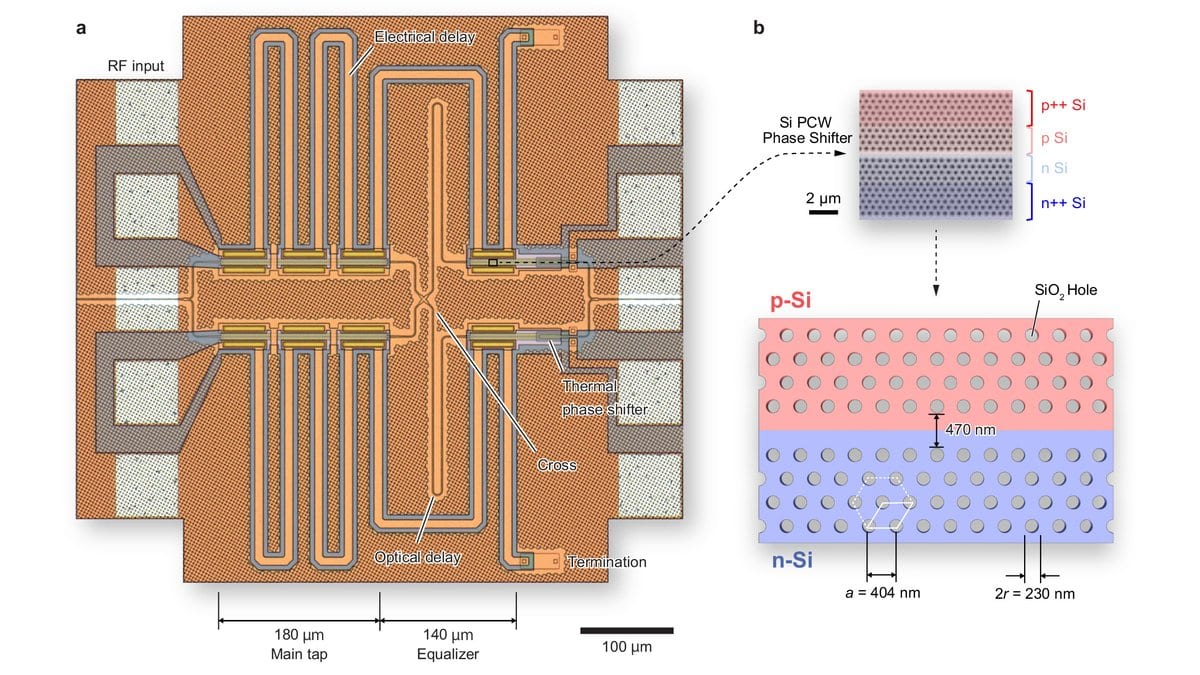
A silicon chip 320 micrometers long carried data at 180 gigabits a second with no digital signal processing at all, a group of Japanese researchers reported Oct. 22, 2026, in Nature Communications. The device slows light inside a perforated silicon waveguide and builds its own signal correction into the optics, instead of leaving that job to a separate electronic chip.
The authors present the design as a potential route toward the dense, multi-terabit optical links that AI data centers will need, by reducing how much of the work is left to power-hungry electronics.
The paper gives 320 micrometers as the length of the whole device, including the optical delay line and the waveguide crossing that form the built-in equalizer. Keisuke Kawahara of the Institute of Science Tokyo, Toshihiko Baba of Yokohama National University and their colleagues report that the device was fabricated on a standard silicon production line at Japan’s National Institute of Advanced Industrial Science and Technology.
The two top rates come from different measurements. Four-level pulse amplitude modulation, which packs two bits into each pulse, reached 180 gigabits a second with no digital processing; the 200-gigabit result needed a low-complexity 11-tap equalizer at the receiving end. In the same device, simple on-off signaling ran at 140 gigabits a second and 26 femtojoules per bit, at drive voltages the authors describe as compatible with the transistor technology in current logic chips. All are the group's own laboratory measurements of one fabricated device.
The paper's survey of the field puts the length of conventional silicon modulators used in commercial optical links at several millimeters, needing digital equalizers of nearly 100 taps to run beyond 100 gigabits a lane.
The authors write that the margin left at the top rate suggests the same receiver equalizer could carry higher rates.
Sources
- Nature CommunicationsPeer-reviewed