The Solar System's Twins May Not Have Grown in the Same Place

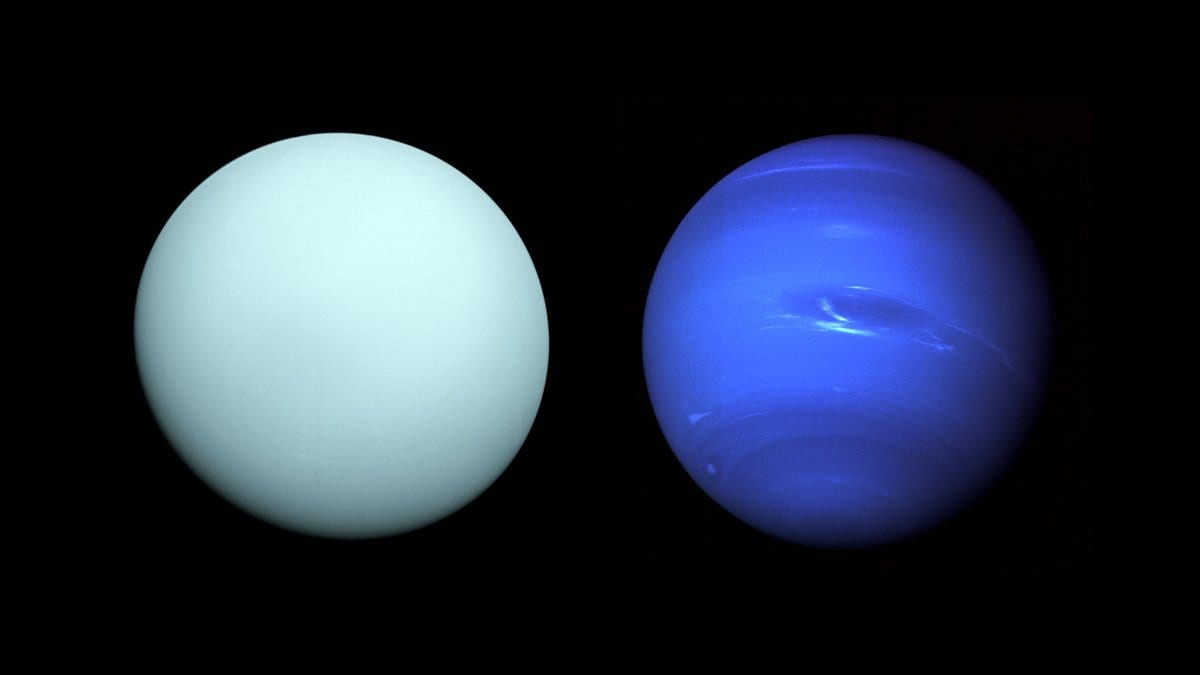
Textbooks introduce Uranus and Neptune as a matched pair: nearly the same size, nearly the same mass, the same blue-green face, both parked in the cold outer solar system. The tidy assumption behind the pairing is that the two planets were built from the same pile of ice and dust. A study published Oct. 19 in Astronomy & Astrophysics, led by Tom Briand at Aix-Marseille University, tests that assumption against the element that would settle it, and finds that the two interiors may not match at all.
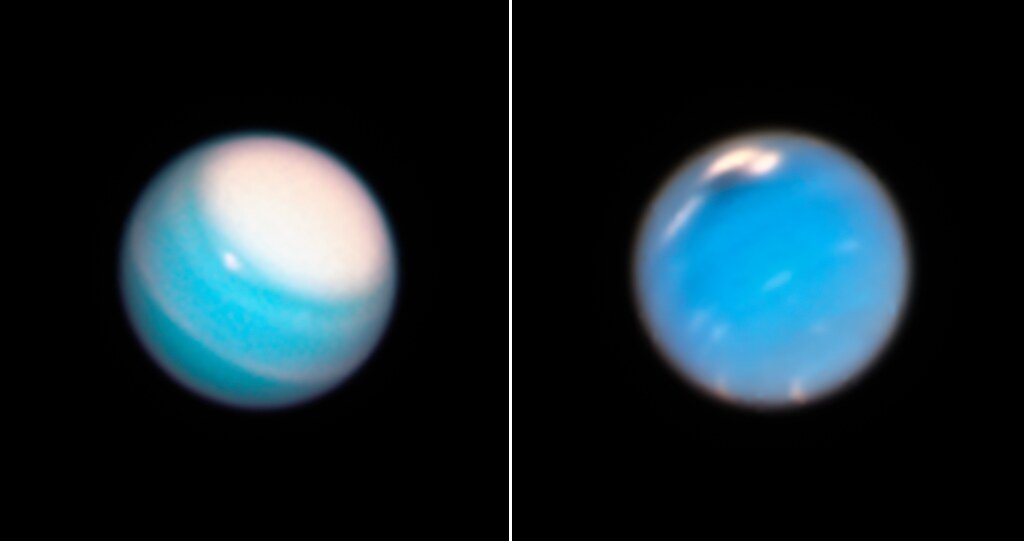
The obstacle is access. Neither planet has a solid surface accessible to direct sampling, and the water that holds most of their oxygen lies thousands of kilometers beneath the visible cloud tops, at pressures no spacecraft has sampled. So the work leans on a messenger. Carbon monoxide forms in the hot depths, rides upward on rising gas, and survives near the top in amounts that depend both on how much water sits below and on how vigorously the air stirs, which is why the paper treats it as an indirect constraint rather than a reading. "We can't directly access the deep atmospheres of Uranus and Neptune, but chemical tracers allow us to probe the conditions hidden beneath their visible clouds," said Olivier Mousis of Southwest Research Institute, a co-author, in the institute's announcement of the work.
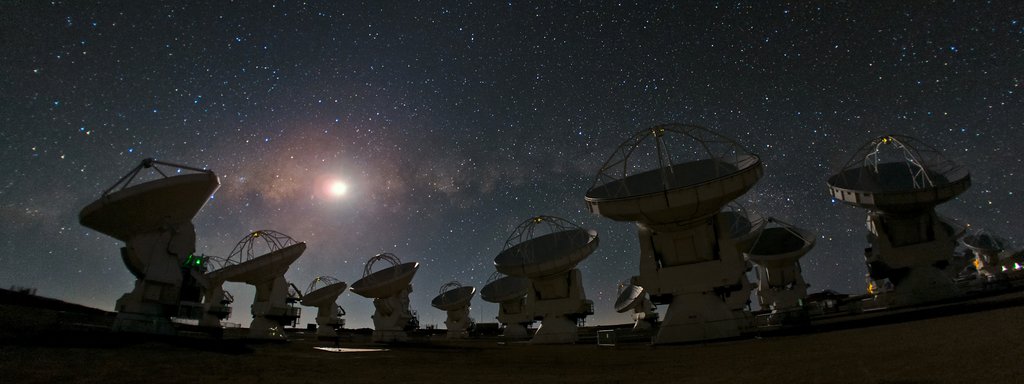
For Uranus the messenger was caught only recently. ALMA, the millimeter-wave array in northern Chile, recorded carbon monoxide emission from the planet in August and October 2022, and a team led by T. Cavalié used those data to detect the gas in the Uranian troposphere, the weather layer, for the first time without ambiguity. Briand and colleagues reanalyzed the same observations and arrived at 5.6 parts per billion. Neptune's value, about 0.2 parts per million, is older and rests on more than one instrument: radio measurements with the CARMA array and with ALMA, in agreement with the Herschel space observatory. No new observations were made for this study, which is a modeling reanalysis of published data.
What is new is that neither planet is treated as a single column of air. Earlier work used one-dimensional models: one profile, standing in for the whole globe. Briand's group let the inputs that matter most vary with latitude instead, stretching the model into a pseudo-two-dimensional version in which temperature, methane content and the strength of vertical mixing all change as you move from the equator toward a pole. So does the oxygen the model needs in order to explain the carbon monoxide seen above.
The paper puts deep oxygen on Uranus at roughly 62 to 177 times its abundance in the gas the Sun formed out of, and on Neptune at roughly 222 to 342 times. The ranges are wide because the least known input is the one that matters most. Holding vertical mixing fixed and varying only methane tightened both ranges considerably; letting mixing float opened them again, and that dominance of mixing is the conclusion the work ends on. Uncertainty in the chemistry itself, the reaction rates that link carbon monoxide to water, accounts for at most about 10% of each range. Every one of these quantities is something a model requires, not something an instrument measured directly.
Dividing the carbon the model also tracks by that oxygen gives the ratio the paper is named for: between about 0.06 and 0.52 on Uranus, between about 0.02 and 0.12 on Neptune. Set those against a model of how the disk of gas and dust around the young Sun froze out into solids at different distances, and the two planets appear less likely to be products of one reservoir. The authors write that the results suggest a different formation or evolution pathway for each, with Neptune's lower ratio fitting building blocks that formed nearer the Sun and later moved outward. Suggest is their word.
That falls short of excluding a common origin, and the authors say so themselves. Some carbon-to-oxygen values, roughly 0.06 to 0.12, come out plausible on both planets at once, and enrichment on both could be reconciled if Uranus's true ratio sits toward the low end of its range, which would follow if the air on Uranus mixes less vigorously than Neptune's. On this analysis, a shared reservoir is still available.
The oxygen ordering is not itself a surprise, and the paper says as much: the finding agrees with previous work. Cavalié's team had already placed Uranus's deep interior at least 52 times richer in oxygen than the nebula from which it formed. What this study adds is the latitude treatment, a figure for how much the chemistry's own uncertainty contributes, and the carbon-to-oxygen ranges themselves.
Mousis, speaking for his institute, went further than the paper does: "Uranus and Neptune may resemble twins today, but their chemistry is telling us that they are more like cousins with very different histories." The comparison with the disk rests on choices worth knowing about. The speed of the disk's gas flow and its inward drift are each fixed at a single value. The curves describing how ices trap other gases are extended beyond the laboratory measurements behind them, and carbon locked into soot-like solids and into methanol is left out. The study also assumes that nothing in the planets' later history shifted carbon relative to oxygen, a question it puts outside its own scope.
The practical conclusion is the authors' own. If latitude changes what a model infers, it also changes where a spacecraft ought to sample. NASA's Uranus Orbiter and Probe, named a top-priority flagship mission by the latest planetary science decadal survey, would release an instrumented probe into the atmosphere once, on one path, at one latitude. The paper offers a framework for choosing that latitude, so that a single descent happens where the chemistry has the most to say rather than wherever the approach geometry is easiest.