How Plant Acoustic Signals Influence Moths’ Choice of Egg‑Laying Sites

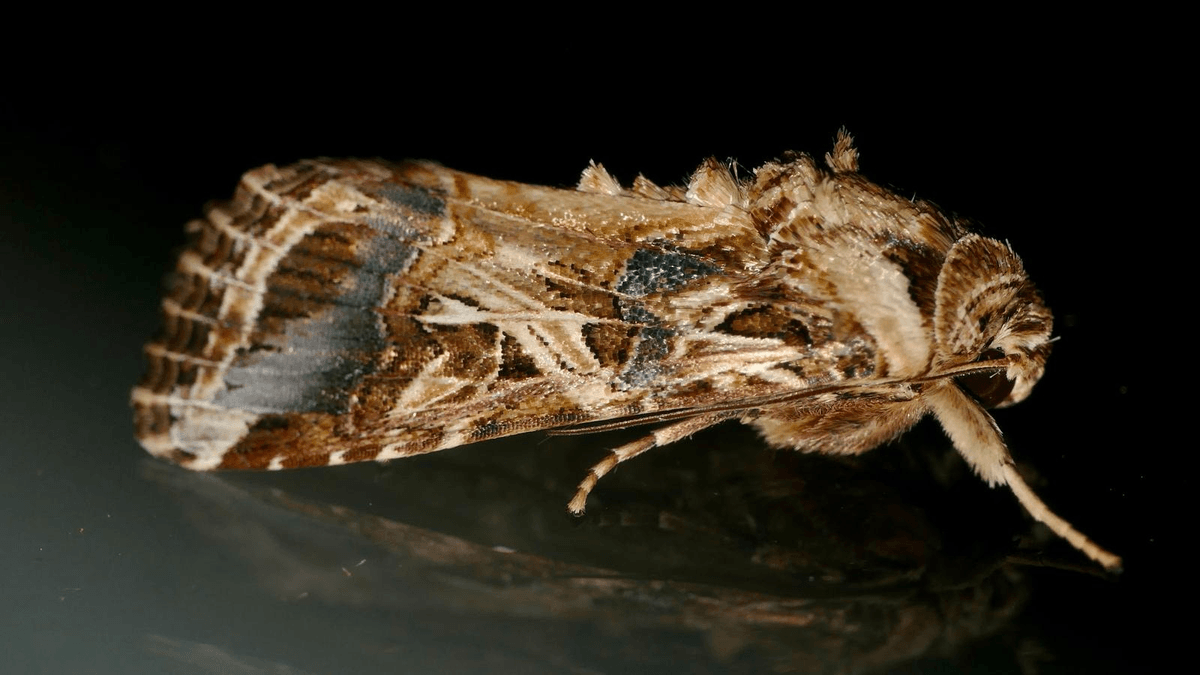
Interactions between plants and insects are not limited to chemical and visual signals. Researchers are particularly interested in the acoustic channel: sounds that plants produce under certain conditions and that may provide insects with information. Experiments have shown that some plants, including tomatoes, emit brief ultrasonic clicks when short of water. These sounds are inaudible to humans, but animals with ultrasonic hearing could potentially detect them. This raises a question: can insects use these acoustic cues, along with a plant’s smell and appearance, to assess its condition?
Many moths can hear ultrasound, which enables them to detect bats' echolocation calls. This hearing ability makes them suitable subjects for studying insect responses to plant sounds. To test whether these sounds influence moth behavior, scientists observed where females laid their eggs. The location of an egg cluster largely determines the conditions in which the offspring develop: after hatching, caterpillars usually begin feeding on the same plant.
Where Ultrasonic Clicks Come From
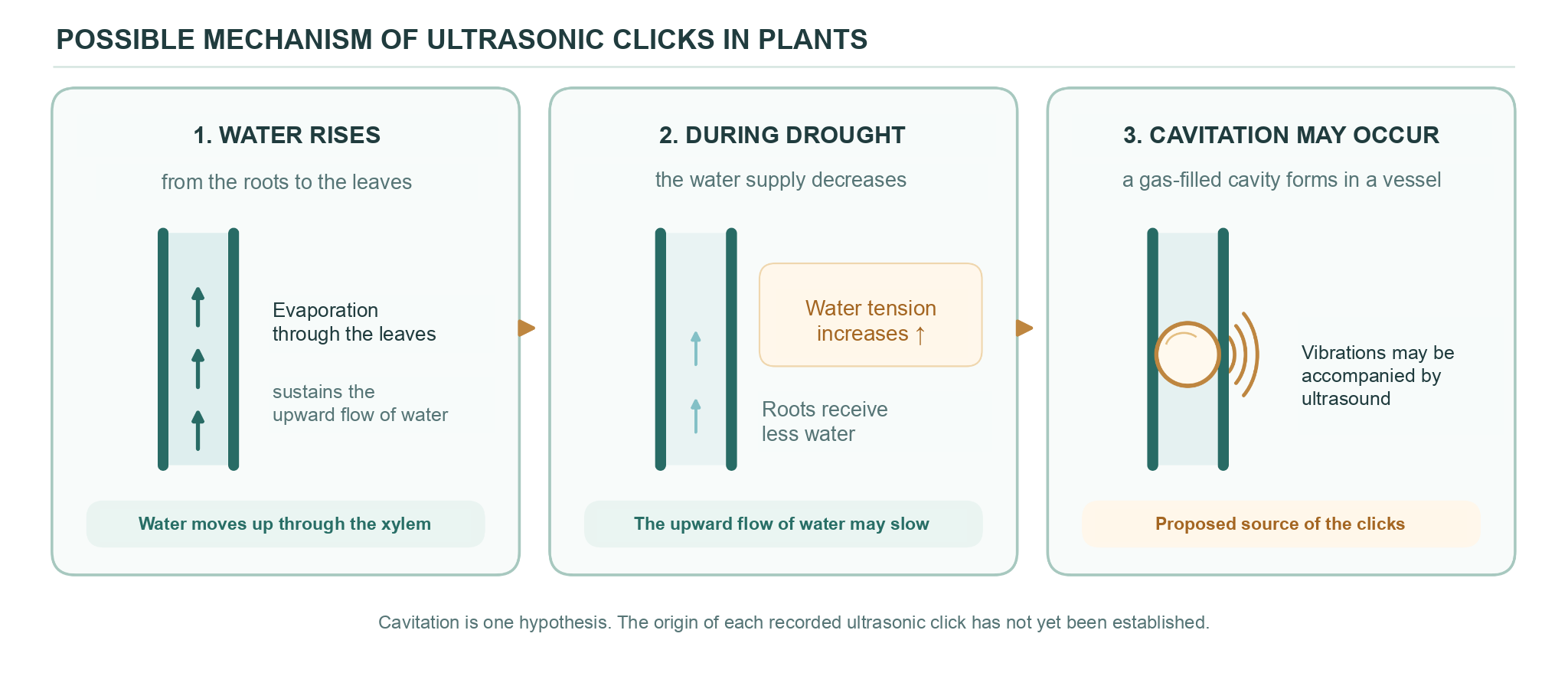
A tomato plant’s ultrasonic clicks may originate in its water-conducting vessels. Water travels through these vessels from the roots to the leaves. The leaves lose water through evaporation, mainly through stomata, tiny openings on their surfaces. This evaporation creates tension in the vessels, helping to draw more water up from the soil.
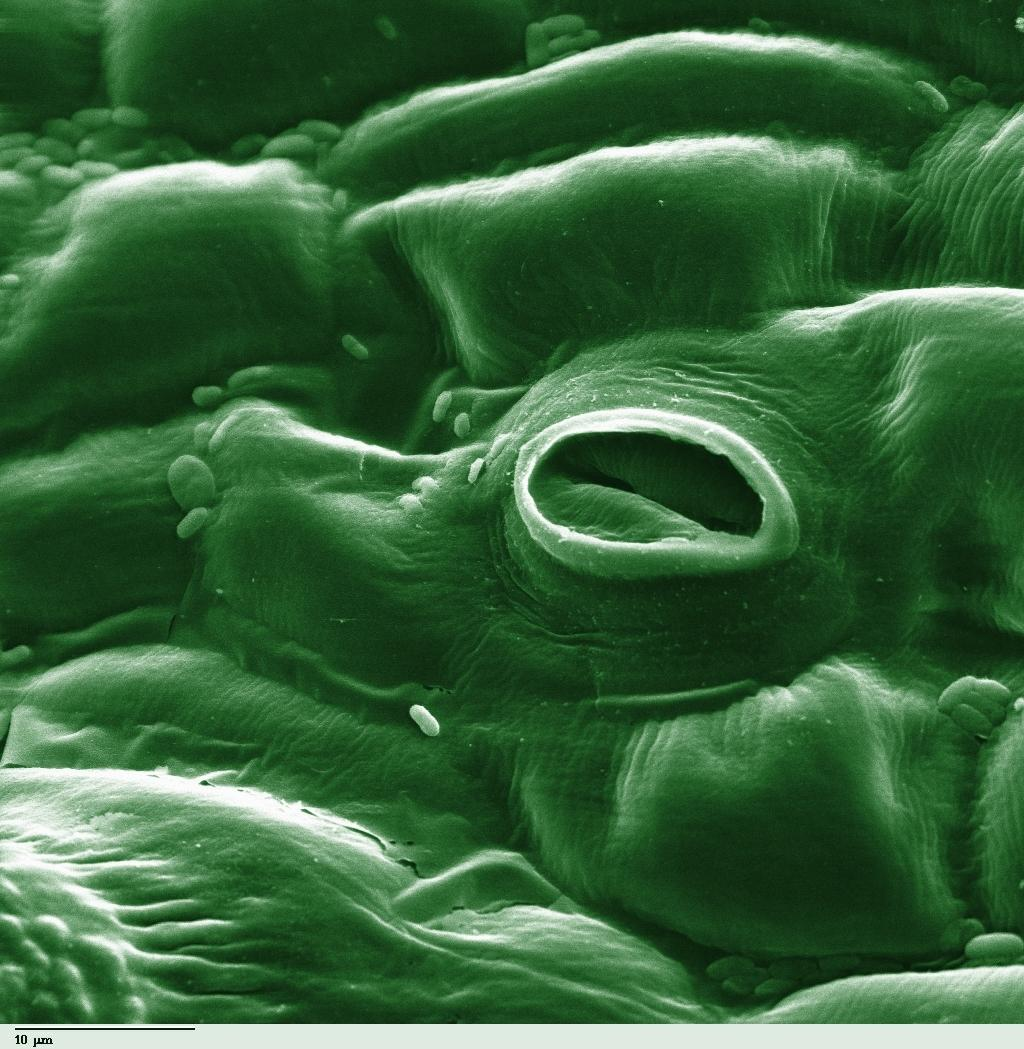
As the soil dries out, the roots receive less water while the leaves continue to lose it. Tension increases in the conducting vessels. Sometimes the continuous water column breaks: gas-filled cavities form in the stem’s water-conducting vessels, pressure changes, and the tissues undergo brief vibrations. The formation of these cavities is called cavitation. Cavitation could explain the ultrasound, but a connection between cavitation and each recorded click has not been confirmed.
Scientists began studying vibrations in plants long before modern ultrasonic microphones became available. In 1966, John Milburn and R. P. C. Johnson recorded vibrations in castor bean tissues using a sensor in contact with the plant. They associated the clicks with the condition of the water-conducting tissues and possible cavitation. This method could detect vibrations in a stem or leaf, but it did not yet answer whether these sounds travel through the air and can be heard at a distance.
In a study published in Cell in 2023, Itzhak Khait, Lilach Hadany, Yossi Yovel, and their colleagues experimentally established that plants’ ultrasonic clicks travel through the air and can be recorded at a distance. Using sensitive ultrasonic microphones, the scientists recorded sounds from tomato and tobacco plants, first in an acoustically isolated chamber and then in a greenhouse. Tomato plants experiencing a water shortage (water stress) emitted an average of about 35 clicks per hour, while plants with severed stems produced about 25 clicks over the same period. A well-watered, undamaged tomato plant typically produced fewer than one click per hour. On average, sound energy peaked at approximately 50 kilohertz in unwatered tomato plants and 57 kilohertz in tomato plants with severed stems. For comparison, the upper limit of human hearing in healthy young people is approximately 20 kilohertz.
The first graph shows how the amplitude of an ultrasonic click changes over fractions of a millisecond. The second shows how the sound’s energy is distributed across frequencies.
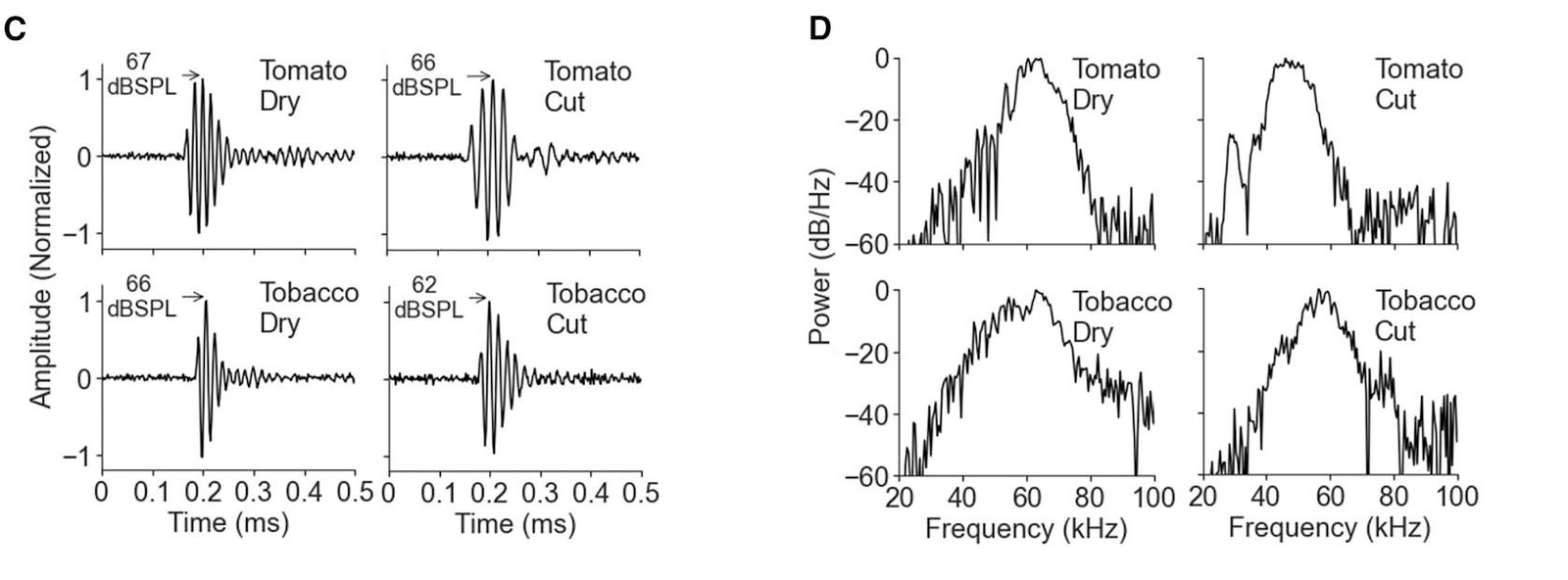
In the same study by Khait and colleagues (Cell, 2023), the microphones used to record ultrasound were positioned 10 centimeters from the plant. For tomato plants experiencing a water shortage, the mean peak sound pressure level was about 62 decibels. The authors calculated that some animals with ultrasonic hearing could detect these signals from approximately 3–5 meters away. The study did not test whether moths can hear plants from that distance in nature.
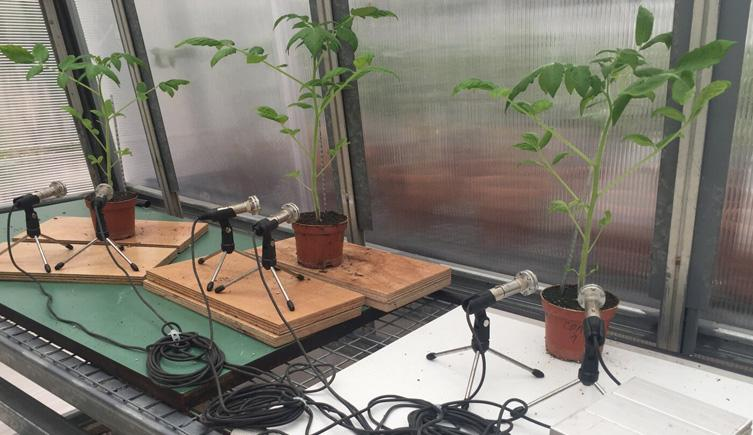
A computer program could distinguish healthy plants from stressed ones based on the characteristics of the recorded clicks. Under some conditions, it could also determine whether the stress was caused by a water shortage or stem damage. When the recording is shifted into the audible range, it resembles the brief pops of popcorn. But can animals hear these sounds and use them to guide their behavior?
Why Choosing a Plant Matters to a Moth
Among the insects potentially able to detect ultrasonic clicks from tomato plants, scientists focused on the Egyptian cotton leafworm moth (Spodoptera littoralis). This is a nocturnal moth whose caterpillars feed on the leaves of many plants, including tomatoes. Adult females lay their eggs in groups, or clusters. Tympanal organs with sensitive tympanic membranes help the moth detect ultrasonic vibrations in the air.
Rya Seltzer, Yossi Yovel, Lilach Hadany, and their colleagues set out to test whether female moths use plants’ ultrasonic clicks when choosing where to lay their eggs. Their findings were published in eLife, with the final version of the paper appearing in 2026. For the experiments, the scientists prepared an enclosed experimental arena one meter long and divided it into two halves with a low partition. Females could move freely between the two sides. A group of mated moths was placed in the arena overnight, and egg clusters were counted in the morning. Observations continued over several nights. New groups of moths were used in different repetitions. The outcome was assessed by the mean number of egg clusters on each side of the arena, rather than by the number of individual eggs.
In the first experiment, two tomato plants were placed in the arena: one was watered regularly, while the other had been left without water for several days. Females laid eggs noticeably more often near the watered plant: an average of 2.23 clusters per night, compared with 0.88 near the drought-stressed plant. Wilting leaves and an altered smell could have informed the moths about the plant’s condition. But this experiment did not reveal which particular cues influenced their choice. To isolate the influence of sound, the researchers conducted the next experiment without actual plants.
What a Moth Chooses When No Plant Is Present
Identical small mesh boxes wrapped in paper towels were placed on either side of the arena, providing surfaces on which females could lay their eggs. A speaker beneath one box played ultrasonic clicks from an unwatered tomato plant. The other side served as a silent control. The setup helped prevent the moths from coming into direct contact with the vibrating speaker. To test for a possible influence of the electric field, some experiments included a resistor on the silent side with impedance comparable to that of the speaker.
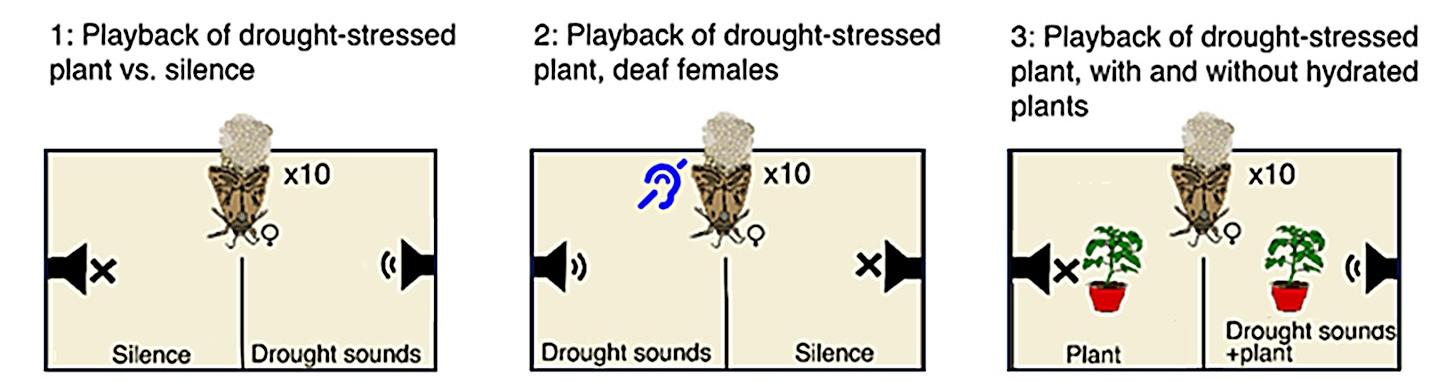
By morning, an average of 1.08 egg clusters per night were found near the box with sound playback, compared with 0.40 near the silent box. A similar preference emerged in two sets of experiments conducted several months apart. In a separate supplementary set of trials, the researchers video-recorded another sample of females. Most of the moths observed visited both halves of the arena, but over time the females as a group spent progressively more time on the side where clicks were played. These observations complemented the main sets of egg-cluster counts and showed how the moths’ behavior changed over the course of the night.
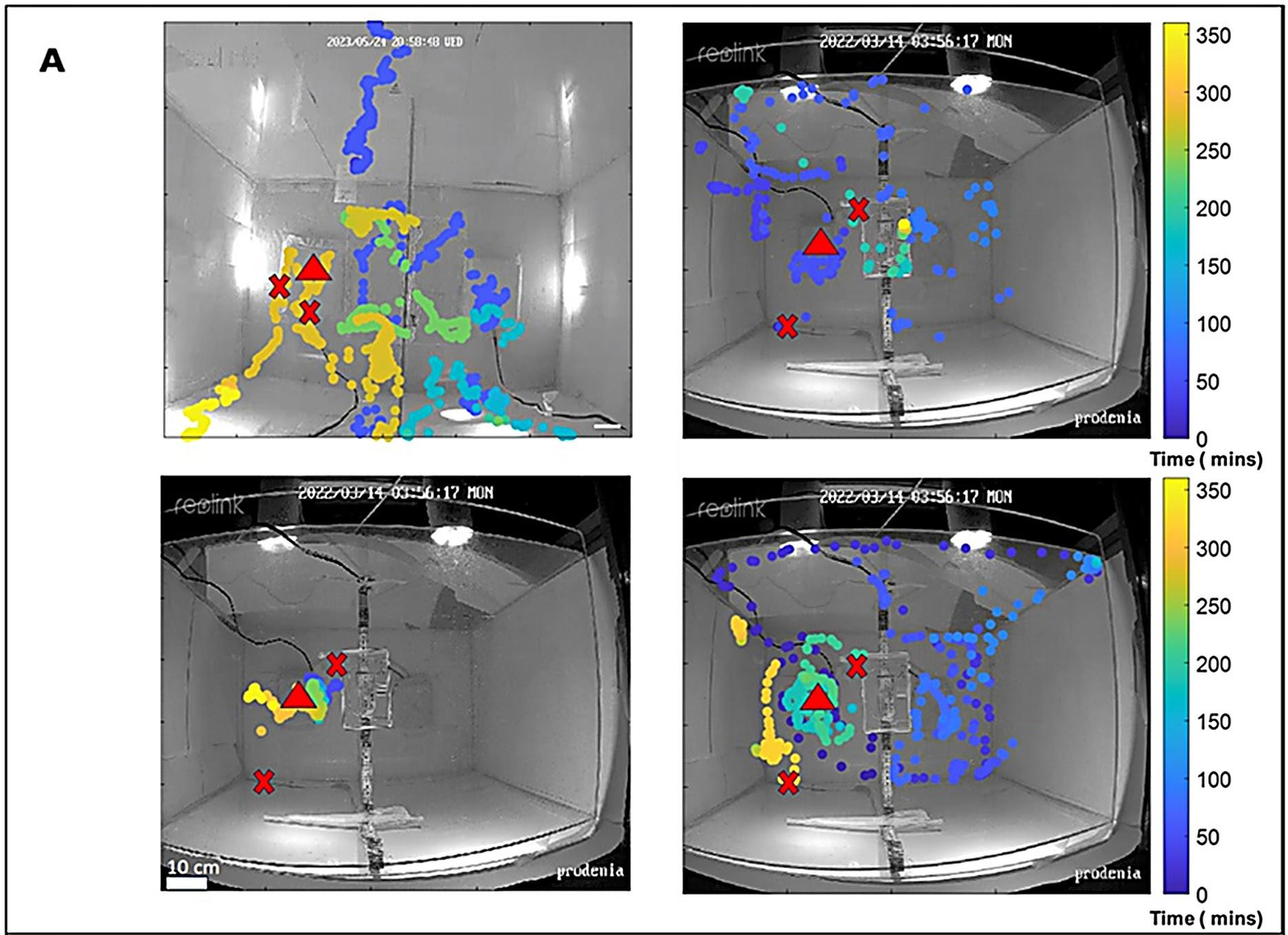
When females were offered two actual tomato plants, they more often chose the watered one. In the experiment without plants, more egg clusters were found on the side where a speaker played recorded clicks from an unwatered tomato plant. Perhaps, in the absence of other plant cues, ultrasonic clicks attract moths and help them orient themselves. A moth’s preference for the playback side alone does not reveal what information the moths extract from the recording.
When Two Live Tomato Plants Are Present
In the next experiment, two well-watered tomato plants were placed in the arena, one on each side of the partition. Both plants had approximately the same water status. A difference was introduced artificially: a speaker near one plant played clicks recorded under drought conditions, while no sound was played near the other. Females could choose between live plants, and the experimenters compared their choices to determine whether the additional acoustic information influenced them.
This time, more egg clusters were found near the silent tomato plant: an average of 1.76 per night, compared with 1.05 near the plant beside which the recording was played. When data from the two sets of experiments were combined, the difference was statistically significant ( = 0.01). If there were no preference for either side, a result this pronounced or more so would occur in approximately 1% of cases under the statistical model used. This probability is denoted by the letter . Table 1 of the original eLife paper by Seltzer and colleagues reports = 0.05 for the first set of experiments. In the second set, conducted about a year after the first, the result on its own did not reach the conventional significance threshold ( = 0.10). In both sets, moths on average chose the silent side more often, but in the second set the difference was not sufficiently convincing under the statistical criterion used. The most reliable conclusion therefore applies to the combined observations, rather than to each set separately.
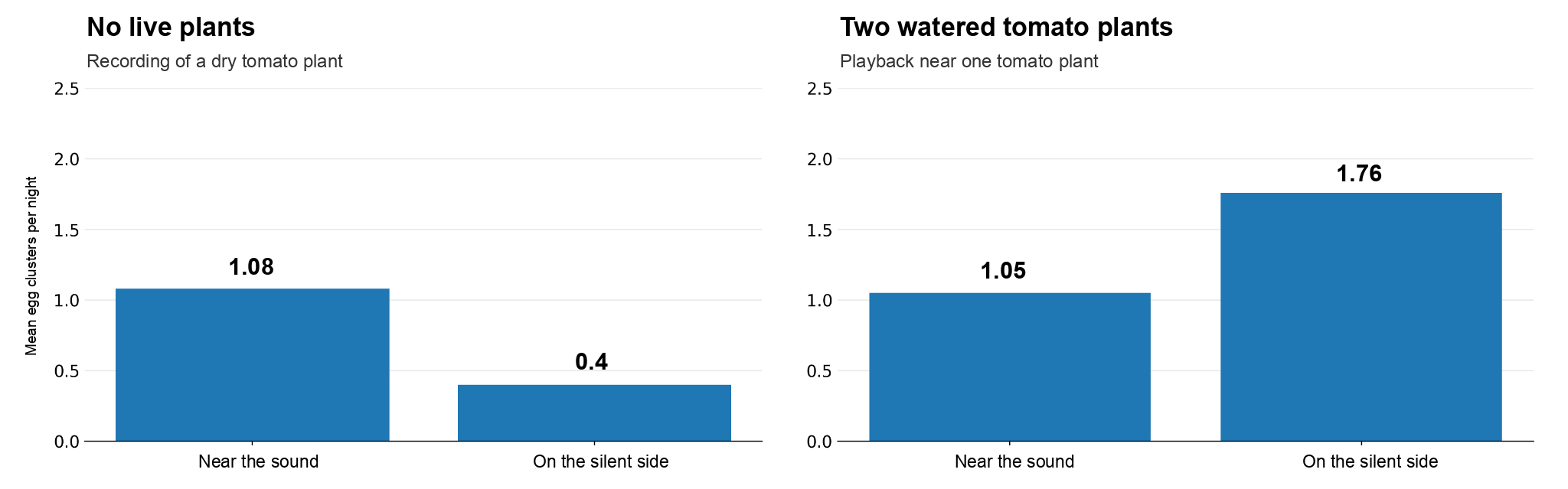
Both setups used clicks from a tomato plant that was short of water. But when no actual plants were present, females laid eggs more often near the speaker playing the recording, whereas in the experiment with two well-watered tomato plants they preferred the silent side. The results show that the influence of ultrasound on egg-laying site selection depends on the presence of plants and other cues available to the moth.
In an additional experiment, the researchers offered moths a choice between an unwatered tomato plant accompanied by sound playback and a side without a plant. Females preferred the side with the tomato plant. Perhaps the presence of even an unwatered plant matters more to females than its condition when there is no plant on the other side. However, this experiment does not allow the contribution of sound to be assessed separately: an actual tomato plant was present on only one side.
How the Role of Hearing Was Tested
But how could the researchers establish that the moths were responding specifically to ultrasound rather than to other influences from the experimental setup? They repeated the experiment without plants using females whose tympanic membranes had first been damaged with a fine entomological needle. After this intervention, no statistically significant preference for the playback side was detected: an average of 0.70 egg clusters per night were found there, compared with 1.00 on the silent side ( = 0.55).
The researchers also checked whether the moths retained their ability to fly and lay eggs. Both abilities remained unchanged, but the usual response to bat sounds was no longer observed after the tympanic membranes were damaged. These results support the proposed role of hearing in the original experiment, but they do not fully rule out an influence of the intervention itself. The published methods do not describe a control experiment in which a similar procedure was performed without damaging the tympanic membranes.
Male Egyptian cotton leafworm moths also produce clicks during courtship; some of their frequencies overlap with those of tomato sounds. Females were offered a choice between a side with males and a control side. No statistically significant preference was detected ( = 0.39). This is consistent with the suggestion that the response depends on more than the signal’s frequency range. The experimental conditions and the temporal characteristics of the sounds differed. These differences prevent the conclusion that females specifically recognized plant sounds and do not allow the signal properties that determined their choice to be isolated.
From Laboratory Recordings to the Sounds of a Real Planting
However, there is a substantial difference between laboratory recordings and the sounds moths may hear in nature. In the experiments described above, Seltzer and her colleagues used a speaker that played 60 ultrasonic clicks per minute. For comparison, in the 2023 study by Khait and colleagues, a single tomato plant experiencing a water shortage emitted an average of about 35 clicks over an entire hour, roughly one-hundredth the rate. In the first case, the experimenters set the playback rate; in the second, they measured the plant’s own sounds. This difference prevents the laboratory results from being directly applied to moth behavior in nature.
Still, insects may be near an entire planting rather than just a single plant. To determine how many sounds occur under these conditions, Seltzer’s team conducted a separate greenhouse experiment. The scientists placed 45 young tomato plants there, left them unwatered for three days, and recorded ultrasound with a microphone. At certain times, they registered up to 20 clicks per minute, one-third the rate played by the speaker in the main moth experiments. The researchers suggested that insects could hear still more sounds from a larger number of plants. However, a single recording of this kind cannot establish how frequently clicks occur in typical fields and greenhouses.
The scientists also tested how females responded to less frequent sounds. In another laboratory experiment, the speaker played 30 clicks per minute. Observations took place in a one-and-a-half-meter-long arena containing one moth at a time. The ultrasound source was at one end, a sugar-solution feeder was in the center, and the opposite end was silent. The most egg clusters were found near the speaker and the feeder, with fewer at the silent end of the arena. Thus, moths also responded to sound at the lower playback rate. However, the conditions of this experiment differed from those of the earlier experiments in more than just click rate, so the influence of that factor alone cannot be determined. Moreover, even 30 clicks per minute was far above the average rate for a single unwatered tomato plant.
The ultrasonic clicks themselves do not necessarily constitute a message that a plant deliberately sends to surrounding organisms. Behavioral ecology has a concept known as acoustic eavesdropping: an animal can use another organism’s sounds even when they are not intended to convey information. In tomato plants, the clicks are thought to arise from physical processes in the water-conducting tissues. Moths may respond to these sounds, but that does not mean the plant produces them specifically to communicate with insects.
Reflecting on the broader significance of the findings, study coauthor Yossi Yovel remarked in a comment provided for this article: “I think this study might be the tip of the iceberg revealing a first plant-animal acoustic interaction of many more to come.”
Laboratory experiments have shown that plants’ ultrasonic clicks can influence egg-laying site selection in female Egyptian cotton leafworm moths. However, this effect has so far been studied in only one species, and the importance of sound under natural conditions remains unknown. Can moths distinguish the clicks amid background noise? From what distance do they respond to them, and does this information help them choose plants on which their offspring will develop more successfully? Answers to these questions will clarify the role of plant ultrasound in interactions between plants and insects beyond the laboratory.
Sources
- Seltzer, R., Zer Eshel, G., Yinon, O., et al. (2026). Female moths incorporate plant acoustic emissions into their oviposition decision-making process. eLife, 13, RP104700. Version of Record.
- Khait, I., Lewin-Epstein, O., Sharon, R., et al. (2023). Sounds emitted by plants under stress are airborne and informative. Cell, 186(7), 1328–1336.e10.
- Milburn, J. A., & Johnson, R. P. C. (1966). The conduction of sap. II. Detection of vibrations produced by sap cavitation in Ricinus xylem. Planta, 69, 43–52.
- Wasserstein, R. L., & Lazar, N. A. (2016). The ASA’s Statement on p-Values: Context, Process, and Purpose. The American Statistician, 70(2), 129–133. Editorial and methodological context.