TRAPPIST-1's Star Has Been Caught Swaying, and the Planet Masses Hold Up

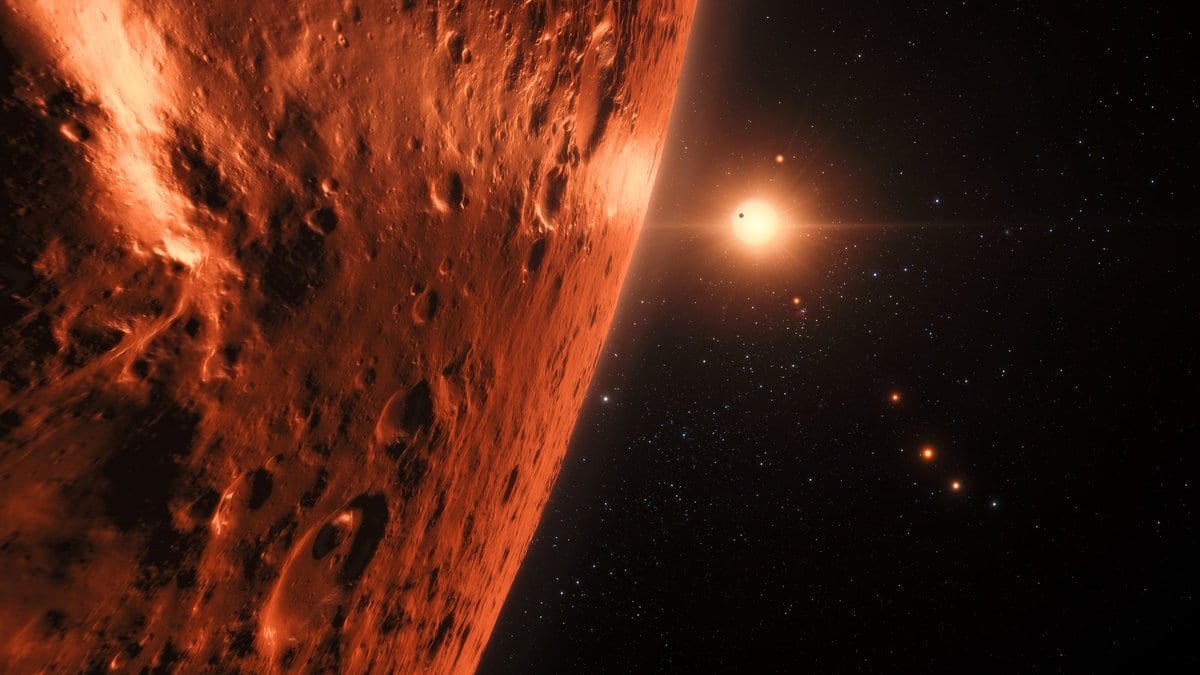
For nearly a decade, the TRAPPIST-1 planets have been weighed by a clock. Seven Earth-sized worlds circle a dim red dwarf on orbits packed so tightly that each planet tugs its neighbors along as it passes, so every transit arrives a little early or a little late. The size of that error is a scale. It is an elegant way to weigh a planet, and it left something conspicuously unfinished. If those worlds are as heavy as the clock says, the star should be moving too.
The star is moving. In a paper accepted for publication in Astronomy & Astrophysics and posted to arXiv on Sept. 2, a team led by Alexandrine L'Heureux reports the first recovery of the radial-velocity signal of the TRAPPIST-1 system: the star's own shuffle toward and away from Earth, read from the Doppler shift of its light. The journal version has not appeared yet, so the preprint is the account in hand.
But the paper is careful about what that does not mean. The measurements are not precise enough to pick the planets out one at a time. What the team can do is treat the seven as one object. By taking the planets' relative masses from the transit-timing analysis and letting the innermost planet, TRAPPIST-1 b, stand in for the whole family, they recover the system's combined signature at odds the paper puts at 1,860 to 1. That figure compares two models rather than reporting a formal significance, and it makes for a solid detection rather than an overwhelming one.
That motion is slight. The star swings back and forth at 3.65 meters per second, with an uncertainty of plus 0.78 and minus 0.83 (roughly the speed of a person running, in an object with the mass of a star). Catching it took two near-infrared spectrographs: SPIRou at the Canada-France-Hawaii Telescope and NIRPS at ESO's La Silla Observatory in Chile, working under the SPIRou Legacy Survey and the NIRPS guaranteed-time program. Both were built for cool red stars, which shine mostly in the infrared and carry surface blotches that can imitate a planet's tug.
Converted into a mass, that sway makes TRAPPIST-1 b 1.31 plus or minus 0.29 times the mass of Earth. The transit-timing value the paper compares it against is 1.374 plus or minus 0.069 Earth masses. The two agree, and the second is by far the tighter of them. Neither is a direct weighing: both methods watch gravity at work and infer a mass from it. The difference is whose gravity. Transit timing watches the planets pull on one another; radial velocity watches them pull on the star.
The timing method had an enormous head start. A 2021 analysis of Spitzer transit times pinned the TRAPPIST-1 masses so tightly that matching them by Doppler shift would take a velocity precision of 2.5 centimeters per second, far finer than any current instrument reaches. Nobody expected this measurement to sharpen those numbers. What it offers is a second route to them, one whose ways of going wrong have nothing in common with the first. Eric Agol, who led that earlier analysis, is among the co-authors here, so the two methods are independent while the people partly overlap.
The NIRPS velocities also rule things out. They exclude Saturn-mass planets on orbits out to 2.7 years and Neptune-mass objects on orbits out to 20 days, which shuts off much of the space a hidden giant could occupy beyond the system's snow line, where water freezes and large planets are thought to assemble.
Those same data settle a question about the star. TRAPPIST-1's brightness has long carried a rhythm of about 3.3 days, and a repeating signal like that is always open to more than one reading. The radial velocities find the star's activity varying on the same period, matching what K2 and TESS saw in its light, which identifies the rhythm as the star turning rather than as something orbiting it.
A planet's mass is the number the rest of its description leans on. Density follows from it, and so does surface gravity, and so does any estimate of whether a rocky world around a red dwarf can hold on to an atmosphere. For the TRAPPIST-1 planets that number now comes from two directions instead of one. The Doppler figure will tighten as more spectra accumulate, which is how radial velocity has always improved; what the team has today is a first measurement that could have contradicted the old one, and did not.