A Dead Star's Odd Chemistry Points to a Planet Born After It Died
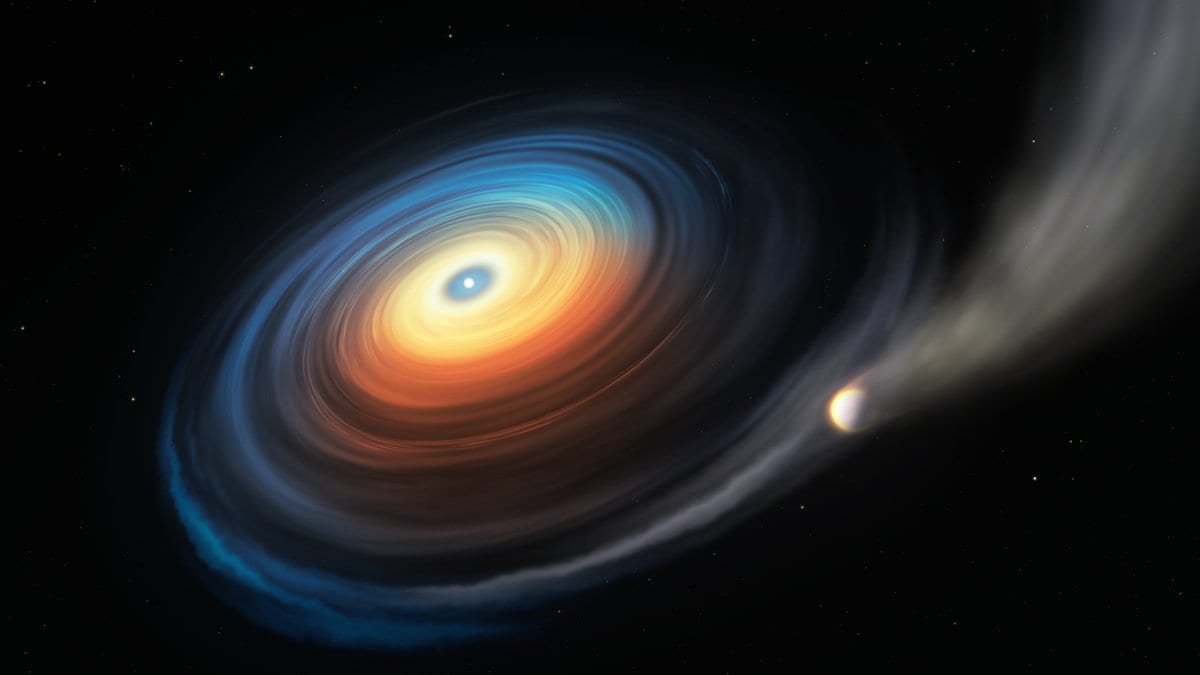
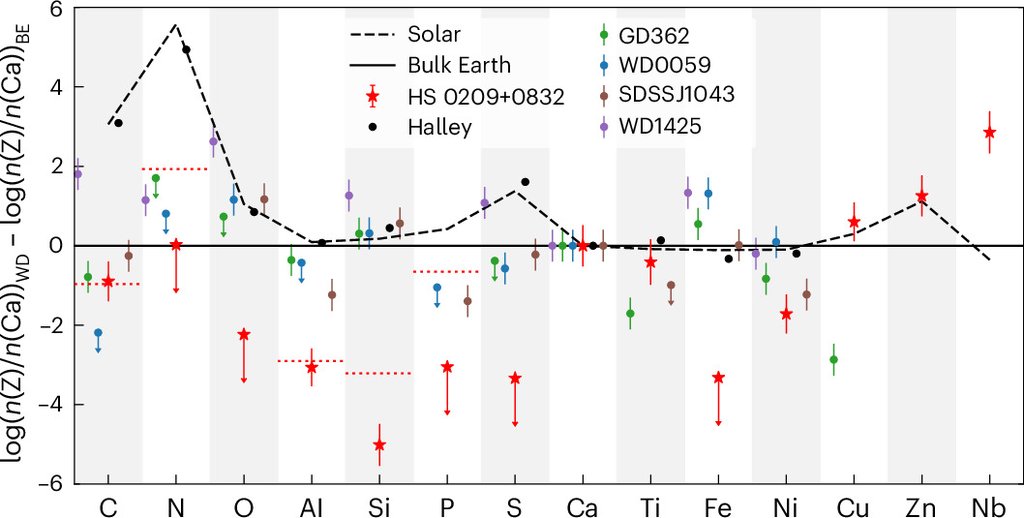
A reanalysis of ultraviolet spectra the Hubble Space Telescope took in 1999 has found the white dwarf HS 0209+0832, the burnt-out core of a dead star, pulling in material that matches nothing in the Solar System. Jamie T. Williams and Boris T. Gänsicke of the University of Warwick and colleagues report an atmosphere heavy in zinc, copper and niobium, with almost none of the silicon and iron that build rocky planets. Their paper was published Oct. 5, 2026, in Nature Astronomy.
The team reads that chemistry as gas escaping from a giant planet that formed after the star died, out of material the star shed as it was dying. The paper calls the object a second-generation planet candidate and says no equivalent has previously been identified orbiting a white dwarf. The authors write that the same signature, carbon plus those heavy elements, gives astronomers a way to look for others.
The earlier spectrum had left about 100 absorption lines unidentified. Matching them against newly computed model spectra, the team assigned most to copper and niobium, and found niobium in none of 33 other metal-enriched white dwarfs it checked. The material falling onto the star is rich in nickel: the authors measure a nickel-to-iron ratio above 2.09, against about 0.05 in primitive meteorites and in Earth as a whole. No white dwarf known to be swallowing rock, and no Solar System meteorite, matches it.
Brightness measurements from NASA's Transiting Exoplanet Survey Satellite, across four observing sectors, carry a repeating cycle of 4.399 days. The team attributes it either to a tidally locked giant planet turning its day and night sides into view, or to a tail of gas streaming off an evaporating one. No planet has been seen directly or caught crossing the star, so the case rests on the chemistry and that cycle.
The authors add that a lone dying star is unlikely to leave a disk behind, and that this one probably had a companion close enough to be pulled into its swelling outer layers and throw them off as a disk a planet could collapse from.
Sources
- Nature AstronomyPeer-reviewed
- science.nasa.gov
- esahubble.org