Researchers Say They Have Proved Why Image and Text Models Learn the Same Thing
A preprint posted to arXiv on Oct. 29, 2026, states and proves what its authors call a Platonic Representation Theorem: models trained separately on different kinds of data learn the same internal representation, up to one rotation, whenever each model's training pairs are two observations of the same scene. Randall Balestriero, of Brown University and AMI Labs, and Yann LeCun, of New York University and AMI Labs, prove it for an idealized setting they define, not for trained systems in general. The paper is not peer reviewed, and every figure in it is the authors' own.
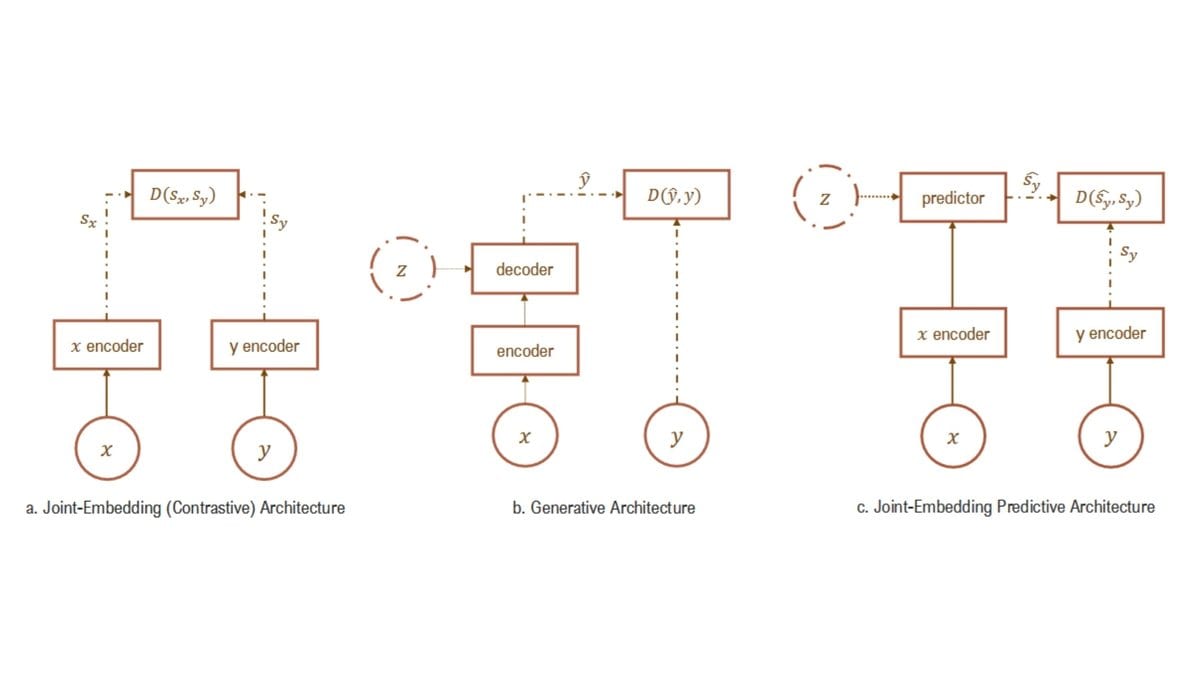
The models it covers are joint embedding predictive architectures, or JEPAs. A JEPA is trained so that two inputs it is told show the same thing come out with nearly the same internal code. What the paper measures between models is cross-modal alignment: how closely a text model's codes match an image model's codes for the same content.
The authors say the proof comes with a recipe. If alignment follows from pairs that show one scene twice, which they call good views, then what a model is shown, rather than how big it is, is the lever. They classify next-token prediction, the objective behind today's language models, as a JEPA with bad views, because its pairs are two parts of one document.
Balestriero and LeCun report testing that on text ranging from 145k captions to the texts of 940M web images. On the same corpus, they report, good views reached the same alignment with 42 times fewer training samples than next-token prediction, and a 109M-parameter text JEPA aligned with the DINOv2 and CLIP image encoders better than every language model they evaluated, up to 72B parameters.
As a demonstration, the authors report that one rotation joined separately trained image and text encoders into an image captioner scoring CIDEr .838 on COCO, a standard captioning benchmark. That result used a rotation fitted on about 30,000 image-caption pairs. The authors separately showed that models could also be aligned without paired examples.
The paper carries a CC BY 4.0 license and links to the authors' code and a live demo.
Sources
- arXivPreprint