A Pulsar, a White Dwarf and a Third Star That Is Still Burning

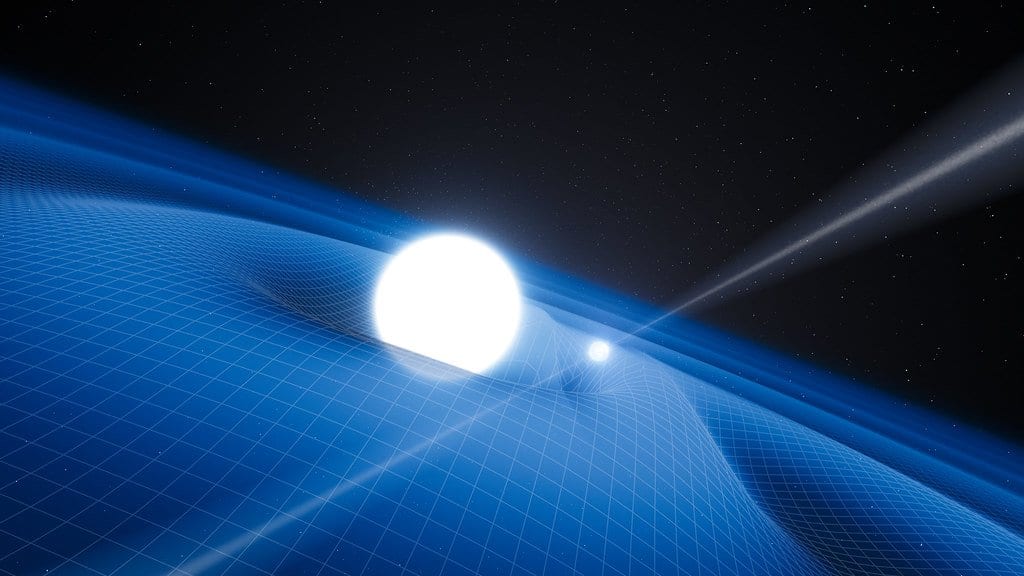
Supernovae are hard on families. When a massive star collapses and blows off its outer layers, the sudden loss of mass and the kick delivered to the remnant usually wreck whatever gravitational arrangement the star belonged to, scattering its companions into the galaxy. That is why the thousands of pulsars catalogued since the 1960s are overwhelmingly solitary objects or members of tidy two-body systems, and why the pulsar-timing literature can name its stable triples on one hand.
The list currently runs to two well-studied cases. PSR J0337+1715 is a millisecond pulsar with two white dwarfs, one close in and one further out. PSR B1620-26, in the globular cluster M4, has a white dwarf companion and an object of roughly Jupiter's mass orbiting far beyond it. That is the field, after three decades of surveys.
A paper posted this month by Z. L. Yang, J. L. Han and colleagues at the National Astronomical Observatories of China proposes a third. The notable feature is the outer companion, which is not a stellar corpse. It is a G-type subgiant, a star of roughly the Sun's mass that has finished burning hydrogen in its core and begun to swell, still shining under its own power while its two neighbors no longer do.
The system is PSR J0435+3233, about 2.1 kiloparsecs away, or roughly 6,800 light-years, with an uncertainty of about a fifth on that figure. At its center is a gamma-ray pulsar, a neutron star whose rotation sweeps a beam of high-energy radiation past Earth with clocklike regularity. Around it, every eight days, moves a helium white dwarf. The inner orbit is very nearly a perfect circle, with an eccentricity of 0.00016, and that roundness is itself a piece of evidence: an orbit that circular is the signature of a long episode of mass transfer, during which tides drained the eccentricity away and the donor star was stripped down to the helium core that survives as the white dwarf.
The outer orbit is nothing like as tidy. The subgiant takes about 26,900 days to complete a circuit, roughly 73.7 years, on an ellipse with an eccentricity of 0.5983, so its distance from the inner pair varies by a factor of nearly four over one long lap.
Establishing all of this took an unusually patient assembly of data. The backbone is 16.7 years of gamma-ray observations from NASA's Fermi Gamma-ray Space Telescope, whose Large Area Telescope has been collecting individual high-energy photons from this part of the sky since 2008; each photon can be assigned a phase in the pulsar's rotation, and over enough years the arrival times trace the pulsar's motion. To that the team added 4.6 years of radio timing from the Five-hundred-meter Aperture Spherical Telescope in China, astrometry from Gaia, and a measurement of the Shapiro delay, the small extra light-travel time the pulsar's signal accrues when it passes close to the white dwarf's gravitational well on its way to Earth.
That combination yields masses for all three stars, and here the paper is careful in a way any account of it should be. The mass solution depends on the geometry between the two orbits, and that geometry is not measured directly. The data admit two configurations. If the outer orbit is nearly perpendicular to the inner one, a mutual inclination near 84 degrees, the pulsar comes out at about 1.15 solar masses, the white dwarf at 0.271, and the tertiary at 0.96. If the mutual inclination is instead a more moderate 55 degrees, the same data give about 1.29, 0.296 and 1.12. These are not three stars placed on a scale. They are the consequences of an assumption, and the assumption is still open.
One independent handle exists. The tertiary's own spectrum indicates a G-type subgiant of about 0.98 solar masses, with an uncertainty of 0.12, which sits comfortably beside either solution and does not discriminate between them. An independent group led by Paulo Freire reached the same triple conclusion four days earlier (arXiv:2607.27462) and reads the third star differently: from its distance and colors, a 1.2-solar-mass F-type star still burning hydrogen in its core, rather than a subgiant that has left the main sequence.
Pinning the geometry down means watching the outer orbit move, and the outer orbit is slow.
Slow enough, in fact, to frame the whole result. Across 16.7 years of Fermi data the subgiant has covered less than a quarter of one circuit around the inner pair. Everything the paper says about that orbit is an extrapolation from a partial arc, which is a normal situation in this business and a reason for restraint about the numbers rather than a flaw in them.
Systems like this earn their attention as stellar archaeology. A triple that survived a supernova intact carries the record of the explosion in its present-day orbits: the mass lost, the direction and size of the kick, the tidal history written into that near-circular inner ellipse. Theorists have worked the same problem from the other end, and the formation of the previously known triple has its own dedicated literature, including a 2014 study by Thomas Tauris and Edward van den Heuvel tracing how a neutron star ends up with two orbiting white dwarfs. J0435+3233 offers a different starting configuration and a different route. When the subgiant finishes evolving and sheds its envelope, this system will also become a neutron star with two white dwarfs, arriving by another road at something resembling the one system astronomers already had.
Sources
- arXivPreprint
- iopscience.iop.org