Phosphorus Chemistry Behind a Supernova Shock Runs the Other Way

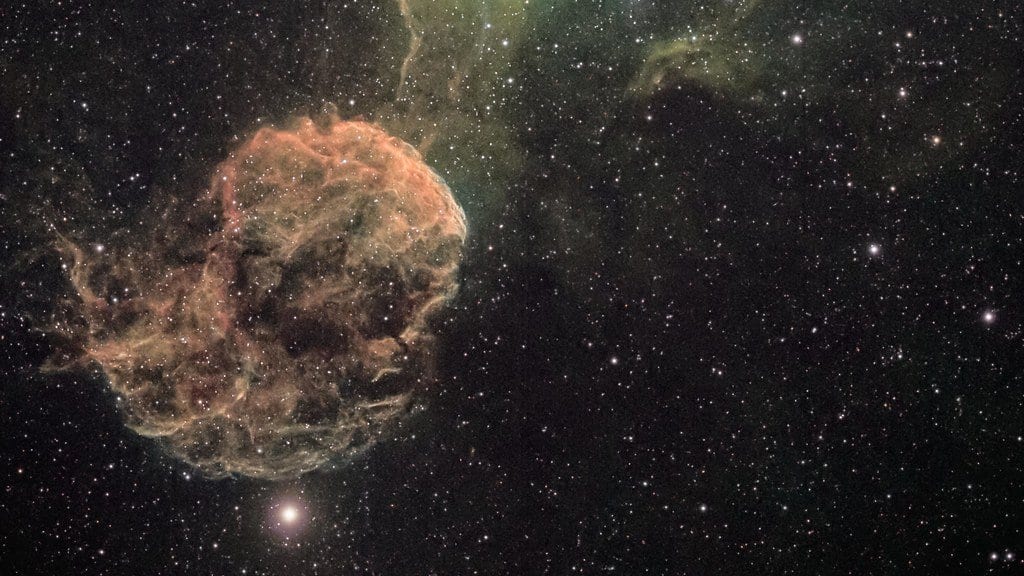
IC 443 and W44 are among the best mapped pieces of debris in the Milky Way. Each is the expanding shell of a star that exploded, and each is driving a shock wave into a neighboring molecular cloud. Astronomers have watched those collisions for decades in silicon monoxide, a standard marker for gas that has been shocked and compressed. Nobody had gone looking there for phosphorus. When a team finally did, it found the junior partner and not the molecule that should have dominated.
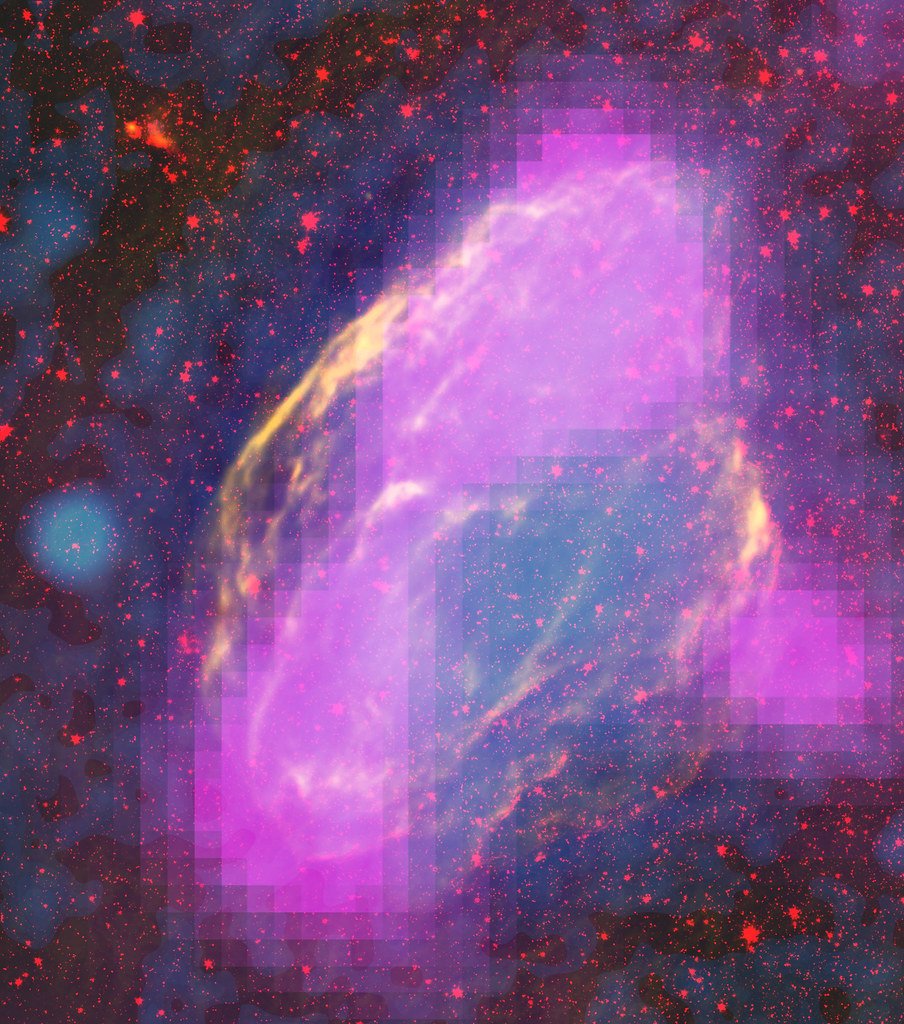
The search was led by G. Cosentino of the Institut de Radioastronomie Millimétrique, with F. Fontani of INAF's Arcetri Observatory and two colleagues. They pointed the IRAM 30-meter telescope at Pico Veleta in Spain at four positions around the two remnants. They were after two phosphorus-bearing species whose radio lines lie close together near 94 gigahertz: PN, which pairs phosphorus with nitrogen, and PO+, the phosphorus monoxide ion. Their report is a preprint, posted Oct. 1. The authors say it has been accepted by Astronomy & Astrophysics, though no published version exists yet.
Phosphorus is found in every cell membrane and in both DNA and RNA. It is also in ATP, the molecule that moves energy around the body. In space it is oddly hard to find. In the cold, dense clouds where stars form, most of it is missing from the gas, presumably locked into dust grains. Only a handful of phosphorus-bearing species have been identified in such places, and those detections have involved gas that was shocked, strongly ionized, or both. PO+ itself was first detected in 2022 by Rivilla and colleagues, in a cloud near the galactic center, and again in 2025 in a shocked starless core in Perseus, by a team that included Scibelli. The two supernova remnants make three known environments where PO+ has been detected. That is the whole of the claim: first toward remnants, not first anywhere.
The detection is thin, and the paper is candid about it. PO+ showed up at two of the four positions, on a single spectral line, at the three-sigma level. Three sigma is the conventional threshold for a tentative line detection, not a secure measurement. At the W44 shock front, the peak of the line stood about three and a half times above the noise. At IC 443, the signal split into two velocity components, with the weaker one peaking below the three-sigma mark, so the detection rests on the whole line profile rather than on its peak. Converted into abundances, that comes to about eight PO+ ions per trillion hydrogen molecules at W44 and about 50 per trillion at IC 443. Each figure is uncertain by roughly 40%, and both rest on an assumption about how the gas is excited and on hydrogen measurements borrowed from earlier papers.
PN is the part that makes this interesting. In the two environments where PO+ had been seen before, PN was the more abundant of the pair by factors of a few. Here it stayed below the noise at all four positions, which leaves an upper limit rather than a measurement. Taken together, those limits put PO+ at least on a level with PN and possibly five times above it, inverting the ratio found in both earlier environments. One caveat comes with that result, and the authors raise it themselves. At W44, the PN limit still sits on the long-known relationship between PN and shock strength, so it is IC 443 that falls an order of magnitude below comparable regions.
The explanation they reach for is ionization. Both remnants are known to sit in gas where cosmic rays strip electrons from atoms and molecules more often than usual. A neutral molecule like PN can be destroyed by reactions with the ions that result, while the same conditions may favor the production of charged PO+. Under ordinary dark-cloud conditions, the team's chemical model never lets PO+ overtake PN. Raise the cosmic-ray ionization rate and the starting temperature to the values expected near an expanding remnant, and the predicted ratio climbs to about one. The model has a soft spot, and the authors point straight at it. The only reaction in the standard chemical databases that destroys PO+ is recombination with a free electron, and the rate used for it has been an educated guess since 1984, with no dedicated study since. Lowering that guessed rate by a factor of 10 is enough, on its own, to push the modeled ratio above one.
What the paper does not do is say where the extra gas-phase phosphorus comes from. Three possibilities are on the table, and the authors say plainly that these observations cannot distinguish among them. Phosphorus may be released into the gas, or phosphorus-bearing grain material may be processed by the shock, or phosphorus already in the gas may simply be redistributed among different molecules. PO, the neutral cousin that would help distinguish among these possibilities, fell outside the frequencies these observations covered, so there is no PO measurement for either remnant.
The reach toward life is the authors' own, and they keep it carefully bounded. They note that if the Sun formed in a nebula that a supernova had already struck, shocks like these may have helped shape the chemical inventory of the young solar system. PO+ is highly reactive, and they speculate, in their words, that it may be a short-lived store of phosphorus that later feeds sturdier molecules.
What would firm any of this up is more of the same molecule, measured better: several rotational lines instead of one, images sharp enough to show where in the shock PO+ sits, and more remnants for comparison. The authors ask for all three. For now, the galaxy has a third known environment where this phosphorus ion has been detected, and the first where the observations suggest it may outnumber PN.