The First Early-Universe Flash Astronomers Can Confirm Without a Cosmic Magnifying Glass

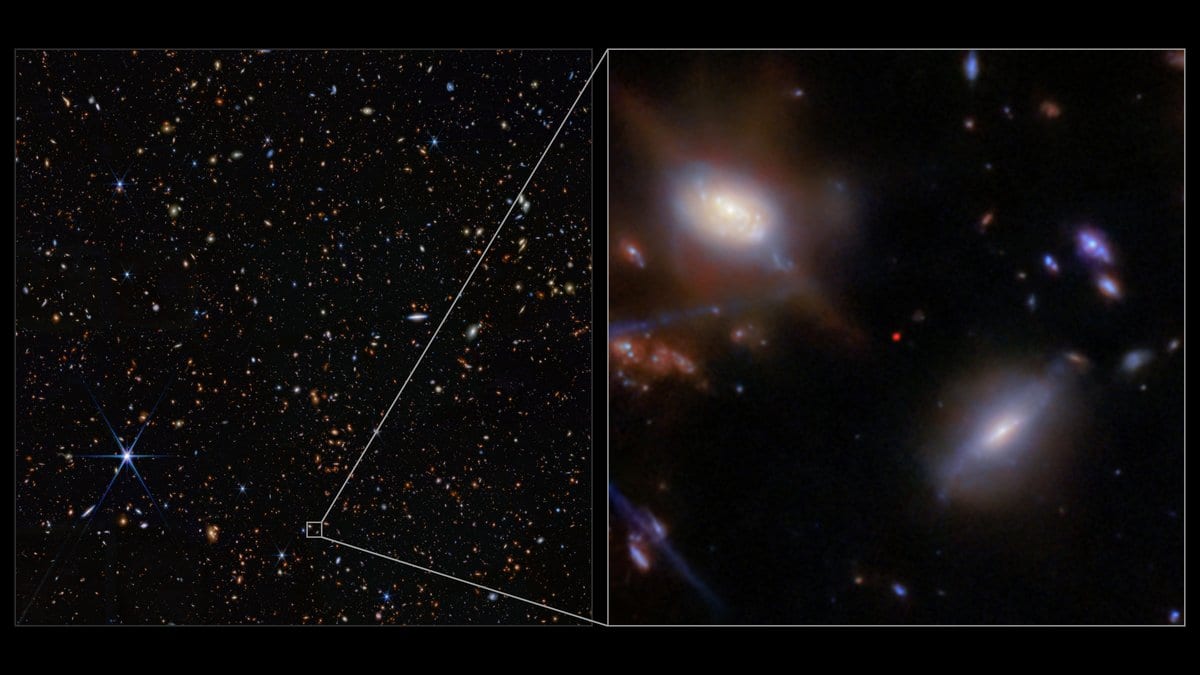
Astronomers have collected light from far earlier in cosmic history than this. What they have rarely had, that far out, is a case with enough evidence to narrow down what they are seeing. A faint dot shows up in images of the same distant galaxy taken weeks apart, and then the arguing starts: a dying star, a black hole flickering, a trick of the noise. On Aug. 7, the NEXUS survey on the James Webb Space Telescope found one of those dots in a star-forming galaxy near the north ecliptic pole, and this time the evidence is stronger.
Ming-Yang Zhuang, Yue Shen and colleagues at the University of Illinois, the University of Arizona and Princeton report AT 2026abck in a preprint posted to arXiv on Sept. 29, and it has not yet been peer reviewed. Its host galaxy sits at redshift 5.017, which means the light we see now left the galaxy when the universe was a little more than a billion years old and has been stretched by the expanding universe ever since. The claim the team makes is narrow and worth reading slowly. AT 2026abck is the first robustly detected transient at redshift about 5 or higher in a non-lensing field, which is to say a patch of sky with no massive foreground object strongly magnifying what lies behind it.
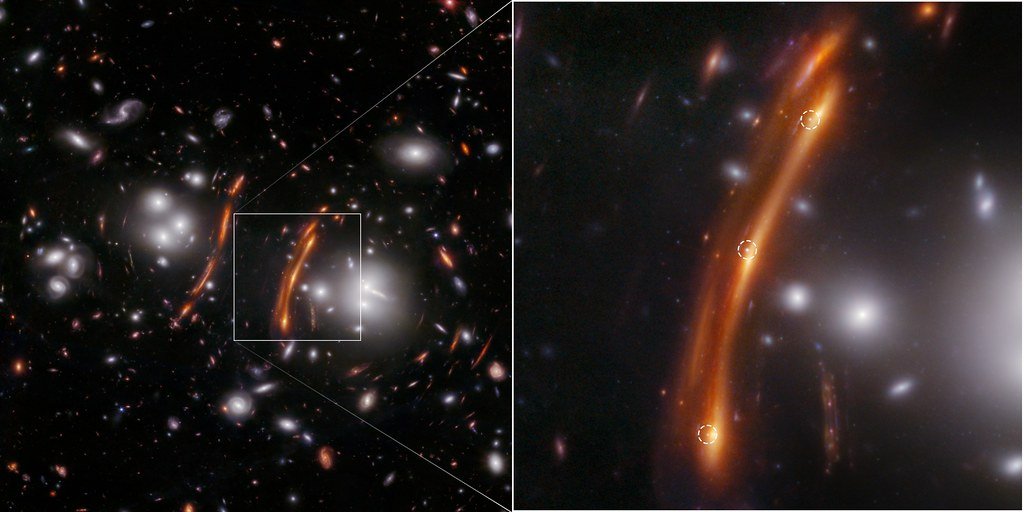
Two phrases in that sentence are doing the work, and they are not doing equal amounts of it. The cleanest views of exploding stars at these distances have come from fields where a foreground cluster of galaxies acts as a cosmic magnifying glass, bending light around itself and brightening whatever sits behind it. SN Eos, at redshift 5.133, was found that way. Lensing provides extra reach, but it works only where a lens happens to sit, and it can distort the observed light and apparent geometry of the source.
"Robustly detected" is the phrase easiest to drop and the one that cannot be. An unlensed transient beyond redshift 5 is not new. In 2025, Christa DeCoursey and colleagues reported AT 2023adya in GOODS-N, an ordinary patch of sky with no lens in it. Its host galaxy sits at redshift 5.274, farther away than AT 2026abck. But the detection rested on two epochs in a single filter, and whether the source was a dying star, a black hole flickering at a galaxy's center, or something else could not be settled from that. NEXUS's own first-year catalog carries a similar uncertainty: one tentative host association at redshift 6.151.
Zhuang's team had three filters at once. The dot appeared in one NIRCam band and, in the same stretch of time, in two more from a parallel camera, at nearly the same brightness in all three. In the longest-wavelength band there was nothing at all. It also had brightened by more than 1.4 magnitudes in less than 12 rest-frame days, meaning days as the galaxy itself experienced them. At this redshift 12 rest-frame days correspond to about 72 days on Earth.
A fit to those three points gives a photosphere near 17,000 kelvin, roughly three times as hot as the Sun's. The dot also sits off the galaxy's center, away from where a flickering black hole would be. Hot, ultraviolet-bright and off-nucleus, it favors a core-collapse supernova, the collapse of a massive star's core and the explosion that follows. The authors do not call that settled. The object is hotter and brighter than normal Type II supernovae are at comparable early phases, and no spectrum was taken of the transient itself. They put the explosion four to ten rest-frame days before the detection, an estimate rather than a measurement.
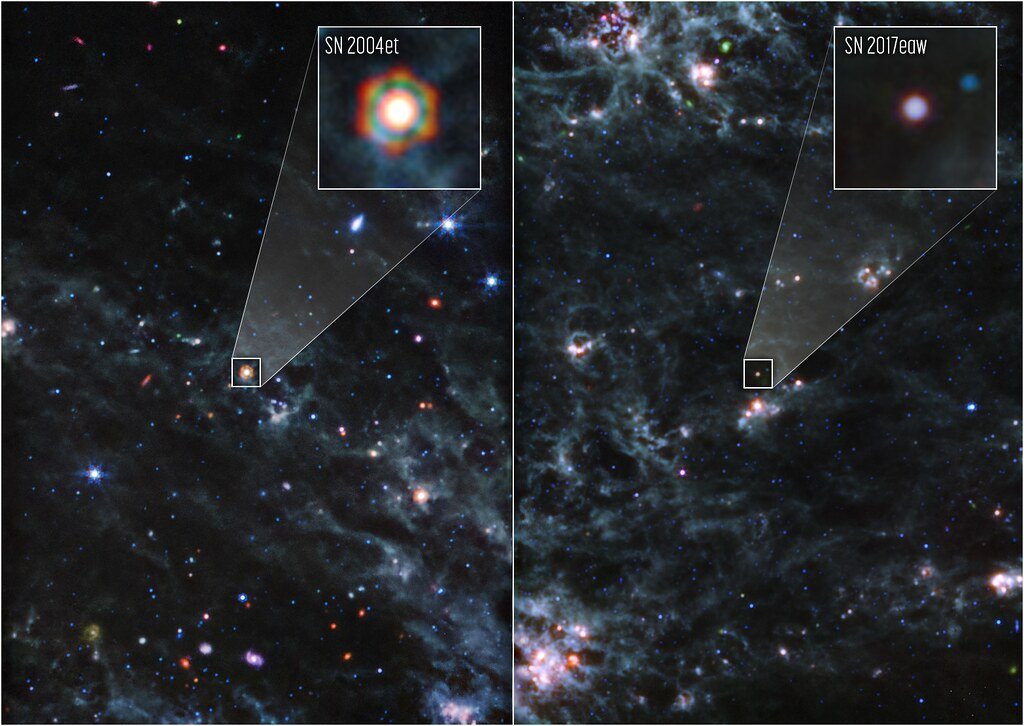
That timing is the part with consequences. Early is when a supernova is hottest and bluest, and when its light says most about the star that produced it. It is also the phase that can be over by the time a survey notices anything is there.
The host galaxy is the other interesting half. SN Eos went off in an ultra-faint dwarf. AT 2026abck's host is a middleweight star-forming galaxy, converting about 20 suns' worth of gas into new stars each year and sitting squarely on the star-forming main sequence at redshift 5. It is around 2,000 times more massive than the host of SN Eos. Two events are not a population, but the team reads the pair as a sign that massive stars at these distances are dying in galaxies of very different kinds.
The practical result is about the survey rather than the object. NEXUS re-images a patch of the north ecliptic pole roughly a quarter the apparent width of the full Moon, coming back about every two months, and its first year produced 68 robust transients. That first-year paper also named the survey's own limit: with only two filters in use, it could find distant supernovae but could not reliably tell what they were. AT 2026abck arrived in three. One object does not make a method, but it shows that a blank patch of sky, revisited often enough and in enough colors, can hand astronomers an explosion in the early universe while it is still young enough to chase.
Sources
- arXivPreprint
- arXivPreprint
- The Astrophysical Journal